How Much Does Retaining Wall Base Gravel Cost?
Retaining wall base gravel is commonly priced at about $25 to $90 per cubic yard, with installed pricing varying by market, delivery minimums, access, trench depth, and whether compaction is included. Base stone is usually a separate cost from drainage stone behind the wall. This guide shows how to estimate the base gravel, compare quotes, and budget for delivery and compaction.
Per-cubic-yard and per-square-foot budget ranges
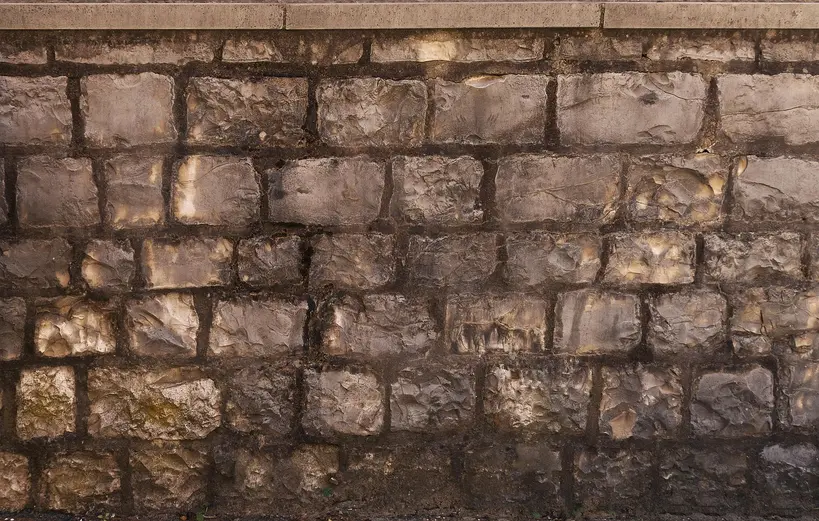
Retaining wall base gravel is usually a small material line compared with the full wall, but it is critical because it supports the first course. Local supplier pricing often drives the range, while installation quotes may bundle excavation and compaction into one price. Separate the base stone from the wall block and drainage items when you compare bids.
A practical budgeting range for base gravel is $25 to $90 per cubic yard, with lower or higher local pricing possible depending on quarry supply, haul distance, and delivery minimums. For a simple wall, that can work out to roughly $0.50 to $1.50 per square foot of wall face for the base allowance alone, but installed pricing should always be separated from material-only pricing.
Typical cost per ton and per cubic yard
A compactable angular stone base is typically sold by the yard or ton, and the price depends on local aggregate supply. As a budgeting shortcut, many suppliers effectively price compactable base stone in the same general band as other clean crushed stone products.
Use these estimates for planning only, because delivered pricing changes by region and order size:
- Per cubic yard: about $25 to $90
- Per ton: about $20 to $70 in many local quotes, depending on whether delivery is included
- Per square foot of wall face: about $0.50 to $1.50 for a typical compacted base allowance
Supplier listings and aggregate yard price sheets are the best source for current material-only pricing. For example, local landscape suppliers often publish per-yard and per-ton rates that change with size, stock status, and delivery zone, which is why a quote from one market may not match another.
What changes the installed price
Installed pricing depends on trench depth, access, compacted lifts, spoil removal, and whether the wall is being built into a slope or around obstacles. Manufacturer installation guides and NCMA-style segmental retaining wall details also make clear that the base is part of the wall system, not just fill. That means labor and prep can cost as much as the gravel itself.
Installed cost should be separated from material cost wherever possible. A quote may include excavation, base stone, leveling, and compaction in one number, while drainage gravel, pipe, fabric, and geogrid are listed separately or hidden inside the total.
Base gravel versus drainage gravel
Base gravel goes under the first course. Drainage gravel goes behind the wall. They can be the same type of clean stone, but they serve different functions and should be priced separately.
Base gravel creates a level, compacted bearing surface. Drainage gravel helps move water toward the drain pipe and reduces hydrostatic pressure behind the wall. On wetter sites or clay soils, the drainage portion can cost more than the base portion because it often covers a much larger area.
How much gravel do you need for a retaining wall base?
Calculate base gravel from trench length, width, and compacted depth. Multiply those three dimensions to get cubic feet, then divide by 27 to convert to cubic yards. If you are ordering from a supplier, add a compaction allowance because loose delivered stone settles when placed and compacted.
The most important distinction is between compacted volume and delivered loose volume. The wall needs the compacted amount under the first course, but the delivery ticket usually reflects loose material.
Trench length, width, and compacted depth
The formula is:
Length × width × compacted depth = cubic feet
Cubic feet ÷ 27 = cubic yards
Example: a 20-foot wall with a 12-inch-wide trench and an 8-inch compacted base depth uses about 0.50 cubic yards of gravel.
20 × 1 × 0.67 = 13.4 cubic feet
13.4 ÷ 27 = 0.50 cubic yards
That is the compacted amount. If your supplier quotes loose yardage, you may need more material delivered to end up with the same compacted base.
Convert cubic feet to cubic yards and tons
| Compacted base volume | Cubic feet | Cubic yards | Approx. tons |
|---|---|---|---|
| Small wall base | 13.5 | 0.50 | 0.65 to 0.75 |
| Standard wall base | 27.0 | 1.00 | 1.3 to 1.5 |
| Longer wall base | 54.0 | 2.00 | 2.6 to 3.0 |
These ton figures are budgeting ranges only. Actual tonnage varies with stone gradation, moisture, and supplier loading. The key point is that a compacted trench volume and a delivered loose volume are not the same thing.
What goes under a retaining wall?
Under a retaining wall, the key layer is a compacted stone base below the first course. That base provides a level bearing surface and helps distribute load into the subgrade. Depending on wall type, soils, and height, the base width, depth, and reinforcement details can change.
Compacted gravel base below the first course
The first course should sit on a prepared trench, not on loose fill. Segmental retaining wall manufacturers commonly call for a compacted leveling pad or compacted aggregate base placed in lifts so the wall starts level and stable. That is why base prep is often part of installation labor rather than a separate stone-only line item.
For budgeting, treat the base as a structural layer. If the base is uneven, every course above it inherits that problem.
Crushed stone base and lock-up
Angular crushed stone is preferred because it interlocks better than round stone. Allan Block installation guidance and other segmental wall manufacturer details emphasize compacted, angular aggregate under the first course to support lock-up and wall stability.
A thin or poorly compacted base can let the first course shift during installation, especially on soft or variable subgrade. The result is more correction work and a higher installed cost, even if the stone quantity itself is not large.
Filter fabric and drainage details
Filter fabric sits between native soil and drainage stone so fines do not migrate into the drainage zone. Behind the wall, drainage gravel works with perforated drain pipe to move water out of the wall system. These pieces are related, but they are not the same as the base under the first course.
Drainage pipe is commonly placed at the base behind the wall and sloped to daylight or another approved outlet. Local standards and manufacturer instructions often require a clear drainage path, which is one reason quotes that include drainage usually cost more than quotes that cover only the base gravel.
Wall height and gravel demand
Wall height affects gravel demand because taller walls usually need more excavation, more drainage stone, and sometimes geogrid reinforcement. Height thresholds vary by jurisdiction and wall system, so avoid using a single universal rule. Many local codes and manufacturer tables use different thresholds for permits, engineering, and reinforcement based on wall height, surcharge, and soil conditions.
Low wall base sizing
Low walls, often below about 3 feet, may use a narrower trench and a simpler base arrangement. For these walls, the base gravel itself is usually a modest material cost, but delivery minimums can make the final price higher than the raw quantity suggests. In small jobs, mobilization and labor can outweigh the stone cost.
Even on short walls, the trench still needs to match the wall system and the subgrade. A small wall is not automatically a simple wall if the site is soft or difficult to access.
Standard SRW wall base sizing
A standard segmental retaining wall often uses a more substantial trench and a clearer split between foundation stone, drainage stone, and labor. Many contractors price SRW walls by face square footage, but the base gravel should still be tied back to trench volume so you can compare quotes more accurately.
For a typical SRW wall, the base gravel can often be estimated from the trench dimensions and then priced using a local supplier quote. That keeps material cost separate from installed wall cost.
Taller wall and geogrid impacts
Taller walls often require deeper excavation, more drainage stone, and sometimes geogrid reinforcement. Whether geogrid is needed depends on wall height, soil type, surcharge, and the manufacturer’s design tables or local engineering requirements. It is better to think in terms of “system design triggers” than a single height rule.
In taller walls, the base stone itself may not become dramatically deeper, but the total project cost rises because the reinforcement zone, backfill, and drainage package get larger.
How much retaining wall worksheet
This worksheet is designed to be reused on quotes. Start with the trench dimensions for the base stone, then add drainage and reinforcement only if the quote includes them. Keep installed work separate from material pricing so you can compare supplier pricing, contractor pricing, and delivery minimums on the same page.
Text-only calculator inputs
Inputs
- Trench length in feet
- Trench width in feet
- Compacted base depth in feet
- Compaction allowance percentage
- Delivered price per cubic yard
- Delivery minimum or minimum load charge
- Optional labor adders: spreading, leveling, and compaction
Formulas
Compacted cubic feet = length × width × depth
Loose cubic feet = compacted cubic feet × (1 + compaction allowance)
Cubic yards = cubic feet ÷ 27
Material cost = cubic yards × delivered price per cubic yard
Total cost = material cost + delivery minimum + any added labor
Compaction allowance guide
- 5% for a tight, predictable trench with good base prep
- 10% for a typical small residential wall
- 15% or more for uneven subgrade, extra grading, or highly variable stone
How much retaining wall table
| Compacted volume | 5% allowance | 10% allowance | 15% allowance |
|---|---|---|---|
| 0.50 yd | 0.53 yd | 0.55 yd | 0.58 yd |
| 1.00 yd | 1.05 yd | 1.10 yd | 1.15 yd |
| 2.00 yd | 2.10 yd | 2.20 yd | 2.30 yd |
Conversion table: cubic feet to cubic yards to tons
| Cubic feet | Cubic yards | Approx. tons |
|---|---|---|
| 13.5 | 0.50 | 0.65 to 0.75 |
| 27.0 | 1.00 | 1.3 to 1.5 |
| 40.5 | 1.50 | 2.0 to 2.3 |
| 54.0 | 2.00 | 2.6 to 3.0 |
Three worked pricing scenarios
Scenario 1: low wall, low delivered price. A 16-foot wall with a 1-foot trench width and a 0.5-foot compacted base uses 8 cubic feet, or 0.30 cubic yards compacted. Add a 10% allowance and the delivered quantity is about 0.33 cubic yards. At $25 per yard, material cost is about $8.25. If the supplier has a 1-yard minimum, the practical delivered charge may be closer to the minimum order than the calculated amount.
Scenario 2: standard wall, median delivered price. A 30-foot wall with a 1-foot trench width and a 0.67-foot compacted base uses about 20.1 cubic feet, or 0.74 cubic yards compacted. Add a 10% allowance and the delivered quantity is about 0.81 cubic yards. At $55 per yard, material cost is about $44.55. If the supplier charges a minimum delivery fee, add that amount separately.
Scenario 3: longer wall, high delivered price. A 40-foot wall with a 1.25-foot trench width and a 0.75-foot compacted base uses 37.5 cubic feet, or 1.39 cubic yards compacted. Add a 15% allowance and the delivered quantity is about 1.60 cubic yards. At $90 per yard, material cost is about $144. If the supplier has a minimum load charge or separate delivery fee, the total can rise quickly even though the base itself is still a small part of the full wall budget.
Why do quotes vary so much by site conditions?
Quotes vary because the same wall face can require very different trench work, drainage, and access. Soil type, slope, and spoil removal change the labor even when the wall dimensions stay the same. Clay soils and wet sites often need more drainage planning, while tight access raises equipment and hand-labor time.
Slope, access, and excavation
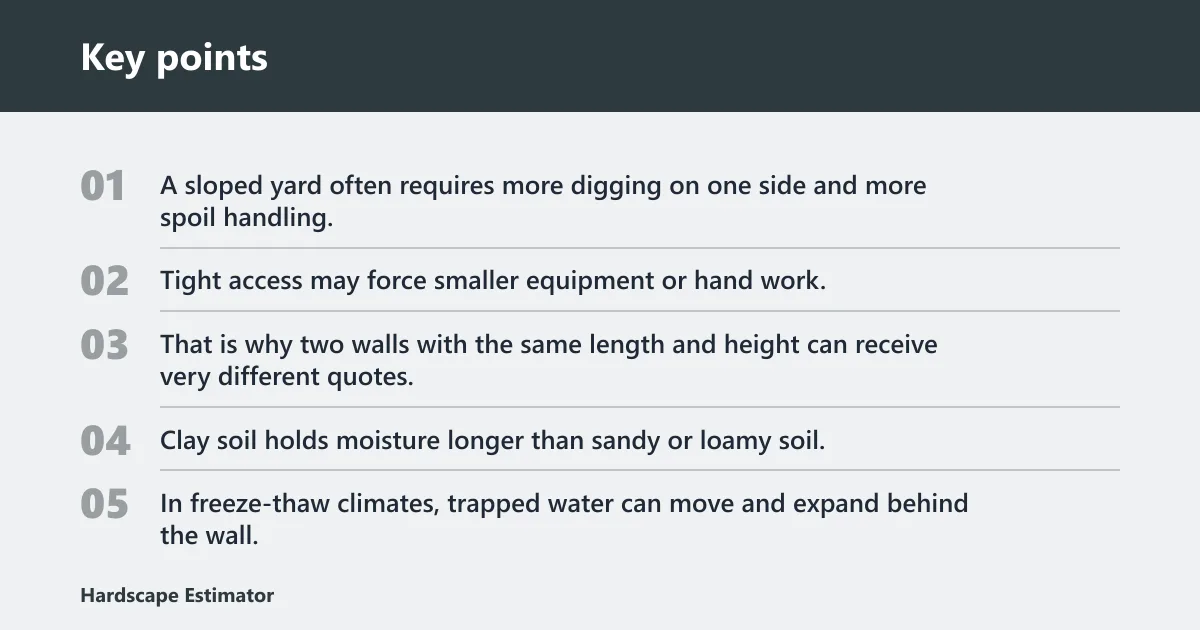
A sloped yard often requires more digging on one side and more spoil handling. Tight access may force smaller equipment or hand work, which increases labor even when the gravel quantity is unchanged. That is why two walls with the same length and height can receive very different quotes.
Clay soil and freeze-thaw
Clay soil holds moisture longer than sandy or loamy soil, which makes drainage more important. In freeze-thaw climates, trapped water can move and expand behind the wall. The extra drainage gravel, pipe, and fabric may raise the price, but they also reduce the risk of pressure buildup and movement.
Drainage pipe, fabric, and haul-off
Drainage accessories can add more to the quote than the base gravel itself. Pipe, filter fabric, and haul-off of spoil are often priced separately, especially on residential jobs where the contractor wants the wall line item to stay clean and the drainage package to stay visible.
A common mistake is to compare only the block price. The quote may look low until excavation, base stone, drainage gravel, pipe, fabric, and haul-off are included.
How to compare contractor quotes
Compare retaining wall bids by separating the foundation layer from the drainage system. Ask whether the quote includes compacted base gravel, excavation, drainage backfill, pipe, fabric, geogrid, and spoil removal. A bundled price can still be fair, but it is harder to evaluate unless the scope is clear.
Separate base gravel from backfill gravel
Base gravel under the first course is not the same as drainage gravel behind the wall. If a quote says only “gravel,” ask where it goes and whether the amount is based on compacted or delivered volume. That distinction helps prevent underbidding and makes supplier comparisons much easier.
Check whether compaction is included
Compaction is part of the base’s function. Without it, the wall can settle. Ask whether the quote includes compaction in lifts, whether the base quantity is compacted or loose, and whether leveling is included. Those details affect the final price and the wall’s performance.
Spot bundled versus itemized pricing
Some contractors price retaining walls by face square footage, which is normal for many projects. The important part is knowing what is inside that number. Installed pricing should be separate from material pricing whenever possible so you can compare apples to apples.
Use this checklist when you compare bids:
- Base gravel under the first course
- Drainage gravel behind the wall
- Perforated drain pipe
- Filter fabric
- Excavation and compaction
- Haul-off of spoil
- Geogrid reinforcement, if required
Frequently asked questions
How much does retaining wall base gravel cost per ton?
For budgeting, retaining wall base gravel often lands around $20 to $70 per ton, depending on stone type, supplier pricing, and delivery terms. Because a yard of compactable stone usually weighs about 1.3 to 1.5 tons, the same project may look different when priced by the yard versus by the ton.
Is base gravel included in retaining wall installation cost?
Often yes, but not always as a separate line. Some quotes include excavation, base gravel, backfill, and labor in the wall price, while others split drainage and haul-off into separate charges. Ask whether the price includes the compacted base below the first course.
What kind of gravel do you use under a retaining wall?
Use angular crushed stone or another compactable aggregate that locks together and compacts well in lifts. Round stone is usually less desirable under the first course because it does not interlock as well. Filter fabric may be used depending on soil conditions and wall design.
How deep should retaining wall base gravel be?
Depth depends on wall system, block size, soil, and local design requirements. A typical compacted base is often about 6 to 12 in., but manufacturer details and local engineering or permit rules may require more for taller walls or difficult soils. The goal is a level, stable foundation rather than a generic fill layer.
Does retaining wall drainage gravel cost more than base gravel?
It can, because drainage gravel often covers more area and is paired with pipe, fabric, and additional excavation behind the wall. The stone itself may be priced similarly, but the drainage side usually uses more volume and more labor. That is why drainage can outprice the base even when both use clean stone.
Sources
Supplier price sheets and local aggregate yard listings for per-yard and per-ton crushed stone pricing; NCMA segmental retaining wall installation guidance for base preparation and drainage principles; Allan Block installation details for compacted aggregate base requirements; local permitting and engineering requirements for wall-height thresholds, reinforcement, and drainage rules; manufacturer installation documents for base depth, geogrid, and drain pipe placement.