Grass Seed vs Sod: Which Is Better for My Yard?
Grass seed is often lower cost per square foot for the same lawn size, while sod is typically the faster choice when full cover is needed in about 2 to 6 weeks. Pick the wrong one and you can overspend or wait months for thin grass that erodes easily. This guide compares speed, risk, prep, and total installed cost so you can choose the right option for your yard.
Grass seed vs sod at a glance
| Decision factor | Grass seed | sod | Winner |
|---|---|---|---|
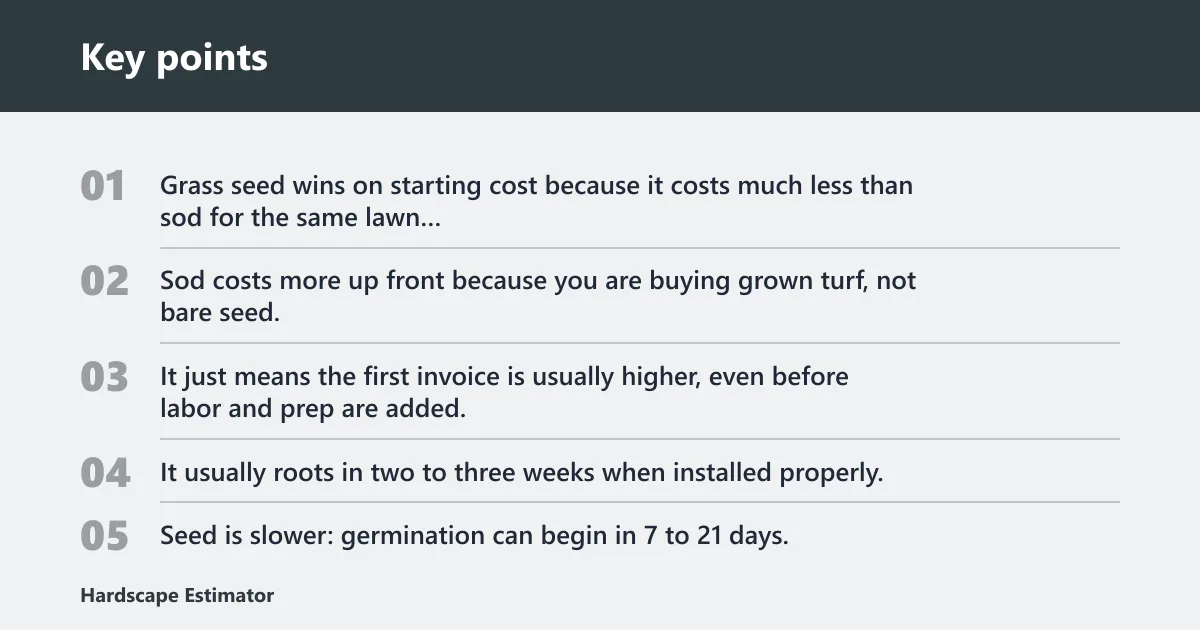
| Upfront cost | Lower material cost for the same lawn size | Higher material cost because it is pre-grown turf | Grass seed |
| Speed to visible coverage | Germination can start in 7 to 21 days, then density builds later | Looks green right away and roots in about 2 to 3 weeks | sod |
| Erosion and weed control | Bare soil stays exposed longer and can wash away before it knits in | Immediate soil cover holds the surface and blocks weeds sooner | sod |
| Grass variety options | Broader choice of species and blends | Limited to what growers produce | Grass seed |
| DIY risk | More forgiving on budget, but watering and weed control matter more | Less forgiving if the base is uneven or if installation sits too long before laying | Grass seed |
Upfront cost
Grass seed wins on starting cost because it costs much less than sod for the same lawn size. Sod costs more up front because you are buying grown turf, not bare seed, and that premium shows up in both material and delivery.
That does not make sod a poor buy. It just means the first invoice is usually higher, even before labor and prep are added.
Speed to usable lawn
sod wins on speed. It usually roots in two to three weeks when installed properly, and fresh sod should ideally be laid within 24 hours of being cut. Seed is slower: germination can begin in 7 to 21 days, but a thicker lawn can take 6 to 8 weeks, and a seed-grown lawn may need at least one full growing season.
That timing matters if the yard needs quick curb appeal, early use, or erosion protection before the next rain cycle.
Risk during establishment
sod closes the surface faster, so it controls weeds and erosion better while the lawn settles. Seed leaves bare soil exposed longer, which raises the chance of washout, wind loss, and weed pressure before the grass fills in.
Seed can still work well, but it asks more of the owner during the first weeks. Watering, traffic control, and weed watch matter more.
Variety and fit
Grass seed wins on variety. It gives more choice in species and blends, which helps when shade, heat, traffic, or soil conditions point to a specific grass type.
sod is narrower because it depends on what growers produce. That can be fine for many yards, but it limits the menu.
Decision matrix
| Yard scenario | Cost score | Speed score | Failure risk score | Maintenance burden score | Recommended pick |
|---|---|---|---|---|---|
| New construction | Grass seed 5, sod 2 | Grass seed 2, sod 5 | Grass seed 3, sod 4 | Grass seed 3, sod 3 | Grass seed |
| Slope | Grass seed 5, sod 2 | Grass seed 2, sod 5 | Grass seed 2, sod 5 | Grass seed 3, sod 3 | sod |
| Heavy shade | Grass seed 4, sod 3 | Grass seed 3, sod 4 | Grass seed 4, sod 3 | Grass seed 3, sod 3 | Grass seed |
| High foot traffic | Grass seed 5, sod 2 | Grass seed 2, sod 5 | Grass seed 2, sod 4 | Grass seed 4, sod 3 | sod |
| Budget-limited | Grass seed 5, sod 1 | Grass seed 2, sod 5 | Grass seed 3, sod 4 | Grass seed 3, sod 3 | Grass seed |
| Patch repair | Grass seed 5, sod 2 | Grass seed 3, sod 4 | Grass seed 3, sod 3 | Grass seed 4, sod 3 | Grass seed |
| Poor drainage | Grass seed 4, sod 2 | Grass seed 3, sod 4 | Grass seed 2, sod 4 | Grass seed 3, sod 3 | sod |
| Hot-climate timing | Grass seed 4, sod 2 | Grass seed 2, sod 4 | Grass seed 2, sod 4 | Grass seed 3, sod 3 | sod |
| Erosion risk | Grass seed 5, sod 2 | Grass seed 2, sod 5 | Grass seed 1, sod 5 | Grass seed 3, sod 3 | sod |
| DIY-only | Grass seed 5, sod 2 | Grass seed 2, sod 4 | Grass seed 3, sod 3 | Grass seed 4, sod 3 | Grass seed |
How to read the scores
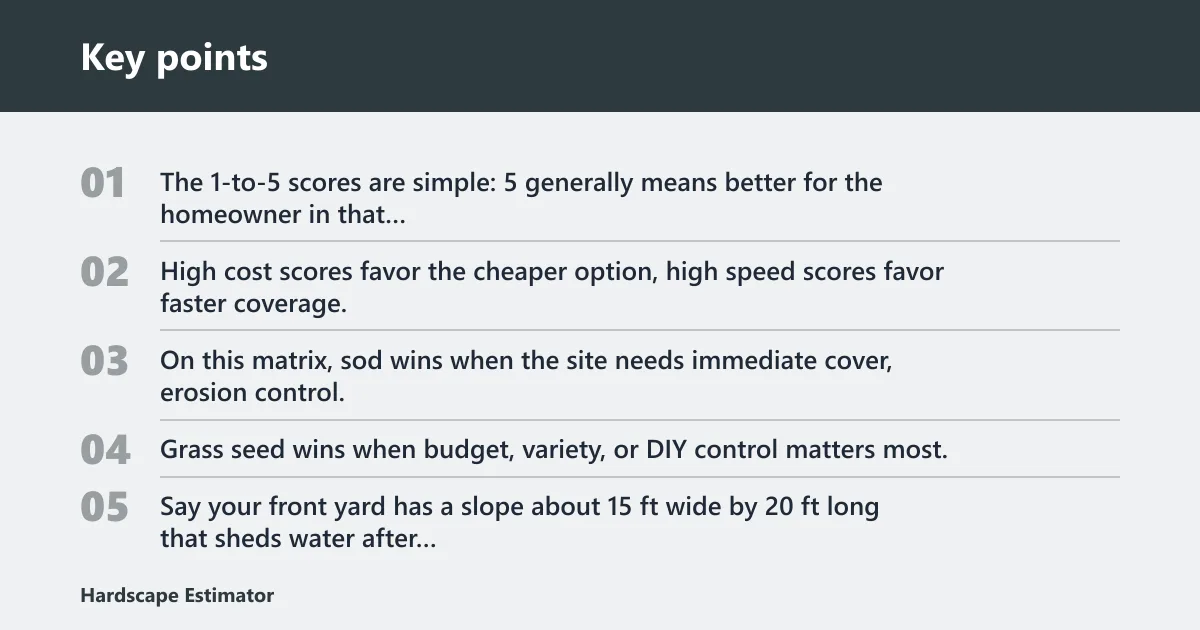
The 1-to-5 scores are simple: 5 generally means better for the homeowner in that category, and 1 means worse. High cost scores favor the cheaper option, high speed scores favor faster coverage, high failure-risk scores favor the option less likely to fail on that site, and high maintenance scores favor the option with less early work.
On this matrix, sod wins when the site needs immediate cover, erosion control, or quick recovery from wear. Grass seed wins when budget, variety, or DIY control matters most.
Say your front yard has a slope about 15 ft wide by 20 ft long that sheds water after heavy rain. Seed can save money, but runoff can move it before it anchors. sod gives immediate cover and is the safer pick for that spot.
Suppose a backyard of about 600 sq ft is flat, sunny, and budget-limited. Seed is the better estimate because the lower material price matters more than instant coverage, and the site gives the lawn time to grow in.
Which is cheaper, sod or grass seed?
Grass seed is cheaper than sod for the same lawn size. That is the simplest cost answer, and it usually stays true after you add material, delivery, and installation time. sod costs more because it arrives as pre-grown turf in ruglike rolls, ready to be unfurled.
Upfront material cost
Seed has the lower purchase price by a wide margin. sod carries the higher upfront material bill because it includes the growing time, harvesting, and handling needed to bring a finished surface to the yard.
If the project is large, the gap can be big enough to change the whole budget. That is why seed often wins when the yard is extensive and the owner can wait.
Labor, prep, and delivery
Both choices need grading and soil prep before installation. A bare lawn with compacted soil, low spots, or poor drainage needs fixing first, or the final result can fail no matter which material is chosen.
sod can add labor cost because it must be laid quickly and evenly, and fresh sod should ideally be installed within 24 hours of being cut. Seed usually lowers material cost, but it can add upkeep cost through watering and weed control during establishment.
Total installed cost per square foot
The full installed cost per square foot is usually lower with seed, but the math depends on site condition. A rough, weed-heavy, or poorly graded yard can erase part of the savings if the prep work is extensive.
For planning, compare these lines on the estimate: soil prep, material, delivery, and early maintenance. The cheapest material is not always the cheapest project.
How fast do sod and seed establish?
sod is faster by a clear margin. It gives instant visual cover and usually roots in two to three weeks when installed properly, while seed starts slower and may need a full growing season to reach a dense lawn.
Rooting time versus germination time
sod comes as finished turf with roots attached to a thin soil layer, so it begins the job already grown. That is why it can be walked on sooner than seed, although it still needs careful watering while the roots knit into the soil below.
Seed first has to germinate, then thicken. Dean’s Landscaping says seed can start in 7 to 21 days, and a thicker lawn can take 6 to 8 weeks.
When the lawn can take foot traffic
Light use comes sooner with sod, but early traffic still needs to be limited. The root system is not fully set at installation, so heavy use too early can shift the pieces or slow rooting.
Seeded ground needs even more caution because the soil stays exposed longer. Foot traffic can break the crust, move seed, and leave gaps that fill with weeds.
Why seed often needs a full season
Seed can look acceptable before it is dense. That is the difference between visible green and a finished lawn that resists wear, runoff, and weeds.
Bob Vila notes that seed-grown lawns can take at least one full growing season. That is the right expectation when the goal is a thick, durable surface instead of quick color.
Which option fits your yard conditions?
The yard itself usually decides the better option. Slope, drainage, shade, traffic, and access matter more than a simple price comparison, because they change both failure risk and the amount of maintenance needed after installation.
Slope and erosion risk
sod is the safer choice on slopes and erosion-prone areas because it holds soil immediately. The same source says sod is better for controlling weeds and erosion, and that matters when rain can move loose soil before seed has time to knit in.
Seed can work on a slope only if the site is stable, protected, and watered carefully. Heavy rain or wind can wash it away before it takes hold.
Shade, drainage, and runoff
Heavy shade often points toward seed, because the broader variety selection makes it easier to choose a grass better matched to low light. Drainage problems are different: low spots and runoff can hurt both options, but sod is often safer when immediate surface cover is needed.
Both choices depend on a workable base. If the soil stays wet, pools water, or has compacted layers, grading and drainage correction should come before either material.
Heavy traffic, patch repair, and DIY-only sites
sod handles early traffic better because it gives a finished surface sooner. That makes it a stronger fit for high-use areas, front yards, and places where a lawn must look presentable fast.
Seed is usually better for patch repair. The same source notes that sod needs bare soil, which makes patch work more disruptive, while seed can fill a damaged spot without ripping up as much of the surrounding lawn.
A common first-timer mistake is seeding a compacted side yard and skipping soil prep. The seed may sprout, but the weak root zone leaves thin spots, then weeds move in where the grass should have thickened.
Choose Grass seed if… / Choose sod if…
Choose Grass seed if the budget is tight, the yard is large, the site is fairly level, or you want more grass variety for shade, heat, or local conditions. It is also the better pick for patch repair and DIY-only projects where slower growth is acceptable.
Choose sod if you need fast cover, erosion control, or a lawn that can look finished sooner. It is the stronger choice for slopes, high-traffic areas, poor runoff spots that need immediate soil cover, and projects where quick results matter more than lower cost.
If the site has compacted soil, standing water, or a steep grade, pause before choosing either product. A soil test should come first, along with checks for pH, organic matter, and nutrient availability, because a poor base can make either lawn struggle.
- Measure the lawn area and estimate total installed cost, not just material cost.
- Check slope, drainage, and shade before choosing a material.
- Test the soil for pH, organic matter, and nutrient availability.
- Decide how fast the lawn must be usable.
- Match the choice to your watering and weed-control capacity.
Frequently asked questions
Is grass seed or sod better for my yard?
Grass seed is better for most yards when budget, variety, and repair work matter most. sod is better when the site needs quick cover, erosion control, or a usable lawn in a short window. The better choice depends on slope, drainage, traffic, and how soon the lawn must look finished.
How long does sod take to root compared with seed?
sod usually roots in two to three weeks when installed properly. Seed takes longer because it must germinate first, then thicken into a durable lawn. The same source says seed can start in 7 to 21 days, while a thicker lawn can take 6 to 8 weeks.
Should I use sod on a slope or erosion-prone area?
Yes, sod is usually the better choice on slopes and erosion-prone areas. It gives immediate soil holding, which helps keep the surface in place before rain or wind can move it. Seed can work only if the slope is stable and protected from runoff during establishment.
Can I repair a lawn with grass seed instead of sod?
Yes, grass seed is often the better repair option for smaller bare spots. It is less disruptive than lifting and patching with sod, and it fits budget repairs well. The tradeoff is slower fill-in and more need for watering and weed control while it establishes.
How much watering does new sod need compared with new seed?
Both need steady watering, but seed usually needs more attention because it stays exposed longer. sod needs careful watering right after install so the roots can knit into the soil, while seeded areas need repeated moisture to keep the top layer from drying out before germination and early growth.