What Is the Best Landscape Edging for Slopes?
For slopes under about 10%, a common rule of thumb is to use 1/8-inch steel or aluminum edging with 12-inch stakes; above about 10% or where soil slides, use terraced containment or paver edging instead of flexible plastic. Wrong edging on a slope can creep downhill, let mulch wash out, and fail after frost heave. This guide compares edging types by grade, soil movement, and installation method.
How slope grade and soil conditions determine edging choice
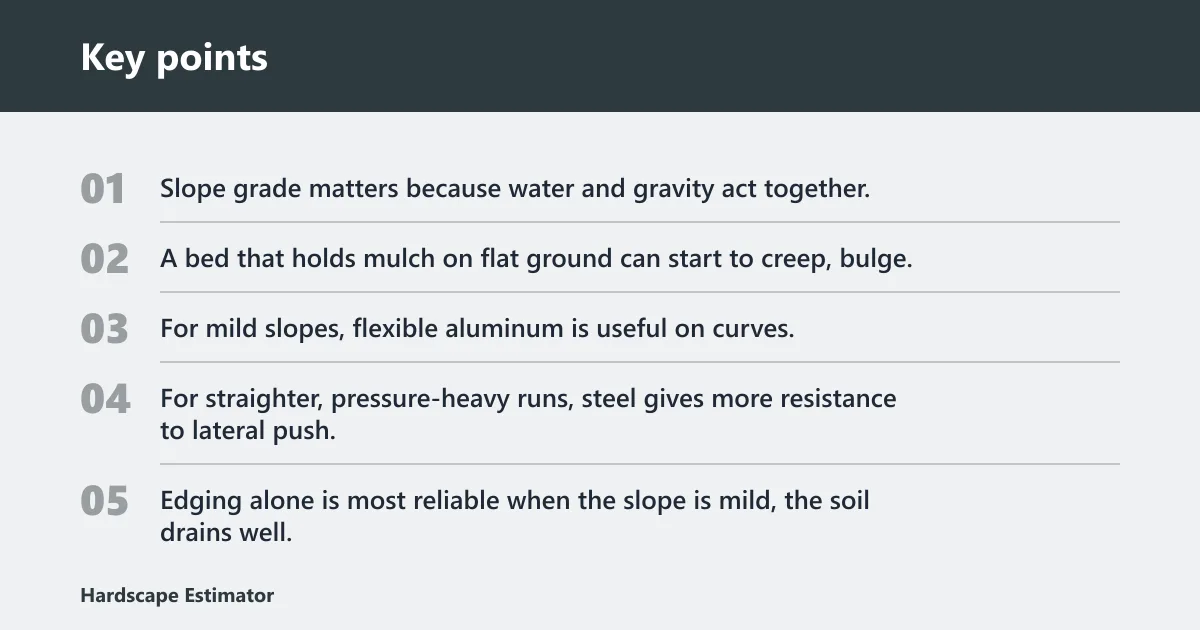
The best edging depends on slope grade and soil movement. Under 15%, aluminum or steel can work with closer stakes and deeper burial. From 15% to 25%, choose rigid metal with stronger anchoring. Over about 25% slope, edging alone is often a poor fit, and terracing is usually the safer call.
Best choice by slope grade
Slope grade matters because water and gravity act together. A bed that holds mulch on flat ground can start to creep, bulge, or wash out once the grade rises. For mild slopes, flexible aluminum is useful on curves. For straighter, pressure-heavy runs, steel gives more resistance to lateral push.
When edging alone is enough
Edging alone is most reliable when the slope is mild, the soil drains well, and runoff does not cut channels through the bed. If the edge only needs to hold mulch or light gravel, a metal border with close stakes can be enough. Once soil starts sliding, the border needs more structure.
When terracing is the safer call
Slopes exceeding 30% often need terracing. That breaks one long downhill push into smaller steps, which lowers pressure on any single edging line. It also creates flatter planting zones and gives runoff more places to slow down. One border line on a steep hill is often doing too much work.
Why slopes push edging to fail
Slopes make edging fail because gravity keeps pulling fill downhill while runoff loosens the base from above. Soil creep, mulch washout, and edge uplift all start to show sooner than they do on level beds. In cold climates, frost heave can add movement and lift stakes out of the ground.
Gravity and soil creep
On a slope, the soil mass is always trying to move downhill. Even slow movement can open a gap behind the edging, which then lets the border lean or bow. The steeper the grade, the more the edging must resist lateral pressure instead of only holding material in place.
Runoff, washout, and mulch loss
Water moving down a slope can cut under the edge and carry away fine soil and mulch. That creates voids, and voids reduce support. If runoff is not redirected around the bed, edging becomes a weak point rather than a containment line. The border should work with drainage, not fight it.
Why freeze-thaw raises the risk
Freeze-thaw cycles can heave soil, open seams, and loosen fasteners. That is why stake angle matters on sloped edging. A 45-degree stake angle is used to resist uplift and lateral motion better than a simple straight push in some installations, especially where frost movement is a concern.
Slope edging selection matrix
This matrix ties slope grade to edging type, height, stake spacing, stake angle, and failure risk. The goal is simple: match the edging to the pressure on it. Mild slopes can use less material depth. Steeper slopes need taller profiles, tighter anchoring, and more attention to runoff control.
| Slope grade | Best edging material | Recommended height | Stake spacing | Stake angle | Failure risk |
|---|---|---|---|---|---|
| Under 15% | Aluminum or steel | 4-inch panels | 2 to 3 feet | 45 degrees | Low to moderate if drainage is handled |
| 15% to 25% | Steel or aluminum with deep stakes | 4-inch to 8-inch panels | 2 feet, tighter at curves | 45 degrees | Moderate if soil is loose or wet |
| Over 25% | Terraced containment, weathering steel, or retaining-style edging | 8-inch panels or tiered walls | 18 to 24 inches | 45 degrees with deeper embedment | High; edging alone may not be enough |
Slopes over 15% require modified installation. Standard spacing of 3-4 feet is insufficient for slopes. Bury 40-50% of edging height on slopes so the edge has enough soil engagement to resist bulging and uplift. Mild slopes under 15% can use 240mm panels, moderate slopes of 15-25% call for 400mm panels, and steep slopes over 25% may need 560mm panels.
Aluminum, steel, plastic, and corten compared
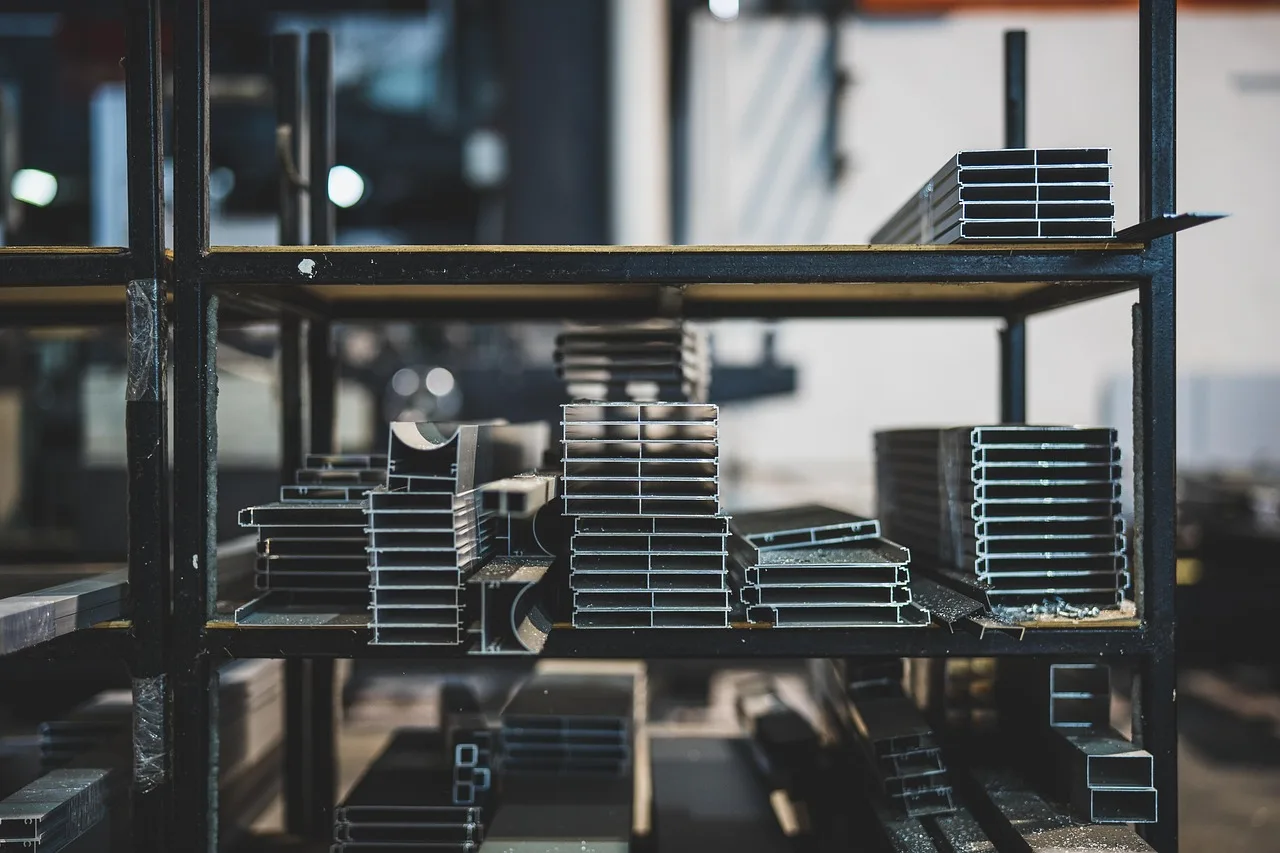
Each material fits a different slope problem. Aluminum is light, corrosion-resistant, and easier to curve around beds and hillside gardens. Steel is stiffer and better where soil pressure is high. Plastic is cheaper, but it needs closer stakes and has less staying power on steep grades. Weathering steel works best where a stronger terraced edge is needed.
Aluminum for curves and hillside beds
Aluminum edging is useful where the border must bend smoothly around a curve or follow an uneven slope line. It is lightweight and corrosion-resistant, so it suits hillside gardens where moisture and exposure are common. Deep-stake options improve hold, but the base still needs careful compaction.
Steel for rigid runs and pressure resistance
Steel edging has high rigidity. That makes it a better fit for formal straight runs and high-traffic slopes where the edge may get bumped or pushed by foot traffic, carts, or maintenance tools. It usually needs longer or deeper stakes because its strength is only useful if the anchoring matches it.
Plastic for lower-duty borders
Plastic edging is the lower-cost option, but it is less durable on steep grades. It can work as a paver restraint or a bed border on mild slopes, especially where the soil is stable. On steeper ground, it needs closer stake spacing and is more likely to flex or creep.
Corten for terraced or exposed settings
Weathering steel, often called corten, forms a protective patina and is useful for terraced beds and slope containment. It can follow contours while giving a more rigid edge than flexible plastic. It is a strong option for exposed outdoor conditions where the edge needs to stand up to view, runoff, and soil pressure.
| Situation | Best fit | Why it fits | Main caution |
|---|---|---|---|
| Curved hillside border | Aluminum | Flexible, light, easy to shape | Needs deep staking on slopes |
| Straight run with traffic | Steel | High rigidity and strong against soil pressure | Needs longer, deeper stakes |
| Lower-cost mild slope border | Plastic | Affordable and useful as a restraint | Less durable on steep grades |
| Terraced or exposed slope | Weathering steel | Good for contours and contained tiers | Needs good drainage and firm base support |
How do you keep edging from shifting on a slope?
Keep edging from shifting by burying enough of the profile, compacting the backfill, and using tighter stake spacing than you would on flat ground. On slopes, the edge needs to resist sliding, bulging, and frost uplift at the same time. That means deeper embedment, closer anchors, and controlled drainage.
Trenching and backfill compaction
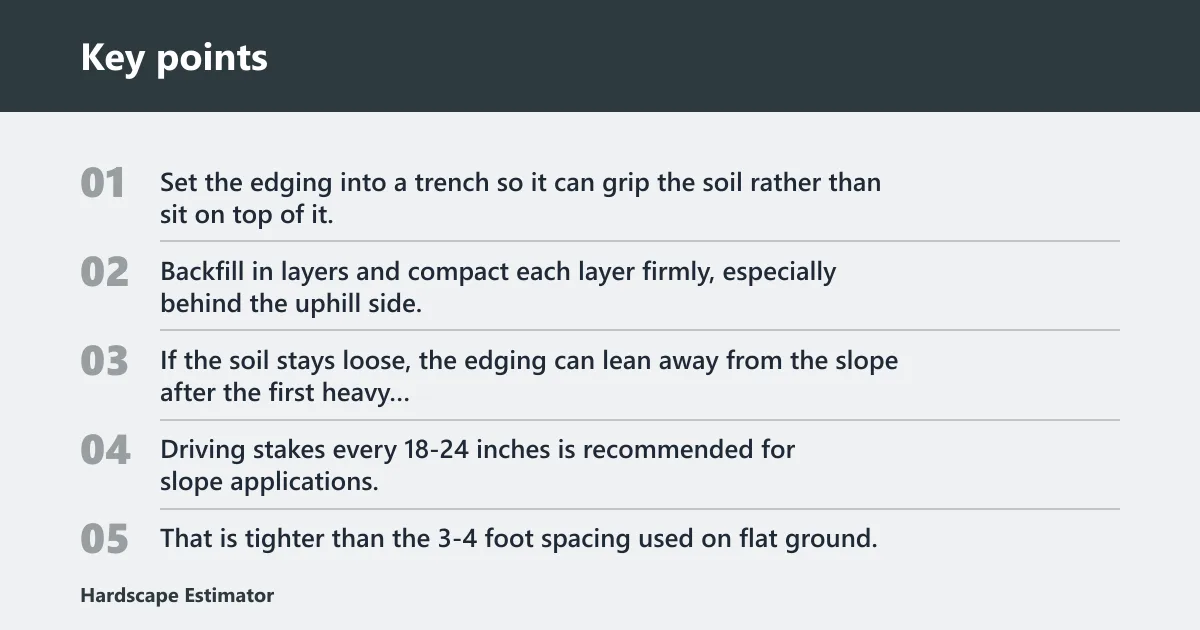
Set the edging into a trench so it can grip the soil rather than sit on top of it. Backfill in layers and compact each layer firmly, especially behind the uphill side. If the soil stays loose, the edging can lean away from the slope after the first heavy rain.
Stake spacing on slopes
Stake every 2 to 3 feet on slopes. Driving stakes every 18-24 inches is recommended for slope applications, especially where the run is curved or the soil is soft. That is tighter than the 3-4 foot spacing used on flat ground, and it reduces bulging between fasteners.
Stake angle and uplift control
A 45-degree angle system helps the stake resist uplift and lateral movement. Some competitor guidance shows vertical stakes, but that approach gives less hold against downhill creep and frost movement on many slopes. Use deeper stakes where soil is loose, and keep the top of the edging firmly seated while backfilling.
Picture a 20-foot border on a 18% slope with wet topsoil. If the stakes are too far apart, the edging can bow between them after the first storm. Closer spacing and compacted backfill keep the line straighter and reduce the chance of a low spot that catches runoff.
Slope edging examples for curves, erosion, and frost
Choose the edging by the problem you are trying to solve. Curves favor flexible aluminum. Erosion-prone soils need stronger anchoring and better drainage control. Freeze-thaw climates call for deeper burial, angled stakes, and materials that can tolerate repeated movement without loosening quickly.
Best picks for curved borders
For curves, aluminum usually fits best because it bends cleanly without fighting the layout. Steel can also work if the curve is broad and the line needs to stay very straight. Plastic bends easily, but on slopes it can wave or lift if the stakes are not close enough together.
Best picks for erosion-prone soils
For sandy, silty, or otherwise mobile soils, steel or weathering steel is usually the safer choice. Those soils shift more under runoff, so the edge needs more rigidity and deeper anchoring. A small terrace may be better than a single border if the soil keeps moving after rain.
Best picks for freeze-thaw climates
Freeze-thaw climates favor metal edging with deeper burial and angled stakes. The 45-degree stake angle helps resist heave, and burying 40-50% of edging height gives the line more resistance. If winter movement is common, avoid shallow plastic borders on slopes that already push soil downhill.
Suppose a homeowner wants a 30-foot border along a moderate slope behind a driveway. A 4-inch aluminum edge may work if the soil is stable and the run curves gently. If the same yard has runoff cutting channels, stepping up to steel or a small terrace reduces the chance of repeated repairs.
When should you use terraces or retaining structures?
Use terraces or retaining structures when the slope is too steep for one edging line to hold soil reliably. Over 25% is already a warning zone, and slopes exceeding 30% often need terracing. Breaking the hill into tiers lowers pressure, controls runoff, and gives each level a more stable edge.
Signs the slope is too steep
If mulch keeps washing out, the soil slumps after rain, or the border keeps leaning downhill, the slope may have outgrown standard edging. Long exposed runs, poor drainage, and soft fill all make the problem worse. At that point, a border is no longer just a trim detail; it is a containment issue.
How tiers reduce pressure on one edge
Tiers divide one steep slope into smaller steps. That shortens the distance water can accelerate and reduces the soil load on any single line. It also makes maintenance easier because each level can be planted and edged separately instead of asking one border to hold an entire hillside.
Simple alternatives to a single border line
Retaining-style edging, stepped terraces, stone courses, or boulder runs can all outperform a single shallow border on a steep hill. These options cost more than basic edging, but they reduce failure risk and future repair work. For steep sites, that tradeoff is often the practical one.
Frequently asked questions
What is the best edging for slopes?
The best choice is the one that matches the grade. Under 15%, aluminum or steel can work with deep burial and close stakes. From 15% to 25%, steel or aluminum with stronger anchoring is better. Over 25%, terracing or retaining-style containment is often safer than a single border.
What type of edging works best on hillsides?
Aluminum works well on curved hillside beds because it is light and flexible. Steel works better on straight runs and where soil pressure is high. On a hillside with erosion or frost movement, the best answer is usually metal edging with deeper stakes, not shallow plastic strips.
How deep should edging be installed on a slope?
Bury 40-50% of the edging height on slopes. That gives the border more soil engagement and reduces the chance that runoff or frost movement will loosen it. Taller profiles also help on steeper grades because they give you more material to anchor below the finished surface.
How far apart should stakes be on sloped edging?
Stake every 2 to 3 feet on slopes, and tighten that to 18-24 inches for curves, soft soil, or higher pressure areas. Standard spacing of 3-4 feet is insufficient for slopes. Closer spacing limits bulging between stakes and improves resistance to downhill creep.
Can plastic edging work on a hillside?
Plastic edging can work on a mild hillside if the slope is gentle, the soil is stable, and the stakes are close together. It is less durable on steep grades and more likely to flex or creep. For erosion-prone or high-traffic slopes, metal is the better choice.