What Is the Best Bagged Mulch for Flower Beds?
For most flower beds, a common choice is shredded hardwood or a bark-based mulch applied about 2 to 3 in. deep; pine bark is often used for acid-loving plants and fine-texture mulch for small perennials. Too little mulch lets weeds and evaporation win. Too much can rot crowns, invite pests, and waste money. This guide compares common bagged mulches by bed type, breakdown rate, appearance, and cost per square foot.
The right pick depends more on the plants than the color. Annuals generally need a lighter touch than shrubs. Beds with poor drainage need a coarser mulch than tight, flat beds. If the goal is soil improvement, organic mulch usually beats rubber or stone because it breaks down and adds organic matter over time.
Pick shredded hardwood, cedar, pine bark, or dyed mulch
Fast buyer answer
Pick shredded hardwood when you want the most general-purpose option for flower beds. Pick cedar if fragrance and a slightly longer-lasting wood mulch matter more. Pick pine bark for woody ornamentals or acid-loving plants. Pick dyed mulch only when color is the main goal. Skip rubber or stone for most planting beds.
Organic vs inorganic mulch
Organic mulch is the better fit for most flower beds because it helps hold moisture, suppresses weeds, and adds organic matter as it decomposes. Inorganic mulch lasts longer, but it does not feed the soil and is usually a weaker choice around annuals, perennials, and shrubs that benefit from root-zone improvement.
Soil benefit and moisture retention
Shredded hardwood, cedar, pine bark, and pine straw are all organic choices. Gen Lawn says organic mulch wins for flower beds because it improves soil over time, and that matches the usual goal in planting beds: keep roots cooler, slow evaporation, and build soil structure as the mulch breaks down.
Inorganic mulch can reduce maintenance in some settings, but the trade-off is clear. Rubber and stone do not add nutrition to the soil. They also tend to be less forgiving in beds where plants are regularly divided, replanted, or fertilized.
How long each type lasts
Finer organic mulch breaks down faster. Shredded hardwood often decomposes sooner than bark nuggets. Cedar often lasts a bit longer than finer wood products, and pine bark can last longer than many small-texture mulches because the pieces are larger and slower to break down.
Inorganic mulch lasts the longest on the surface. That is its main advantage. The drawback is that long life does not equal better plant performance, which is why inorganic materials usually fall short in flower beds unless the bed has a narrow decorative role and little planting turnover.
Flower bed mulch decision matrix
The best mulch depends on plant type, bed moisture, drainage, slope, and how much color longevity matters. A mulch that looks good for two seasons may still be the wrong choice if it dries out seedlings, floats downhill, or creates cleanup problems near a house wall.
| Mulch type | Best plant type | Moisture retention | Soil benefit | Color longevity | Risk flags |
|---|---|---|---|---|---|
| Shredded hardwood | Annuals, perennials, shrubs | Good | Good | Moderate | Fresh wood can cause nitrogen drawdown in seedlings; can mat if applied too deep |
| Cedar mulch | Perennials, shrubs, ornamental beds | Good | Good | Moderate | Fragrance may be a plus or a minus; avoid overreliance on pest-repelling claims |
| Pine bark | Shrubs, foundation beds, acid-loving plants | Good | Good | Moderate | Light pieces can move on slopes; smaller bark can wash in heavy rain |
| Dyed wood mulch | Display beds, low-change ornamental beds | Good | Low to moderate | High | Color residue, wet-bag staining, and dye quality concerns; watch for pale transfer on hardscape |
| Rubber or stone | Narrow edge cases only | Moderate | None | High | No soil nutrition; poor fit for most flower beds; can heat up and complicate replanting |
Annuals, perennials, and shrubs
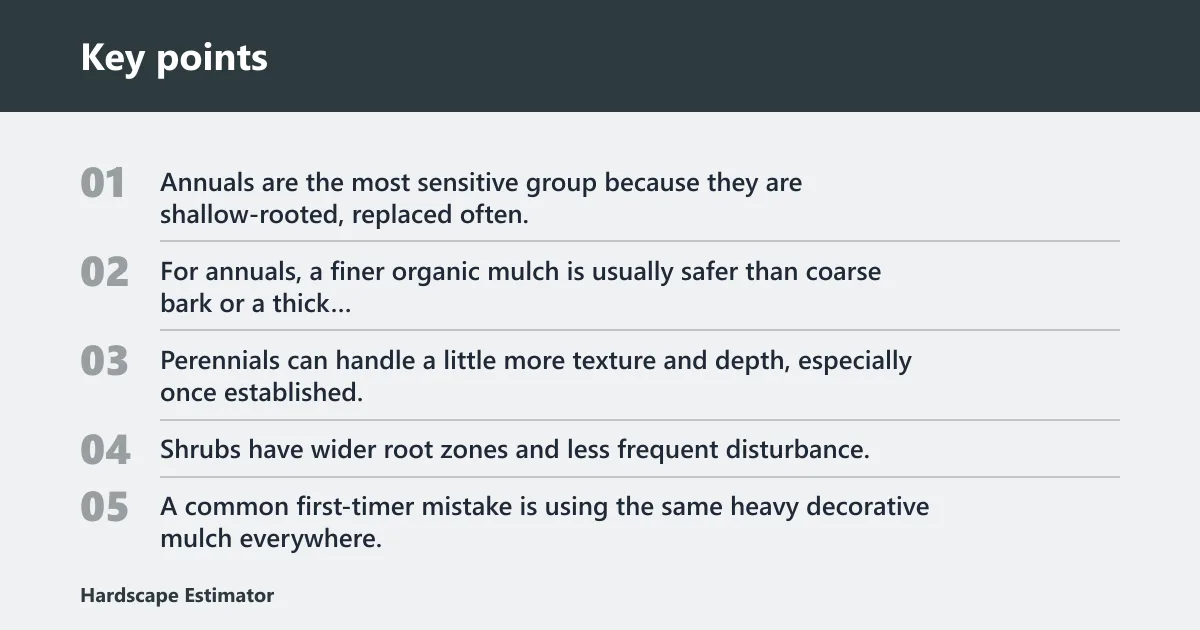
Annuals are the most sensitive group because they are shallow-rooted, replaced often, and usually planted close together. For annuals, a finer organic mulch is usually safer than coarse bark or a thick decorative layer. Perennials can handle a little more texture and depth, especially once established.
Shrubs have wider root zones and less frequent disturbance, so they can benefit from bark mulch that lasts longer between top-ups. A common first-timer mistake is using the same heavy decorative mulch everywhere, then wondering why small annuals look buried while shrubs look fine.
Moisture, drainage, and slope
Flat beds with average drainage can use most organic mulches at the standard depth. Beds that dry quickly usually benefit from shredded hardwood or bark because they help slow evaporation. On sloped beds, lighter mulches can float or shift, so a more interlocking texture is often better than loose, fluffy material.
Say your front bed is 120 sq ft and slopes toward the walk. A loose, light mulch may move after the first hard rain. In that case, a coarser organic bark mulch can stay put better than a very fine product, even if both are bagged and labeled for landscaping.
Color longevity versus soil benefit
Dyed mulch is mainly an appearance-first choice. Mike’s Backyard Nursery says dyed mulch is made from ground-up wood and dyed for color, which explains why its selling point is consistent black, brown, or red appearance rather than soil improvement. That can matter in display beds near an entry, but it is not the same as a soil-building mulch.
The same source says the best bagged mulch for flower beds is shredded hardwood or cedar mulch, while also noting that organic mulch is the better long-term choice for soil. That is the right ordering for most buyers: plant performance first, color second.
Risk flags: nitrogen drawdown and artillery fungus
Wood-based mulches can draw nitrogen from soil during decomposition, especially when the mulch is fresh and the plants are small. That matters most for seedlings and annuals. Established shrubs and perennials are less likely to show a problem, though a light nitrogen feeding may still be useful in poor soil.
Artillery fungus is another buyer caution point. It is associated with some mulches and can leave dark spots on siding and other surfaces. If a bed sits close to a house wall, choose a clean, well-stored bagged product and avoid mulch that smells sour, looks spoiled, or has obvious mold.
Which mulch fits annuals, perennials, and shrubs?
Annuals usually do best with a finer organic mulch applied lightly. Perennials can take shredded hardwood, cedar, or bark mulch with fewer problems once established. Shrubs are the most flexible group, and they often work well with bark-based mulch because the larger root zone tolerates longer-lasting material.
Annuals
Annuals need the most caution because they are replanted often and sit closer to the soil surface. Fresh wood mulch can be useful, but nitrogen drawdown matters most here. Use 2 in. rather than a heavy 3 in. layer if the plants are small, and keep mulch off stems.
Perennials
Perennials usually benefit from a balanced organic mulch that holds moisture without packing down too tightly. Shredded hardwood is a strong default. Cedar is reasonable when fragrance or longer life matters. Pine bark is a good fit when the bed has a more permanent structure and the mulch can be left in place longer.
Shrubs
Shrubs tolerate coarser mulch better than annuals because their roots are deeper and the bed is disturbed less often. Pine bark and cedar are common choices in ornamental beds. If the goal is a neat look with fewer top-ups, a bark-based mulch is often easier to live with than a fine mulch that breaks down quickly.
Coverage and bag size basics
Bag coverage matters because a bag size alone does not tell you how far it goes. The right quantity depends on depth. A 2 in. layer covers more area than a 3 in. layer, and most flower beds need somewhere in that range. Use the bag label, then do the math for your square footage.
| Bag volume | Coverage at 2 in. | Bags for 100 sq ft at 2 in. | Coverage at 3 in. | Bags for 100 sq ft at 3 in. |
|---|---|---|---|---|
| 1.5 cu ft | 9 sq ft | 12 bags | 6 sq ft | 17 bags |
| 2.0 cu ft | 12 sq ft | 9 bags | 8 sq ft | 13 bags |
How to estimate quantity
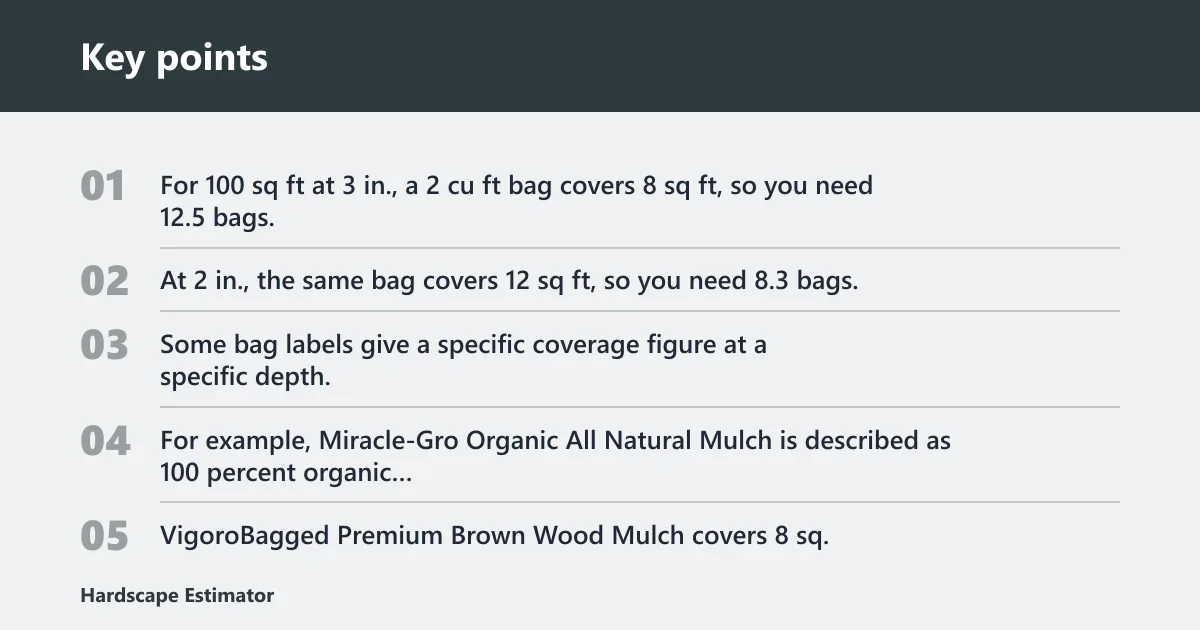
For 100 sq ft at 3 in., a 2 cu ft bag covers 8 sq ft, so you need 12.5 bags. Round up to 13 bags. At 2 in., the same bag covers 12 sq ft, so you need 8.3 bags. Round up to 9 bags.
Some bag labels give a specific coverage figure at a specific depth. For example, Miracle-Gro Organic All Natural Mulch is described as 100 percent organic and covers 6 sq. ft. at a 3-inch depth. VigoroBagged Premium Brown Wood Mulch covers 8 sq. ft. at a 3-inch depth. CleanStraw Long Leaf Bagged Pine Straw covers 80 sq. ft. at 3- to 4-inch depth.
When to buy extra
Buy extra when the bed edges are uneven, the soil settles after watering, or the bed has dense roots and pockets that absorb more material. Extra bags also help when a slope causes thin spots after rain. A small overage is cheaper than making a second store trip.
Suppose a 100 sq ft bed needs a 3 in. layer and the label says 8 sq ft per bag. Thirteen bags is the base order. If the bed has a slight slope and several curved edges, adding one more bag is a practical buffer, especially when the finish needs to look even from the sidewalk.
Choose shredded hardwood if… / Choose cedar if…
Choose shredded hardwood if you want a general-purpose organic mulch for most flower beds, especially when soil improvement matters and the bed will be refreshed regularly. Choose cedar if you want an ornamental-bed look with a natural wood scent and slightly longer life than finer wood mulch.
Choose shredded hardwood if…
- the bed contains mixed annuals and perennials
- you want a common flower-bed choice that breaks down over time
- soil structure matters more than color retention
- you plan to refresh mulch on a regular schedule
Choose cedar if…
- the bed is decorative and near a seating area or entry
- you want a wood mulch option with fragrance
- the plants are shrubs or established perennials
- you want a mulch often associated with pest-repelling reputation, while still treating that claim cautiously
Choose pine bark if…
- the bed has shrubs or acid-loving plants
- you want a bark mulch that lasts longer than many fine wood products
- the site gets regular rain and needs decent drainage around roots
- you prefer a bagged mulch that looks tidy in planted borders
Choose dyed mulch if…
- appearance is the main goal
- you want black, brown, or red color consistency
- the bed is low-change and ornamental rather than soil-first
- you are comfortable with a product where color retention matters more than soil benefit
Choose inorganic mulch if…
- the bed is a narrow edge case, not a typical planting bed
- you want long surface life and no soil nutrition
- you are covering a small decorative strip with minimal replanting
- you accept that rubber or stone is usually less suitable for flower beds
Frequently asked questions
What is the best bagged mulch to buy?
For most flower beds, shredded hardwood or bark mulch is the best bagged mulch to buy. It gives a good balance of weed suppression, moisture retention, and soil improvement. Cedar is a strong second choice for ornamental beds, while dyed mulch is better when appearance matters most.
Is bagged mulch better than bulk mulch?
Bagged mulch is better for small jobs, mixed plantings, and clean handling near patios, doors, or foundation plantings. Bulk mulch is usually cheaper for large areas, but bagged mulch gives better control over texture, color, and quantity when the bed is under 500 sq ft or needs a careful finish.
What is a good mulch for flower beds?
A good mulch for flower beds is usually an organic wood-based mulch such as shredded hardwood, cedar, or pine bark. Those options hold moisture, suppress weeds, and fit common bed plants better than rubber or stone. The right pick depends on whether the bed is annual-heavy, perennial-heavy, or shrub-focused.
How deep should mulch be in flower beds?
Most flower beds do best with 2 to 3 inches of mulch. That depth helps block weeds and slow evaporation without smothering crowns or creating a soggy layer around stems. For small annuals, stay closer to 2 inches; for established shrubs, 3 inches is usually acceptable if spread evenly.
Should I use shredded hardwood or cedar mulch in flower beds?
Use shredded hardwood when you want the most practical all-around choice for soil improvement and regular bed maintenance. Use cedar when you want a slightly longer-lasting wood mulch and a more ornamental look. Both are reasonable, but shredded hardwood is usually the broader default for mixed flower beds.
Is dyed mulch safe for flower beds?
Dyed mulch can be safe for flower beds if it is made from clean wood and applied correctly, but it is usually chosen for appearance rather than soil benefit. Check for wet-bag staining, residue transfer, and poor storage signs. Avoid bags that are moldy, sour-smelling, or visibly degraded.