How Much Does a Pallet of Bagged Mulch Cover and Weigh?
A pallet of bagged mulch usually covers about 432 sq ft at 2 inches when it holds 36 bags of 2 cu ft mulch; at 3 inches, that same pallet covers about 288 sq ft. Total weight is simply bag count × bag weight, and a pallet can move from manageable to too heavy fast as bag size, mulch type, and moisture change. This guide shows the math for coverage, pallet weight, and ordering.
Bagged mulch pallet basics
Bagged mulch is sold by bag volume, not by bed size. So the pallet math starts with three numbers: bag size, bag count, and spread depth. A pallet is just a stack of bags, so total coverage equals per-bag coverage times bag count, while total weight equals bag weight times bag count.
That part is simple. The details are not. A 2 cu ft bag does not cover the same area as a 3 cu ft bag at the same depth, and wet inventory can weigh much more than dry stock. Organic mulch usually weighs less than inorganic mulch, and finer shredded material can weigh more than coarse chips of the same volume.
A cubic yard equals 27 cubic feet. That makes it the easiest bridge between bagged mulch and bulk mulch, because you can compare bag volume to yard volume and then convert that volume into square feet at the depth you plan to spread.
How much does a pallet of bagged mulch cover?
A pallet’s coverage depends on bag size and bag count. For a 2 cu ft bag, coverage is about 12 sq ft at 2 inches and 8 sq ft at 3 inches. Multiply that by the pallet count, and you have the pallet’s total usable coverage at the depth you plan to install.
The same pallet covers less area at 3 inches because deeper spread uses more material per square foot. This matches the standard volume-to-depth math used by extension publications and mulch retailers: coverage is simply volume divided by the intended depth.
Coverage by bag size
One bag’s coverage comes from volume divided by depth. A 2 cu ft bag spread at 2 inches covers about 12 sq ft. At 3 inches, it covers about 8 sq ft. At 4 inches, it covers about 6 sq ft. A 3 cu ft bag covers about 18 sq ft at 2 inches and about 12 sq ft at 3 inches.
Suppose a bed needs more body over a weed barrier or around shrubs. Going from 2 inches to 3 inches cuts coverage by one-third for the same amount of mulch. That is why depth planning changes both bag count and pallet count.
Coverage by pallet count
A pallet with more bags covers more area, but the bag count is not fixed across every retailer. Some pallets carry 36 bags, some 30, and some more or less depending on bag size and supplier. Check the listing for the pallet count before you order.
For a retailer-sourced example, Home Depot listings for bagged mulch commonly show pallet quantities and weight variation by product; for instance, a product-page listing may state “36 bags per pallet” for a 2 cu ft mulch and show a total pallet weight range that changes with the product line. This kind of variation can appear on retailer pages because the bag count and pallet weight are often displayed separately from the individual bag weight, and they do not always match across product types.
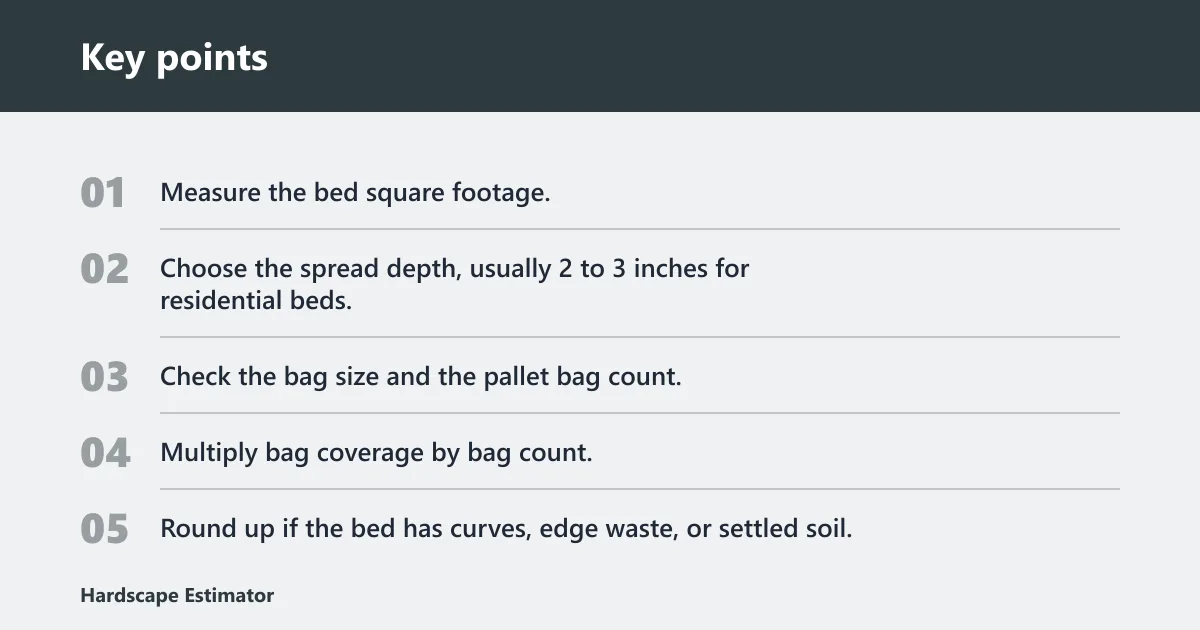
- Measure the bed square footage.
- Choose the spread depth, usually 2 to 3 inches for residential beds.
- Check the bag size and the pallet bag count.
- Multiply bag coverage by bag count.
- Round up if the bed has curves, edge waste, or settled soil.
How much does a pallet of bagged mulch weigh?
A pallet weighs bag weight times bag count. A bag of mulch typically weighs around 40 pounds, but bag weights can vary between 20 to 50 pounds. That puts many pallets in a wide range, and wet storage can raise the total still further. Consumer and supplier listings commonly show this spread because the same volume of mulch can be packaged as a light bark product, a denser shredded blend, or a heavier dyed mix.
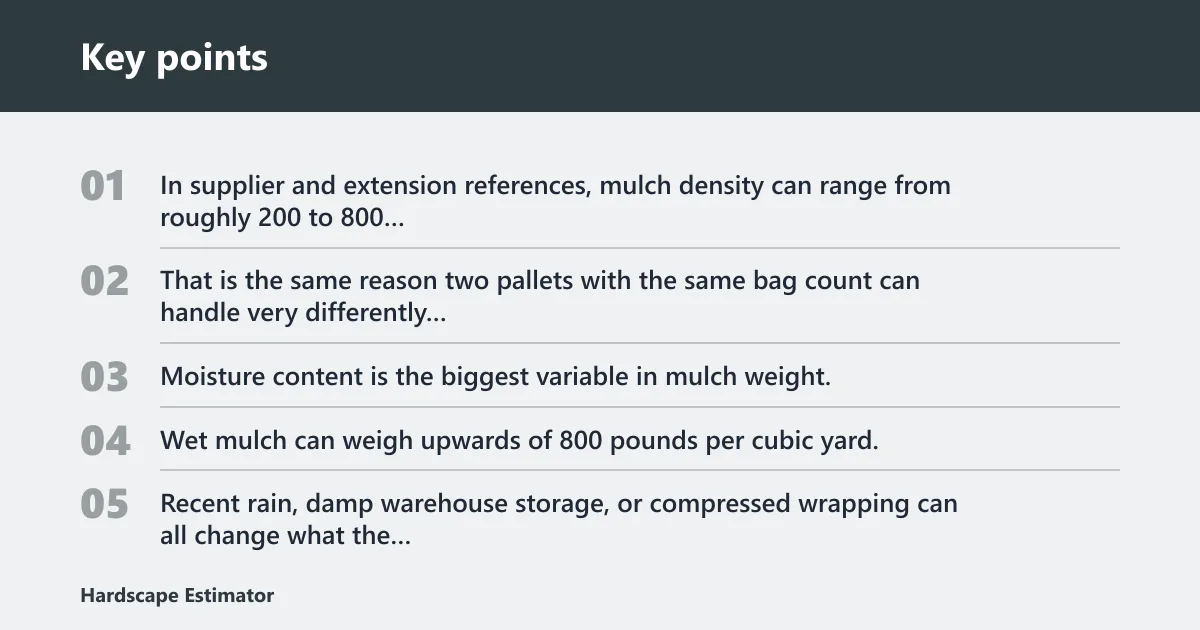
In supplier and extension references, mulch density can range from roughly 200 to 800 pounds per cubic yard depending on material and moisture. That is the same reason two pallets with the same bag count can handle very differently at pickup: the dry product may be light enough for easy hand unloading, while the same volume after rain or in a denser formulation can add hundreds of pounds.
Why wet stock weighs more
Moisture content is the biggest variable in mulch weight. Wet mulch can weigh upwards of 800 pounds per cubic yard, while dry mulch can weigh as little as 200 pounds per cubic yard. Recent rain, damp warehouse storage, or compressed wrapping can all change what the pallet actually weighs at pickup.
That matters for transport. A pallet that looks similar in size can be much heavier if the bags are saturated or packed tightly. If you are loading by hand or using a light trailer, check the retailer’s listed pallet weight when it is available and confirm your vehicle’s capacity before loading.
Why mulch type changes pallet weight
Hardwood, pine bark, cedar, straw, and leaf mulch do not weigh the same at equal volume. Finer shredded material often weighs more than coarse chips because more material fits into the same space. Inorganic mulch also tends to sit in a higher bag-weight range than many organic products.
Picture two pallets with the same bag count and bag size. One is a dry, light bark mulch. The other is a denser shredded mulch stored after rain. The second pallet can be much harder to move, even if the coverage looks identical on paper.
Pallet mulch coverage table
This table uses common bag sizes and assumed pallet counts to show how coverage and weight work together. Actual pallet counts vary by retailer, and the weight range changes with mulch type and moisture. Use the table as a planning tool, not a brand-specific listing.
| Common bag size | Assumed bags per pallet | Estimated pallet weight range | Coverage at 2 in | Coverage at 3 in |
|---|---|---|---|---|
| 1.5 cu ft | 40 | 800 to 2,000 lb | 360 sq ft | 240 sq ft |
| 2 cu ft | 36 | 720 to 1,800 lb | 432 sq ft | 288 sq ft |
| 3 cu ft | 30 | 600 to 1,500 lb | 540 sq ft | 360 sq ft |
Those weights come from multiplying the bag count by the sourced bag-weight range of 20 to 50 pounds. Real pallets can weigh more when the product is wet, dense, or packed tightly. Real coverage can also dip slightly if the bags are compressed or the spread is uneven.
How many bags do you need for your bed?
Measure the bed square footage first, then divide by the coverage per bag at your target depth. For a 2 cu ft bag, use about 12 sq ft per bag at 2 inches or 8 sq ft per bag at 3 inches. Add extra for settling, cut edges, and thin spots around curves.
A common first-timer mistake is to estimate mulch by eyeballing the bed and then skip the depth check. That usually leads to an under-order, especially on irregular beds where narrow strips and corner cutouts are easy to miss.
Irregular beds need section math
Break an irregular bed into rectangles, triangles, or other simple sections. Measure each section, calculate area, and add them together. That gives a usable square-foot total before you convert to bags or pallets.
Say your front bed is made of two rectangles: 12 ft by 4 ft and 8 ft by 3 ft. The total area is 48 sq ft + 24 sq ft = 72 sq ft. At 2 inches, a 2 cu ft bag covers about 12 sq ft, so you need 6 bags before any extra for waste or settling.
Worked example for 1,000 square feet
For a 1,000 sq ft bed at 2 inches, divide 1,000 by 12. That equals 83.3 bags of 2 cu ft mulch, so the practical order is 84 bags. At 3 inches, divide 1,000 by 8. That equals 125 bags of 2 cu ft mulch.
If the pallet count is 36 bags, the 2-inch job needs 3 pallets because 84 bags ÷ 36 bags per pallet = 2.33 pallets, then round up. The 3-inch job needs 4 pallets because 125 ÷ 36 = 3.47 pallets, then round up again.
For weight, use the bag-weight range. At 40 pounds per bag, 84 bags weigh about 3,360 lb. Using the sourced range of 20 to 50 pounds per bag, the same order could weigh from 1,680 to 4,200 lb before you account for wet inventory or a denser product.
That spread matters for transport. A pallet-based order may fit your delivery plan better than a loose pile if the bed is small, the access is tight, or the truck and trailer capacity are limited. For a larger bed, though, bagged mulch can quickly become a handling problem.
How many bags of mulch equal a yard?
One cubic yard equals 27 cubic feet. From there, divide 27 by the bag size. A 2 cu ft bag means 13.5 bags per yard. A 1.5 cu ft bag means 18 bags per yard. A 3 cu ft bag means 9 bags per yard.
This conversion helps when you are comparing bagged mulch to bulk mulch. If you know how many cubic yards a bulk order needs, you can compare that volume to the bag count without guessing. It also makes pallet coverage easier to sanity-check before pickup.
How deep should mulch be spread in garden beds?
For most garden beds, 2 to 3 inches is the range that makes the most sense. Two inches gives lighter coverage and uses fewer bags. Three inches gives fuller coverage and better material depth, but it lowers square-foot coverage per bag and raises the pallet count.
Use 1 inch only for touch-ups or a very light refresh. Use 4 inches only when the design or site conditions call for it, because deeper mulch sharply cuts coverage and can create excess material if the bed was already built up.
Is bagged mulch better than bulk mulch for a small project?
Bagged mulch is often the better fit for small jobs because it is easier to count, move, and store. It is also easier to split across several beds, which matters when the project is a few hundred square feet or when access is limited. Bulk mulch usually makes more sense when the area grows.
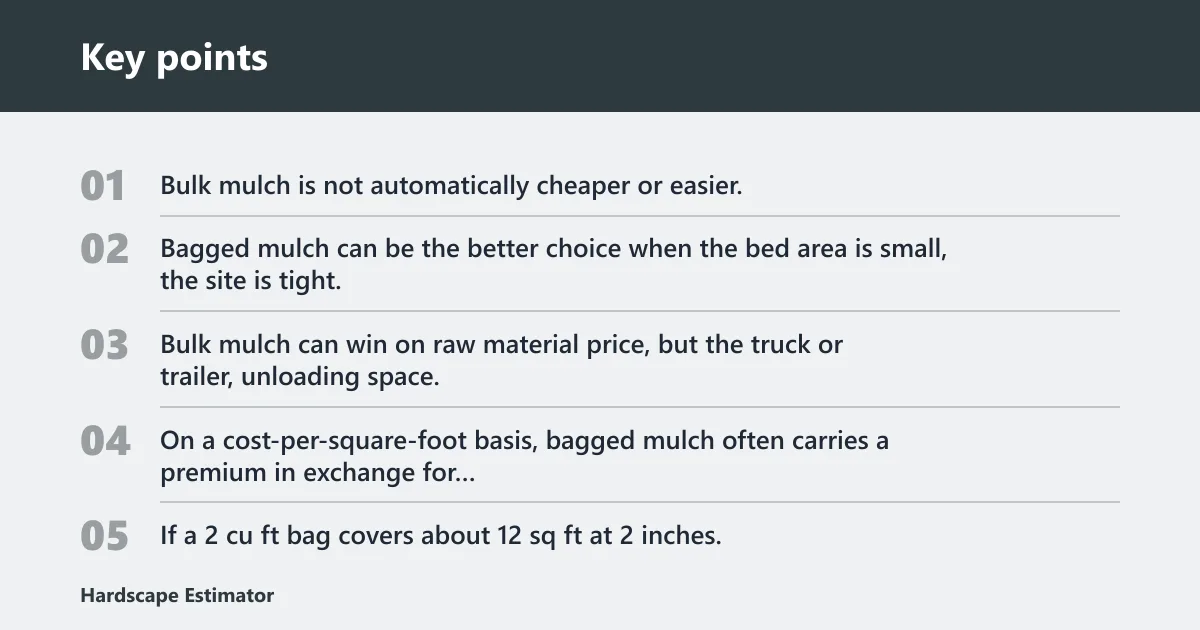
Bulk mulch is not automatically cheaper or easier. Bagged mulch can be the better choice when the bed area is small, the site is tight, or the job needs exact portioning. Bulk mulch can win on raw material price, but the truck or trailer, unloading space, cleanup, and disposal of torn bags or loose debris all become part of the estimate.
On a cost-per-square-foot basis, bagged mulch often carries a premium in exchange for convenience. If a 2 cu ft bag covers about 12 sq ft at 2 inches, then every bag’s price can be divided by 12 to get a rough installed-material cost per square foot before labor. Bulk mulch uses the same square-foot math, but the delivered yard price is usually lower per unit of coverage; however, the savings can shrink once you add delivery fees, driveway protection, unloading time, cleanup, and the extra labor of moving material from the pile to the beds. In smaller jobs, bagged mulch can actually be competitive when you count labor and disposal time, especially if the alternative is a partially used bulk load that still needs extra handling after delivery.
For a small residential refresh, bagged mulch gives better control over total lift weight. For a bigger bed system, a bulk order may cut handling time and reduce the number of packages to move, but the delivered load still needs to fit the vehicle and the site.
Frequently asked questions
How many square feet does one bag of mulch cover?
A 2 cu ft bag covers about 12 sq ft at 2 inches and about 8 sq ft at 3 inches. A 3 cu ft bag covers about 18 sq ft at 2 inches and about 12 sq ft at 3 inches. The depth you choose changes coverage directly.
How much does a cubic yard of mulch weigh?
A cubic yard of mulch weighs around 400 to 800 pounds, and the full weight of mulch can range from 200 to 800 pounds per cubic yard depending on moisture and density. Wet mulch can weigh upwards of 800 pounds per cubic yard, while dry mulch can weigh as little as 200 pounds. These ranges align with supplier and extension references that note large weight swings based on product type and moisture.
How many bags of mulch do I need for 200 square feet?
At 2 inches, a 2 cu ft bag covers about 12 sq ft, so 200 sq ft needs 16.7 bags, or 17 bags. At 3 inches, a 2 cu ft bag covers about 8 sq ft, so 200 sq ft needs 25 bags. Round up if the bed has curves or settling.