Pickup Truck Capacity for Gravel, Mulch, and Soil
Use the truck’s payload rating first, then limit gravel to about 0.9 tons per cubic yard, mulch to about 500 to 700 lb per cubic yard, and damp topsoil to about 1.1 tons per cubic yard. Ignore that limit and you can bend the suspension, overload the tires, and turn a cheap load into a tow or cleanup bill. This guide gives a pickup bed-size and payload table for gravel, mulch, and soil, plus wet-material cautions and safe load examples.
Pickup load limits and bed size
Payload comes first. Bed volume comes second. The door sticker payload rating is the number to use, because it already accounts for the truck’s GVWR-based limit, and that limit must cover passengers, fuel, tools, hitch gear, and the load itself.
A short bed, standard bed, and long bed can all carry very different volumes, but none of them can safely ignore the sticker. A larger bed can still overload on dense material long before it looks full.
How to read payload and GVWR
GVWR is the truck’s maximum allowed weight when loaded. Payload is the amount left for people and cargo after the empty truck weight is subtracted. The payload sticker on the driver’s door jamb is the quickest way to check the usable limit.
That number is the working limit for gravel, mulch, and soil. If two adults, a full tank, a toolbox, and a hitch ball already use 700 lb, that weight comes off the payload before a single shovel of material goes in.
Pickup bed volume and tailgate position
Bed size matters because bed volume sets how much loose material can physically fit. A short bed usually holds less than a standard bed, and a long bed holds more. Tailgate-up volume is the safest planning number because it matches a contained load.
Tailgate down can add usable length for light, secured material, but it does not create extra payload. Loose gravel or wet soil can spill, shift, or break local load rules if the bed is overfilled or left unsecured.
For planning, use tailgate-up volume for safety and tailgate-down only as a transport detail when the load is tied down, legal, and still within payload.
Which pickup bed size works best for hauling?
The right answer depends on what you haul most often, but standard beds are usually the best all-around option for hardscape work. The pickup bed size chart breaks down short, standard, and long beds by usable length, so you can see when sheet goods fit flat, when overhang becomes a problem, and when a longer bed saves trips.
That matters because bed length is only part of the equation. Payload can limit how much gravel, block, or soil you can carry long before the bed fills up, so the chart helps you compare space and capacity together instead of guessing from model names alone.
How much gravel can a pickup carry safely?
Most pickup trucks can carry far less gravel by weight than the bed can hold by volume. A safe load is usually about 0.4 to 0.9 cubic yard for a half-ton truck, depending on payload, bed length, and the type of gravel. Dense stone reaches the payload limit fast.
Gravel weight by type
Gravel density varies by stone shape and void space. Pea stone is usually lighter per yard than crusher run because the rounded stones leave more air gaps. River rock can be heavier still when the pieces are large and the load packs tightly.
A practical planning range for many landscape loads is this: pea stone around 2,400 to 2,700 lb per cubic yard, crusher run around 2,700 to 3,000 lb per cubic yard, and river rock often near the upper end of that range. That is why one cubic yard can be too much for a half-ton truck even when the bed still looks half empty.
Safe gravel loads by bed size
For a truck with a common 1,500 to 2,000 lb payload rating, a short bed often lands near 0.4 to 0.6 cubic yard of gravel, a standard bed near 0.5 to 0.8 cubic yard, and a long bed near 0.7 to 0.9 cubic yard. Those ranges assume the truck is not already carrying heavy passengers or tools.
If the truck is a three-quarter-ton or one-ton model, the usable range may be higher, but the same logic applies: stop at the sticker, not at the top rail. Gravel packs tightly, so the weight can climb before the bed looks full.
When gravel weight beats bed space
Gravel is the material most likely to hit payload before it hits bed volume. A short bed can hold roughly a yard of loose material by space, but a yard of crusher run can weigh more than many half-ton payload ratings allow.
Say your truck has a 1,700 lb payload and two adults already take 350 lb of it. That leaves 1,350 lb for gravel. At about 2,700 lb per cubic yard, the safe load is about 0.5 cubic yard, not a full yard.
Gravel Weight for Pickup Loads
A cubic yard of gravel usually weighs about 2,800 to 3,000 pounds, which is why it can push many pickups past their safe payload even when the material fits in the bed. The supporting article breaks down that weight range, explains how bed size affects what you can actually haul, and shows why the door-sticker payload rating matters more than guessing by eye. It also covers the difference wet gravel can make and when a half yard is the smarter load. For a clear breakdown, see pickup gravel weight.
Hauling pavers in a pickup without overloading
Pavers can go in a pickup, but only if the total load stays under the truck’s payload rating and rear-axle limit. The supporting article breaks down what a pallet of pavers typically weighs, why half-ton trucks are often the first to max out, and how to judge the load before it goes in the bed. That matters because exceeding the limit can hurt braking, steering, tires, and suspension even if the pavers “fit.”
It also shows a practical way to decide whether to load the truck or switch to a trailer, so you can move materials safely and avoid a costly overload. See the paver hauling guide for the weight checks and loading rules.
How much mulch fits in a pickup?
Mulch is light compared with stone and soil, so bed volume usually matters more than payload. A pickup can often carry a full bed of loose mulch before it reaches the weight limit, but compacted mulch takes up less space after it settles, and that can change the estimate at delivery.
Loose versus compacted mulch
Loose mulch is fluffy and full of air. Compacted mulch settles after transport or after rain, so the same yard can look smaller once it is dumped and raked out. For hauling, use the loose volume from the loader or supplier, not the finished bed after spreading.
Double ground mulch usually packs a little tighter than single ground mulch. Pine bark mulch often has larger pieces and more air space, so the same yard can appear bulkier while still weighing less than a wetter, finer mulch blend.
Mulch weight by type
A common hauling range for mulch is about 500 to 700 lb per cubic yard. That range fits double ground mulch, single ground mulch, and many pine bark products, though wet mulch can move above that band quickly.
Because the weight is low, the bed shape usually limits the load before the suspension does. A short bed may run out of space around 1.5 to 2 cubic yards of loose mulch, while a standard or long bed can carry more if the truck’s payload still allows it.
Coverage at 2, 3, and 4 inches
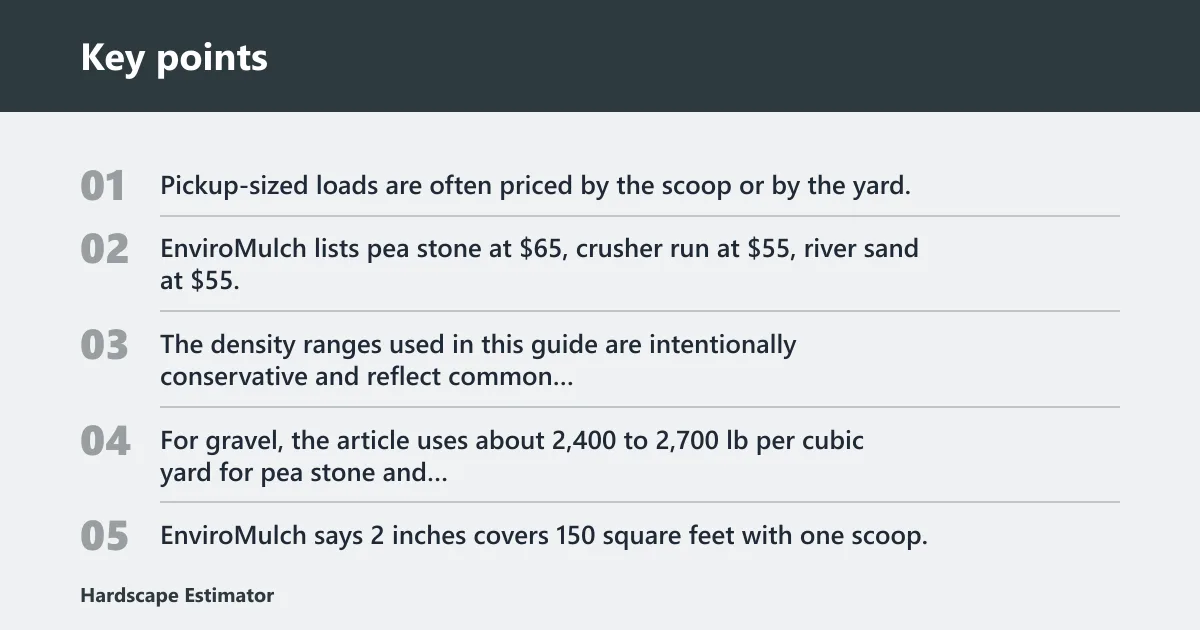
Coverage is easier to compare with thickness. EnviroMulch says 2 inches covers 150 square feet with one scoop, 3 inches covers 100 square feet with one scoop, and 4 inches covers 80 square feet with one scoop. Those numbers help translate a pickup load into project area.[1]
If a bed holds about 2 cubic yards of loose mulch, the delivered area changes with thickness. At 2 inches, the same volume covers much more ground than at 4 inches, so the order size should match the intended finish depth.
Can a pickup carry topsoil safely?
Yes, but topsoil is the easiest of the three to misjudge because moisture changes the weight fast. Screened topsoil can be safe in pickup-sized loads when dry, but damp soil can push a half-ton truck over payload quickly, even if the bed does not look full.
Dry versus wet topsoil
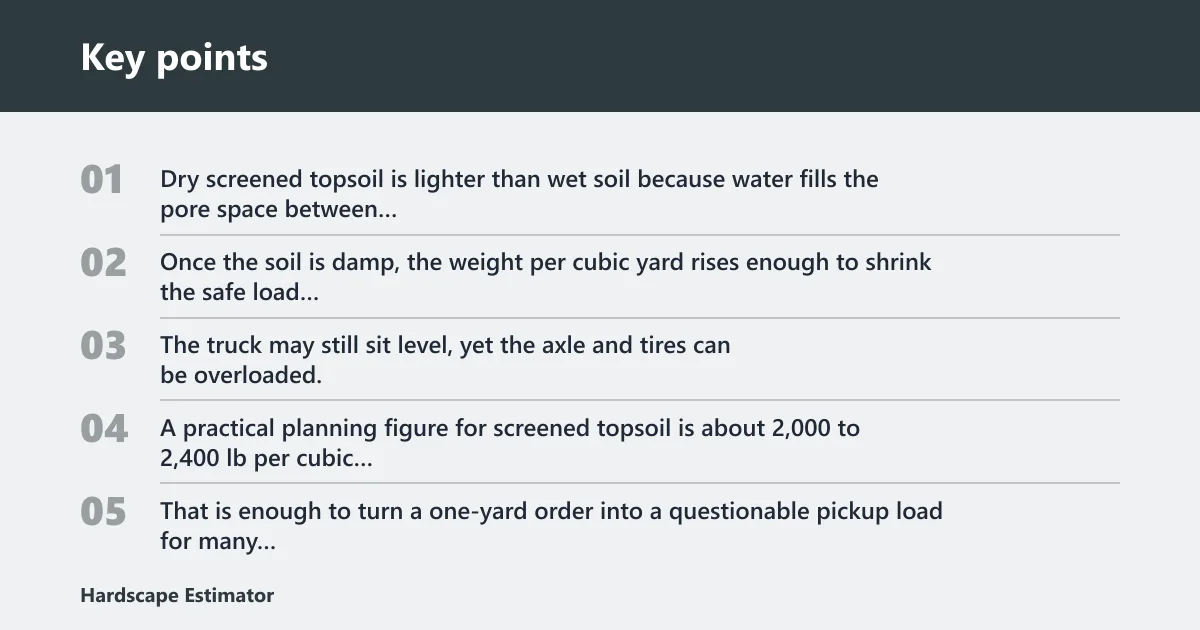
Dry screened topsoil is lighter than wet soil because water fills the pore space between particles. Once the soil is damp, the weight per cubic yard rises enough to shrink the safe load noticeably. The truck may still sit level, yet the axle and tires can be overloaded.
A practical planning figure for screened topsoil is about 2,000 to 2,400 lb per cubic yard when dry, and damp material is often closer to about 1.1 tons per cubic yard or more depending on clay content and drainage.[2] That is enough to turn a one-yard order into a questionable pickup load for many half-ton trucks.
Can a pickup carry 1 cubic yard of topsoil?
Sometimes, but not always. A one-yard load of dry screened topsoil may fit in the bed and stay within the truck’s payload on some heavier pickups. Wet topsoil is different. One yard can be too heavy for a half-ton once passengers and fuel are counted.
If the truck has a 1,500 lb payload and 300 lb of passengers, only 1,200 lb remains for soil. A yard of damp topsoil can exceed that limit, so the safer choice may be a smaller load or a trailer.
Practical load fractions for pickups
For many half-ton pickups, a safe topsoil load is often closer to 0.5 to 0.8 cubic yard than a full yard, especially if the soil is damp. Standard and long beds help with volume, but they do not change the sticker rating.
Picture a short-bed truck headed for a garden bed project after rain. The soil pile looks modest, but wet topsoil loads heavier than it appears. The driver who stops at about half a yard avoids the common mistake of judging by bed fill instead of payload.
Safe loading for stone and soil
If you’re putting stone or soil in a pickup, the key is staying within the truck’s payload and keeping the heaviest material positioned low and centered over the axles. The supporting guide explains how to estimate wet versus dry material weight, why overloading quickly affects braking and steering, and how much safety margin to leave before you head out. It also covers basic ways to secure the bed so shifting material does not create a sudden imbalance on the road.
For a practical walkthrough of load placement, weight checks, and a simple pre-drive go/no-go check, see pickup stone loading.
Pickup load calculator table
This table is a planning tool, not a substitute for the door sticker. It assumes a common light-duty pickup with roughly 1,500 to 2,000 lb of payload available after passengers and gear are counted. If your sticker is lower, use the lower end or switch to a trailer.
| Bed size | Tailgate-up usable volume | Safe loose gravel load | Safe loose mulch load | Safe topsoil load |
|---|---|---|---|---|
| Short bed | About 1.2 to 1.5 yd³ | 0.4 to 0.6 yd³ | 1.0 to 1.5 yd³ | 0.4 to 0.7 yd³ |
| Standard bed | About 1.6 to 2.0 yd³ | 0.5 to 0.8 yd³ | 1.5 to 2.0 yd³ | 0.5 to 0.8 yd³ |
| Long bed | About 2.2 to 2.7 yd³ | 0.7 to 0.9 yd³ | 2.0 to 2.7 yd³ | 0.7 to 1.0 yd³ |
| Wet-material adjustment | Use less freeboard | Reduce by 10% to 20% | Reduce by 15% to 25% | Reduce by 20% to 35% |
| Use trailer instead | Any load above sticker after passengers | Above 0.9 yd³ on half-ton trucks | Above bed volume or when wet and heavy | Above 0.8 yd³ on a loaded half-ton |
These ranges are intentionally conservative. They keep room for straps, bed liners, uneven loading, and real-world truck weight that does not show up in a bed-volume calculation.
How to calculate a safe load
- Check the door sticker payload rating.
- Subtract passengers, tools, hitch gear, and anything already in the truck.
- Choose the material density range for gravel, mulch, or topsoil.
- Divide remaining payload by pounds per cubic yard.
- Compare that number with the bed’s usable volume.
- Use the smaller number, then reduce it if the material is wet.
A common first-timer mistake is to use bed space as the only limiter. A truck can look only half full and still be over payload, especially with crusher run or damp soil.
How to choose pickup or trailer
A pickup is enough when the load stays under the sticker after passengers are counted and the material fits within bed volume without mounding high. A trailer makes more sense when the order is heavy, wet, or large enough that braking distance and axle load start to rise together.
Half-ton versus trailer decision rule
Use the pickup when the load stays comfortably below the payload limit and the material can sit low and level. Choose a trailer when you need more than about 0.9 cubic yard of gravel, when topsoil is damp, or when the truck is already carrying people and tools.
If the estimate is close, do not make it fit. The margin disappears fast once the load settles, the truck hits a bump, or the material shifts during braking.
When a small dump truck makes more sense
A small dump truck is the safer choice for repeated runs, dense stone, or larger soil orders. It also reduces the chance of overfilling a pickup bed and helps keep the load flatter, which matters for visibility and braking.
For contractors, that choice also lowers labor time. Fewer trips usually beat one overloaded trip, especially when the product is sold by the yard and the delivery charge is modest compared with the risk of damage.
Why braking and axle load matter
Payload is not only a suspension issue. Extra weight increases stopping distance, pushes more load onto the rear axle, and can exceed tire load rating even before the truck feels unstable. Wet gravel and wet soil make that problem worse because the weight climbs without much change in bed shape.
Level the load, keep the center of gravity low, and secure it before driving away. A high mound shifts during turns and braking, and that shift matters more on a loaded pickup than on an empty one.
Material pricing and delivery notes
Material pricing
Pickup-sized loads are often priced by the scoop or by the yard, and delivery minimums can change the total more than the product price does. The same source lists pea stone at $65, crusher run at $55, river sand at $55, screened top soil at $50, fill dirt at $25, and red mulch at $38.[1]
Density data
The density ranges used in this guide are intentionally conservative and reflect common hauling estimates for landscape materials.
That makes it easier to match the material price to the area being covered.[1]
Delivery minimums and surcharge examples
EnviroMulch charges a $60 minimum delivery fee. It charges $4 per mile for orders over $200 and $7 per mile for orders under $200. Those mileage charges matter on small pickup-sized orders because freight can rival the product cost.[1]
The same source says the first dump is included and charges $10 for each additional dump after the first. That makes the first load easier to budget, but it also means multiple dump runs should be planned before the truck leaves the yard.[1]
How delivery pricing affects pickup planning
If a pickup can safely haul only part of the order, the rest may need a second trip or a trailer. That second trip adds fuel, time, and sometimes another delivery fee. A larger single drop or a small dump truck may cost less overall when the material is heavy.
Use the order total, not just the yard price, when comparing options. A cheap product can become expensive once delivery minimums, mileage, and extra dump charges are added.
Frequently asked questions
How much gravel can a pickup truck carry safely?
A safe gravel load is usually limited by payload before bed volume. For many half-ton trucks, that works out to about 0.4 to 0.9 cubic yard, depending on the truck’s sticker rating and the gravel type. Crusher run and river rock reach the limit faster than pea stone.
How much mulch fits in a pickup truck bed?
Mulch is light enough that bed volume usually sets the limit first. A short bed often holds around 1 to 1.5 cubic yards, a standard bed around 1.5 to 2 cubic yards, and a long bed may take more if the payload rating still allows it.
Can a pickup truck carry 1 cubic yard of topsoil?
Sometimes, but a yard of topsoil is often too close to the limit for a half-ton pickup once passengers are counted. Dry screened soil may fit on some trucks, while damp topsoil can exceed payload quickly. The door sticker should decide, not the bed size alone.
How do I know my pickup truck payload limit?
Look at the payload sticker on the driver’s door jamb. That figure already reflects the truck’s GVWR-based limit and includes everything added to the empty truck: passengers, fuel, cargo, tools, and hitch gear. It is the number to use before loading any material.
How much does a cubic yard of gravel weigh?
It depends on the stone type, shape, and how tightly it packs.
Will wet soil or stone overload my truck?
Yes, it can. Wet topsoil is the bigger risk because water adds weight fast, but damp gravel also gains weight and settles denser. The safe approach is to reduce the planned load, especially on a half-ton truck with passengers or tools already on board.
Sources
[1] EnviroMulch pricing and coverage figures referenced in the material pricing and delivery notes: pea stone $65, crusher run $55, river sand $55, screened top soil $50, fill dirt $25, red mulch $38; coverage guidance of 2 inches = 150 square feet, 3 inches = 100 square feet, and 4 inches = 80 square feet; delivery minimum $60; $4 per mile for orders over $200; $7 per mile for orders under $200; first dump included; $10 for each additional dump.
[2] Conservative bulk-density planning ranges used for pickup hauling estimates in this article: gravel approximately 2,400 to 3,000 lb per cubic yard depending on type and compaction; mulch approximately 500 to 700 lb per cubic yard; dry screened topsoil approximately 2,000 to 2,400 lb per cubic yard, with damp material increasing substantially.
[3] Load-planning method based on standard GVWR and payload-sticker calculations: truck payload is reduced by passengers, fuel, tools, hitch gear, and cargo before comparing remaining capacity with material density and bed volume.