Why Cover Grass Seed with Straw or Peat Moss?
Cover grass seed with a thin layer only when it improves erosion control or moisture buffering: straw for slope control and light anchoring, peat moss for moisture buffering, and no cover if it would block seed-to-soil contact. Too much cover slows germination, traps seed above the soil, and can waste seed. This guide explains when to use straw or peat moss, how much to apply, and when to leave seed exposed.
What you’ll need
- Grass seed and prepared soil
- Clean wheat straw for lawn seeding, or peat moss for moisture buffering
- Rake for light smoothing and final touch-up
- Hand spreader or broadcast spreader for even distribution
- Watering can, hose nozzle, or sprinkler with a gentle spray
- Optional erosion control blanket for slopes and hillsides
Grass seed cover checklist
Use the site conditions to decide whether to cover seed, and what to use. The aim is control, not burial. Grass seed needs steady moisture and direct soil contact, so the right cover is thin enough to protect the seed without cutting it off from the seedbed.
| Site condition | Best cover | Thickness range | Failure warning |
|---|---|---|---|
| Windy, flat lawn | Wheat straw | About 1/4 to 1/2 inch | Dense mats can shade seed and reduce contact with soil. |
| Calm weather, patch repair | Peat moss | About 1/4 inch | If it is packed too deeply, seed can sit above the soil. |
| Loose topsoil with light rain risk | Wheat straw | Thin, visible layer | Heavy rain can move loose straw if the slope is steep. |
| Sandy soil, hot sun, frequent drying | Peat moss | About 1/4 inch | Dry peat moss can turn water-repellent and stop absorbing evenly. |
| Steep slope or hillside | Erosion control blanket | Installed snugly to the surface | Loose straw can slide or blow off before roots take hold. |
| Full-lawn seeding with decent soil contact | Often none, or a very thin layer | Keep seed visible in places | Too much cover can block germination instead of helping it. |
| Overseeding patch in a small area | Peat moss or light straw | Lower volume than a full lawn | Extra mulch can hide seed instead of protecting it. |
Why cover grass seed?
Covering helps grass seed hold moisture, stay in place, and avoid being eaten by birds or moved by wind and runoff. It helps when the seedbed dries fast or when rain could carry seed away. If the seed already has firm soil contact and the weather is calm, a cover is optional.
What the cover does
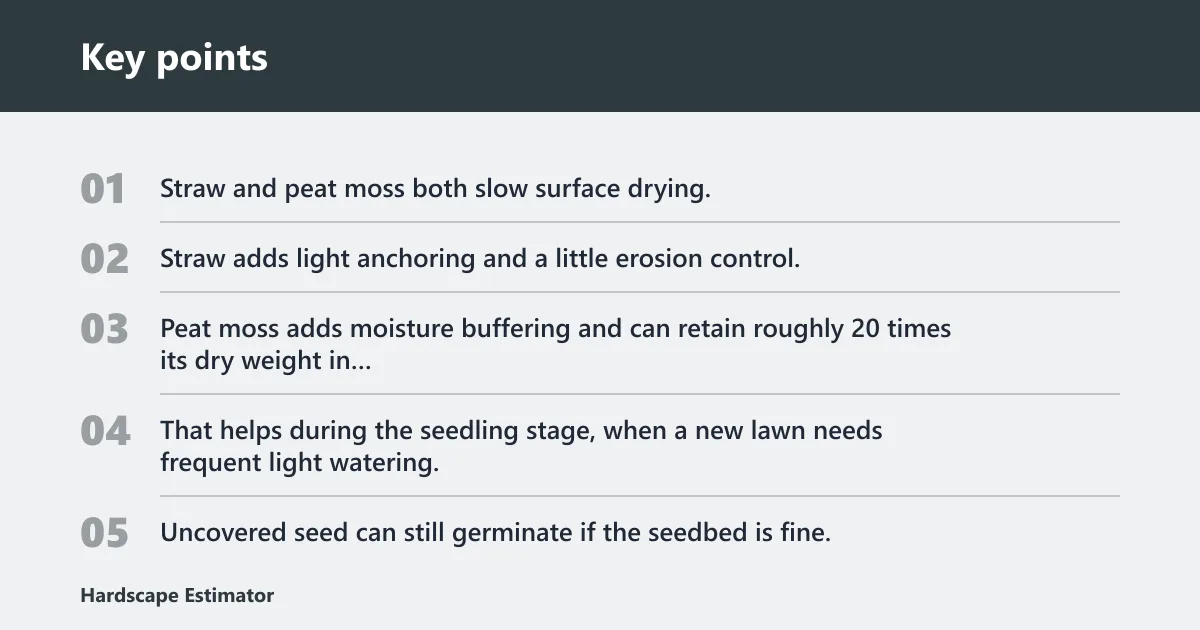
Straw and peat moss both slow surface drying. Straw adds light anchoring and a little erosion control. Peat moss adds moisture buffering and can retain roughly 20 times its dry weight in water, according to common horticulture references used by university extension programs. That helps during the seedling stage, when a new lawn needs frequent light watering.
When uncovered seed can still work
Uncovered seed can still germinate if the seedbed is fine, the seed is pressed into the soil, and watering stays steady. A bare, sheltered patch with good soil contact may not need mulch at all. In that case, adding a thick layer creates a new problem: the seed stays off the soil.
How do you choose straw or peat moss?
Choose straw when you need light anchoring, wind protection, or mild erosion control. Choose peat moss when moisture retention matters more than surface anchoring, especially on patch repairs and drier topsoil. Skip both if the layer would bury the seed or keep it from touching the soil.
Use straw for light anchoring
Wheat straw is the preferred straw type for lawn seeding. University extension guidance commonly recommends a thin straw layer rather than a mat, usually in the 1/4- to 1/2-inch range. That is a light mulch cover, not a blanket of loose fiber. Too much straw can suffocate seed.
Use peat moss for moisture buffering
Peat moss can be used to cover grass seed during a new lawn or bare spots. It protects seed from wind, rain, and birds, and the usual application is about 1/4 inch. It helps where moisture is the main issue, but it can become hydrophobic when it dries out, so it needs steady watering.
Skip both when the layer would block soil contact
Grass seed must touch soil. If the top layer is so fluffy that seed sits in it instead of on it, germination drops. That failure is more common on small, overworked patches where people try to “help” by piling on extra mulch.
How do you apply the cover?
Apply the seed first, then add only a thin, even cover. Keep some seed visible after spreading the cover. Water lightly and often so the top inch stays damp without washing seed downhill or puddling the surface.
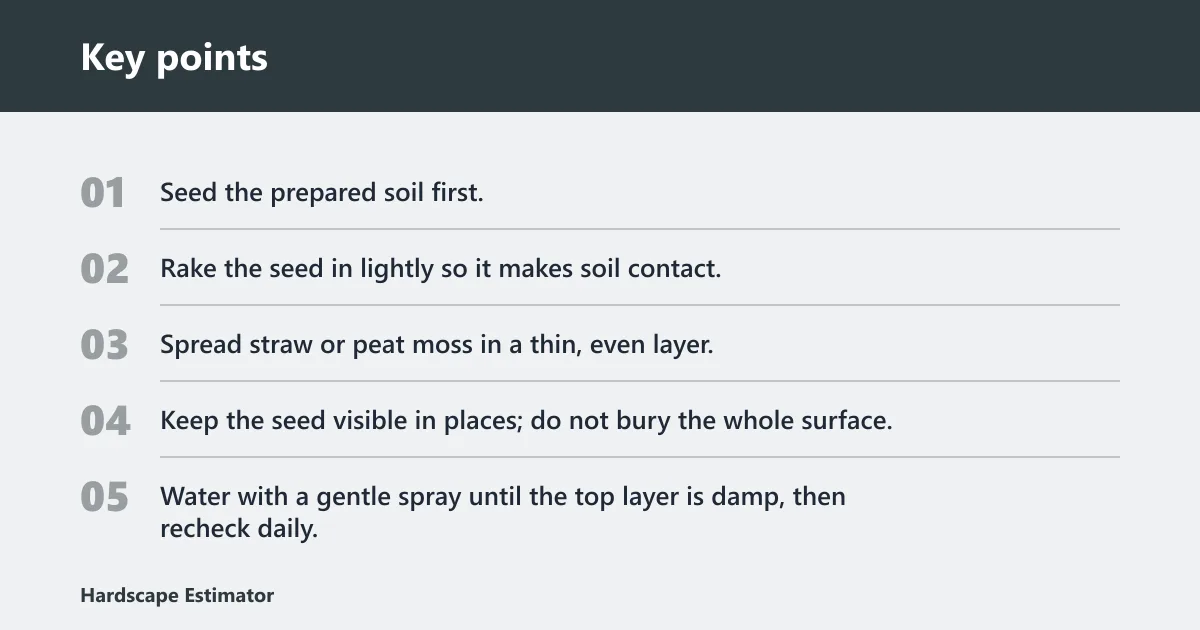
- Seed the prepared soil first.
- Rake the seed in lightly so it makes soil contact.
- Spread straw or peat moss in a thin, even layer.
- Keep the seed visible in places; do not bury the whole surface.
- Water with a gentle spray until the top layer is damp, then recheck daily.
For a full lawn, aim for even coverage across the area. For bare spots or overseeding patches, use less material than you would on a larger seeding job. Say the patch is about 50 square feet and the seed is still visible after a light pass. Stop there. If you cannot see any seed at all, the layer is already too heavy.
Suppose a front slope of about 1,000 square feet gets a windy afternoon and light rain the next day. Straw can help hold the seed in place if the slope is mild and the layer stays thin. If the slope is steep enough that loose straw starts moving, switch to an erosion control blanket instead of adding more straw.
Failure case: On a newly seeded backyard bank, a homeowner spread peat moss too thickly after a dry spell. The surface looked protected, but the peat formed a tight crust in spots after the first watering and then repelled water when it dried again. The result was uneven germination: some seed stayed too dry, while other areas stayed suspended in the mulch instead of rooting into the soil. A thinner layer, plus gentler and more frequent watering, would have kept the seedbed open and evenly moist.
Common mistakes
The biggest errors are using the wrong material, using too much of it, and watering too hard. These mistakes matter because seed needs moisture and soil contact at the same time. A cover that solves one problem can create another if it is applied too thickly.
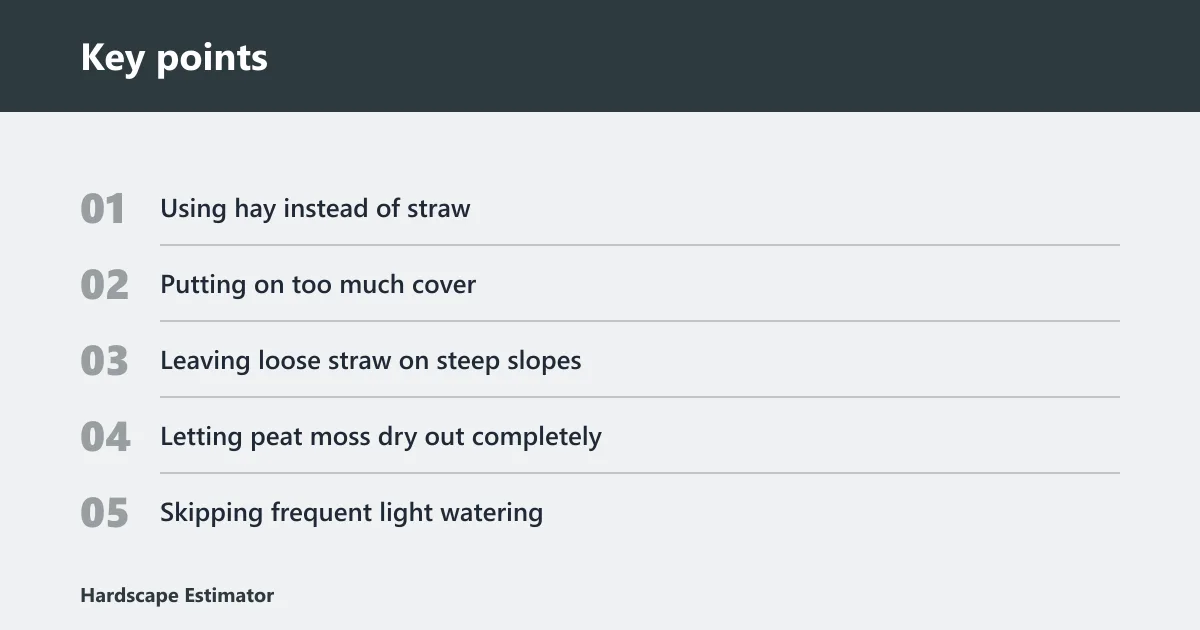
- Using hay instead of straw: Hay should not be used on lawns because it can contain weed seeds. A clean wheat straw bale is the safer choice.
- Putting on too much cover: A thick layer can block seed-to-soil contact and slow germination. Thin is the rule.
- Leaving loose straw on steep slopes: Hillsides have higher erosion risk. Straw alone may move, so an erosion control blanket is often the better choice.
- Letting peat moss dry out completely: Dry peat moss can turn water-repellent. Once that happens, watering becomes less effective until the surface is rewetted carefully.
- Skipping frequent light watering: New lawn seed needs steady moisture. Heavy watering can move seed; light, repeated watering keeps the surface damp without washout.
A common first-timer mistake is to cover a bare spot so heavily that the seed disappears under a fluffy layer. A better approach is to spread just enough to break the wind, hold moisture, and still leave seed touching soil. If the cover looks like a blanket, it is probably too much.
Do slopes need something different than loose straw?
Yes. Steep slopes and hillsides often need more than loose straw because runoff and wind can move the material before seedlings root. Erosion control blankets are ideal for slopes, and a biodegradable jute mesh option gives extra stabilization while still breaking down over time.
When a blanket makes more sense
If rain can run downhill in channels, a blanket is the better control choice. Straw can still help on mild grades, but it is not a fix for a steep bank. The practical rule is simple: if the site needs the cover to stay put against gravity, use a blanket instead of relying on loose fibers.
Frequently asked questions
Should you cover grass seed with straw?
Yes, when the site needs a light mulch to reduce drying or keep seed from shifting. Straw is most useful where wind or light runoff can move seed, but the layer should remain thin enough for the seed to still make soil contact. On protected, evenly raked soil, it is optional rather than required.
Is peat moss good to cover grass seed?
Yes, especially on small repairs where moisture loss is the main concern. Peat moss is better for buffering dry periods than for anchoring seed, so it works best when the surface is calm and the seedbed has already been lightly raked in. It is not the best choice for slopes.
Can I use straw to cover grass seed?
Yes. Wheat straw is the preferred straw type for lawn seeding, and a thin layer works as an effective mulch. Keep it light enough that the seed is still visible in places. A thick mat can slow germination and trap seed above the soil.
What kind of straw to cover grass seed?
Choose clean wheat straw. It is the standard option for lawn seeding because it is light, easy to spread, and less likely to carry weed seed than hay. Avoid mixed bales or anything that looks heavy, coarse, or full of seed heads.
How thick should straw or peat moss be over grass seed?
Straw should stay thin, around 1/4 to 1/2 inch, and peat moss should be about 1/4 inch. Those ranges are enough to help with moisture and movement without blocking soil contact. If the seed disappears completely, the layer is too thick.
Can hay be used instead of straw on grass seed?
No. Hay should never be used on lawns because it can contain weed seeds. If straw is unavailable, wait for a clean wheat straw bale or use peat moss on smaller areas instead of reaching for hay.
When should you remove straw from new grass seed?
Usually, there is no need to remove it right away. Thin straw can be left to break down, or raked lightly later if clumps remain after establishment. The key is not to strip away cover while seedlings still need moisture protection.
Will grass seed grow if not covered?
Yes, if it has firm soil contact and the seedbed stays evenly moist. Cover is a helper, not a requirement. In calm weather on a smooth patch, uncovered seed can do fine. In wind, on slopes, or during drying weather, a thin cover helps more.