Gabion Basket Calculator: Stone Weight and Tonnage
A gabion basket calculator uses basket volume × packed fill density, not solid-rock density; a practical starting rule is roughly 1.4 to 1.5 tons per cubic yard of tightly packed gabion stone. Using the wrong density can over-order stone and push freight costs up fast. This guide shows the volume formula, packed-fill tonnage math, and a worked example for baskets, walls, and erosion-control builds.
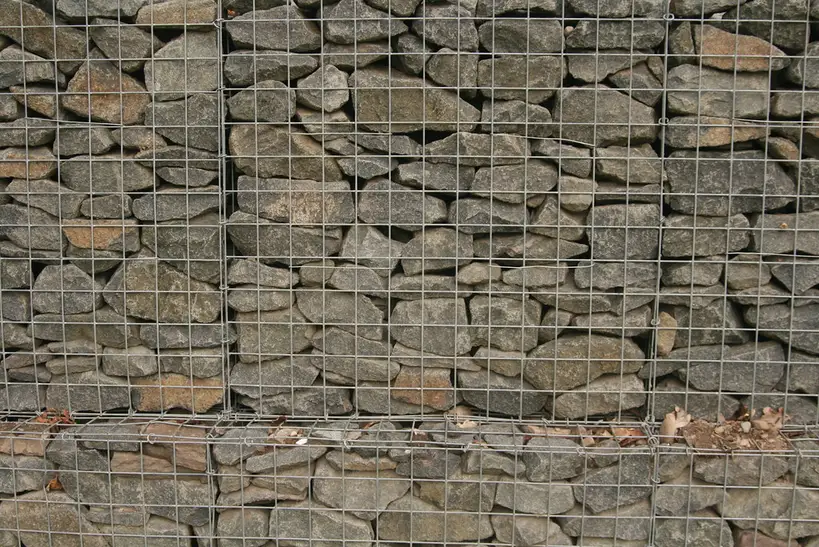
A gabion basket is a wire mesh box filled with stone. It is used for retaining walls, garden walls, erosion control, drainage, landscaping, and decorative structures. The estimating job is not just counting cubic volume. It is turning basket size into a realistic stone order after voids, packing method, and waste are considered.
What is a gabion basket calculator?
The common mistake is treating a basket like a solid block of rock. It is not solid. Stone bridges across air gaps, so the basket holds less mass than a same-size block of intact stone. That difference is what separates a usable takeoff from an oversized delivery ticket.
Why estimating by basket volume matters
Basket volume is the starting point because the basket sets the maximum space available for fill. A 1 × 1 × 1 metre basket holds 1 cubic metre. A 2 × 1 × 1 m basket holds about 2 cubic metres, and a 3 × 1 × 1 m basket holds about 3 cubic metres before voids are counted.
Once volume is known, the order estimate becomes a conversion problem. The packed-fill density of gabion stone is lower than solid rock density, so the same basket volume does not weigh like a solid block. That gap is exactly why a gabion basket calculator needs a packed-fill assumption.
Standard gabion mesh has a 50 mm aperture.
How do you calculate gabion basket fill?
Calculate gabion fill by finding basket volume from length × width × height, then converting that volume to packed stone tonnage. A 2 m × 1 m × 1 m basket has a volume of about 2 cubic metres, and a filled-weight estimate can be around 3 tonnes or a bit more, depending on the stone and packing. The math changes with basket size, unit system, and packing method.
Measure length, width, and height
Use the outside basket dimensions specified for the order. For metric baskets, multiply metres by metres by metres. For imperial work, multiply feet by feet by feet to get cubic feet, then convert to cubic yards if the supplier prices that way. The calculator should keep the unit path visible.
For the example basket of 2 m × 1 m × 1 m, the volume is 2 cubic metres. With a packed-density assumption of about 1.6 tonnes per cubic metre, the fill estimate is 3.2 tonnes. That figure matches the standard example used for this basket size.
Use cubic volume for one basket or many baskets
Total basket volume is basket count × single-basket volume. If a wall uses six 1 × 1 × 1 m baskets, the total volume is 6 cubic metres. If the same wall uses three 2 × 1 × 1 m baskets, the total is also 6 cubic metres, though handling and delivery may differ.
That is where a takeoff sheet helps. It lets the estimator see whether the project needs several small baskets or fewer large ones. The stone tonnage may be similar, but ordering, loading, and on-site placement can change the practical purchase plan.
Convert volume into stone tonnage
For metric estimating, a common packed density assumption is about 1.6 tonnes per cubic metre. That means a 1 × 1 × 1 m basket takes about 1.6 tonnes of rock, and a 2 × 1 × 1 m basket takes about 3.2 tonnes. For imperial estimating, the page recommends roughly 1.5 tons per cubic yard.
| Basket size | Volume | Packed fill estimate |
|---|---|---|
| 1 × 0.5 × 0.5 m | 0.25 m³ | About 0.4 tonnes |
| 1 × 1 × 1 m | 1 m³ | About 1.6 tonnes |
| 2 × 1 × 1 m | 2 m³ | About 3.2 tonnes |
| 3 × 1 × 1 m | 3 m³ | About 4.8 tonnes |
Why solid-rock density gives the wrong order
Solid-rock density is the density of intact stone with almost no air gaps. Packed gabion fill includes voids between pieces, so the same basket volume weighs less than a solid block. Using solid density for ordering usually overstates tonnage and can push the order above what the project actually needs.
Solid density versus packed basket density
A gabion calculator should separate two ideas: the density of the rock itself and the density of the filled basket. The first is a material property of the stone. The second is a packing result, shaped by stone size, shape, and how tightly the basket is filled.
The packed density assumption is about 1.6 tonnes per cubic metre. The page says gabions use about 40% void space, and typical void factor guidance ranges from 25% to 45% depending on packing. That range explains why two baskets of the same size can order differently.
How void factor changes the final tonnage
Void factor is the share of the basket volume that remains air. Higher void factor means lighter fill per cubic metre. Lower void factor means denser packing and a heavier order. For estimating, a midrange assumption is safer than a single rigid number, especially where stone size varies.
Hand-packing usually closes voids better than loose dump-filling. Dump-filling can leave larger air gaps and more irregular seating. The result is not just a visual difference. It can change the amount ordered, the number of trips, and the amount of excess stone left after closing the final lid.
Why hand-packing and dump-filling do not weigh the same
Hand-packing generally settles the face stones and corners more tightly. Loose dump-filling can bridge and trap air. That is why one calculator should allow a void-factor selector rather than forcing a single answer. The same basket can consume different tonnage depending on method.
For practical estimating, use tighter packing for exposed decorative walls and looser assumptions where baskets are filled more quickly or irregular rock is being placed. The point is not to chase exactness to the kilogram. The point is to avoid buying stone for empty space that will never exist.
What stone size and mesh opening should you use?
Gabion fill should use angular rock that is larger than the mesh opening and sized to interlock well. Standard gabion mesh commonly has a small aperture, and gabion fill often uses angular rock in a size range roughly around 70 to 150 mm. That combination reduces stone loss and helps the basket hold shape.
Mesh aperture and rock size compatibility
The rule is simple: rock must be larger than the opening. With a 50 mm aperture, undersized stone can escape through the mesh or sit too loosely in the basket. If the rock is close to the opening size, order risk rises because smaller fragments can migrate during handling.
Mesh opening matters to estimating because undersized stone can force rework or extra material. A basket filled with rock that is too small may settle more, leak through the mesh, or create a less stable face. The order should start with the mesh specification, not the other way around.
Why angular stone is the safer estimating choice
Angular rock locks together better than rounded stone. It creates more friction, less rolling, and better internal stability. Rounded cobble can leave larger voids and may bulge the mesh face if the basket is packed loosely. That can change both the look and the material demand.
For most estimating workflows, angular rock in the 70 to 150 mm working range is the clearest starting point. It fits the standard mesh rule, resists migration, and gives a more predictable packed density than smooth stone of the same nominal size.
Typical working stone sizes for gabions
The nominal size has to suit the aperture and the basket face. Smaller pieces can fill gaps inside the basket, but the main fill should still be large enough to stay contained. For a 50 mm aperture, the 70 to 150 mm range is the practical working band stated on this page.
For decorative walls, tighter grading and more careful face selection may be used. For erosion-control baskets, the priority is containment and mass. For retaining walls, the fill should be angular and consistently sized enough to reduce settlement and keep the basket profile.
How much extra stone should you order?
Add extra stone for settlement, breakage, and small losses during handling. A common allowance is 5% to 15%, and the page’s calculator example uses 10% to 15% extra for settlement. That buffer helps avoid short loads and protects against batch variation.
Waste allowance for settlement and breakage
Waste allowance is not the same as void factor. Void factor describes how much of the basket is air after fill. Waste allowance covers breakage, placement losses, and the extra stone needed to finish the top course without running short. Both should be included in the order plan.
Delivery buffer and leftover planning
Stone is commonly sold and hauled by tonnage, so a small underestimate can create a second delivery round. A modest buffer may cost less than a repeat haul. A larger buffer makes sense where the basket count is high, the site is hard to access, or the grading is inconsistent.
Leftover planning matters too. If the order is built on the low end of void assumptions, some stone may remain after closing the final basket. That is normal. The better question is whether the buffer is cheaper than a return trip or project delay.
When a larger buffer makes sense
Use the higher end of the 5% to 15% range when baskets are large, when the wall has many cut pieces, or when hand-packing is not consistent. Use a smaller buffer only when the basket count is low, the stone source is reliable, and delivery space is limited.
Gabion takeoff sheet: standard sizes, packed tonnage, and common mistakes
A one-page gabion takeoff sheet should list standard basket sizes, a void-factor selector, packed-fill tonnage ranges, and a common mistake checklist. That layout keeps the estimator focused on the difference between solid density and packed density instead of defaulting to one generic number.
| Basket size | Volume | Packed fill range | Notes |
|---|---|---|---|
| 1 × 0.5 × 0.5 m | 0.25 m³ | About 0.35 to 0.45 tonnes | Small wall or cap section |
| 1 × 1 × 1 m | 1 m³ | About 1.4 to 1.7 tonnes | Standard reference basket |
| 2 × 1 × 1 m | 2 m³ | About 2.8 to 3.4 tonnes | Common wall module |
| 3 × 1 × 1 m | 3 m³ | About 4.2 to 5.1 tonnes | Long run or tiered wall |
Void-factor selector for quick ordering
Use a lower void factor for tighter hand-packing and a higher one for looser placement. A practical selector can show 25%, 35%, and 45% as the main choices. That lets the estimator see how tonnage shifts without hiding the packing assumption.
A simple workflow is: select basket size, choose void factor, apply waste allowance, then round the result to a deliverable tonnage. That is enough detail for most quotes and purchase orders without making the sheet hard to use.
Common ordering mistake checklist
- Using solid-rock density instead of packed gabion density.
- Ignoring the 50 mm mesh aperture when choosing stone size.
- Specifying rounded cobble where angular rock is needed.
- Forgetting the 5% to 15% waste allowance.
- Skipping the void-factor choice for hand-packing versus dump-filling.
- Ordering by basket count only, without converting to tonnage.
What standards apply to gabion mesh and wire?
ASTM-A974 and ASTM-A975 are the standards context most estimators should confirm before ordering mesh. They matter because the mesh type, wire specification, and basket build affect durability and compatibility. For takeoff work, the standard helps define what product is being priced.
Why mesh type matters for estimating and specification
Mesh type affects stiffness, opening consistency, and product naming. GabionSupply says its standard gabions are made in accordance with ASTM-A975 and ASTM-A974. That does not replace a project spec, but it is a useful reminder that welded wire and twisted wire baskets are not identical products.
For estimating, the key is to match the basket specification to the intended use. A retaining wall, erosion-control installation, or decorative feature may use different wire construction, even if the stone tonnage formula is similar.
What to confirm before you place an order
Confirm basket dimensions, mesh aperture, wire standard, fill stone size, packing method, and whether the quote is by tonne, cubic metre, or basket. Those six items control most of the ordering error. If any one is missing, the takeoff can drift fast.
Frequently asked questions
What size gabion basket do i need
The right basket size depends on wall height, run length, and whether the project is a retaining wall, erosion-control line, or decorative structure. Start with the required dimensions, then match a standard basket such as 1 × 0.5 × 0.5 m, 1 × 1 × 1 m, 2 × 1 × 1 m, or 3 × 1 × 1 m.
How do gabion baskets work
Gabion baskets work by holding stone in a wire mesh container so the mass of the rock resists movement, spreads load, and allows drainage through the voids. The structure depends on basket size, mesh strength, stone size, and how tightly the fill is packed.
What is a gabion basket
A gabion basket is a wire mesh box filled with stone and used for retaining walls, erosion control, landscaping, drainage, and decorative structures. Its estimating value comes from being a defined volume that can be converted to a realistic stone order once packing losses are included.
How much stone do I need to fill a gabion basket
Stone quantity depends on basket volume and packed density. A 1 × 1 × 1 m basket takes about 1.6 tonnes of rock, and a 2 × 1 × 1 m basket takes about 3.2 tonnes. Add extra if the packing is loose or the project needs a delivery buffer.
What stone size should I use for gabions
Use angular rock between 70 and 150 mm for the working fill range, and keep the stone larger than the mesh opening. With standard gabion mesh at 50 mm aperture, undersized material can escape or settle too much, so the stone should be clearly larger than the opening.
How do I calculate gabion basket fill by tonnage
Multiply basket volume by packed density, then add waste allowance. A common starting density is about 1.6 tonnes per cubic metre, and the page recommends roughly 1.5 tons per cubic yard in imperial units. After that, add 5% to 15% for settlement and losses.
How much does a standard gabion basket weigh when filled
A standard 1 × 1 × 1 metre basket holds 1 cubic metre and takes about 1.6 tonnes of rock when filled. A 2 × 1 × 1 m basket takes about 3.2 tonnes. The exact filled weight depends on stone size, void factor, and how tightly the basket is packed.