Bagged Mulch: How Much to Buy, Cost, and Best Uses
A 2-cu-ft bag of mulch covers about 12 sq ft at 2 in. deep or about 8 sq ft at 3 in., so bagged mulch usually makes sense for small or scattered beds, while bulk is often cheaper once you need about 1 cubic yard or more. Buy too little and depth falls below the range that helps block weeds. Buy too much and bagged mulch often costs about 2 to 4 times as much as bulk mulch by volume. This guide shows the exact bag-count math from bed size and depth, then compares bagged and bulk costs by project.
Bagged mulch buying basics
Calculate volume first, then compare products and prices. Bagged mulch is sold by the cubic foot, and a typical bag holds 2 cubic feet of mulch. That makes 2-cu-ft bags the clearest baseline for estimating, price comparison, transport planning, and checking whether bulk pricing beats bags on the full project.
What bagged mulch usually contains
The label volume matters more than the name on the front. Most mulch bags are listed in cubic feet, not by covered area, because coverage changes with depth. Spread the same material deeper, and it covers fewer square feet.
The common reference points are simple:
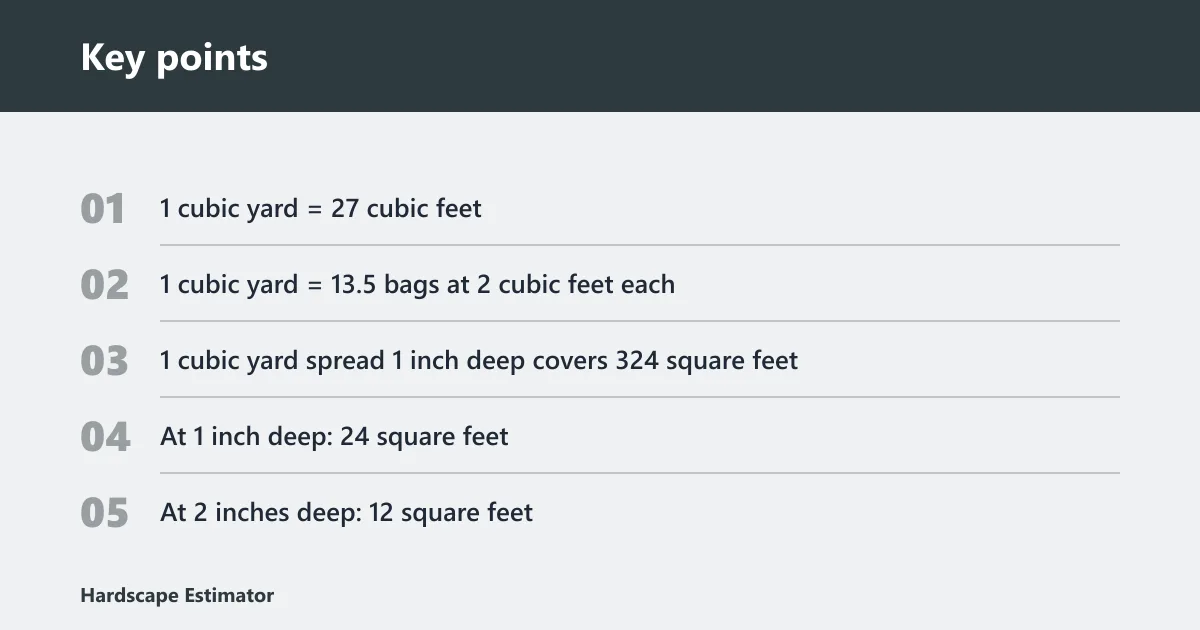
- 1 cubic yard = 27 cubic feet
- 1 cubic yard = 13.5 bags at 2 cubic feet each
- 1 cubic yard spread 1 inch deep covers 324 square feet
Use these three conversions to move between bags, cubic feet, and bulk-yard pricing. Once you know bed size and target depth, the rest comes from the same volume math.
Why 2-cu-ft bags are the main estimating baseline
A typical bag holds 2 cubic feet of mulch, so it converts cleanly to bulk-yard pricing and project coverage. For example, 10 bags is 20 cubic feet. Divide by 27, and that is 0.74 cubic yard. Then check the spread depth, and the project size is easy to verify.
Coverage from one 2-cu-ft bag:
- At 1 inch deep: 24 square feet
- At 2 inches deep: 12 square feet
- At 3 inches deep: 8 square feet
When bagged mulch is the practical choice
Bagged mulch fits small beds, touch-up work, scattered planting areas, and jobs where leftovers need to stay clean and stackable. It also helps when the total need is below a full cubic yard, when access is tight, or when ordering a truckload would leave a large pile to manage.
Mulch type still affects handling. Two bags with the same labeled volume can feel very different because moisture content and material vary. That changes carrying effort and settling after spreading, but it does not change the listed cubic-foot volume used for estimating.
How much bagged mulch do you need?
Multiply square footage by depth in feet to get cubic feet needed, then divide by bag size. For inches, use square feet × depth in inches ÷ 12. A 100-sq-ft bed at 2 inches needs about 16.67 cubic feet, which is about 8.34 bags at 2 cubic feet each, so the buy list rounds to about 9 bags.
The formula that converts beds into bags
Use this formula:
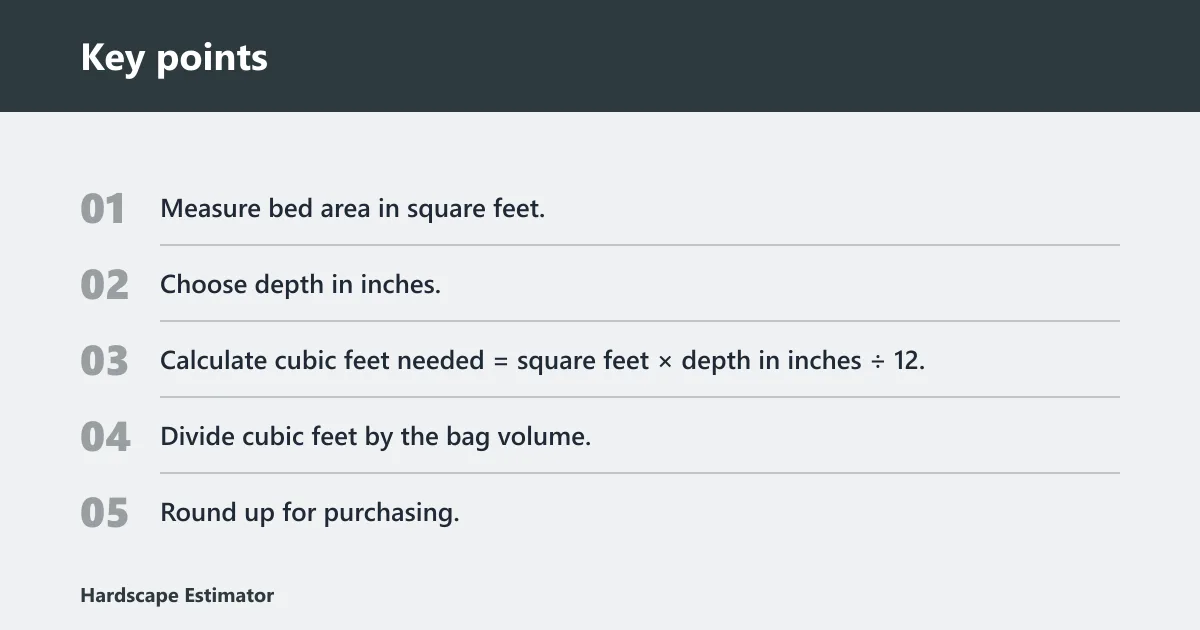
- Measure bed area in square feet.
- Choose depth in inches.
- Calculate cubic feet needed = square feet × depth in inches ÷ 12.
- Divide cubic feet by the bag volume.
- Round up for purchasing.
Worked example: 50 square feet at 3 inches deep.
50 × 3 ÷ 12 = 12.5 cubic feet of mulch needed.
For 2-cu-ft bags: 12.5 ÷ 2 = 6.25 bags, so buy 7 bags.
For 1.5-cu-ft bags: 12.5 ÷ 1.5 = 8.33 bags, so buy 9 bags.
For 1-cu-ft bags: 12.5 ÷ 1 = 12.5 bags, so buy 13 bags.
When to round up
Round up in nearly every case. Bed edges, root flares, uneven grade, and loose spreading make exact coverage hard to hit. The main exception is a light refresh where old mulch remains in place and the goal is to top up, not build full depth from bare soil.
Say your front foundation bed measures 96 square feet and still has a thin layer left from last season. At 1 inch, the math is 96 × 1 ÷ 12 = 8 cubic feet. That is exactly 4 bags at 2 cubic feet each. On a clean rectangle, 4 may do it. On a curved bed with edging, 5 is safer.
How much extra to buy
For clean, square beds, the round-up bag is usually enough. For irregular beds, tree rings, or several disconnected spots, the extra bag matters more because edge spill and small height changes add up. A small overbuy usually costs less than making a second trip.
Mulch buying table
This table converts common project sizes directly into cubic feet and bag counts. Exact bag counts are shown first, then the purchase count should be rounded up. For quick comparison, the same project is listed for 1-cu-ft, 1.5-cu-ft, and 2-cu-ft bags.
| Area | Depth | Cubic feet needed | 1-cu-ft bags | 1.5-cu-ft bags | 2-cu-ft bags |
|---|---|---|---|---|---|
| 50 sq ft | 1 in. | 4.17 cu ft | 4.17 | 2.78 | 2.09 |
| 100 sq ft | 1 in. | 8.33 cu ft | 8.33 | 5.56 | 4.17 |
| 200 sq ft | 1 in. | 16.67 cu ft | 16.67 | 11.11 | 8.34 |
| 500 sq ft | 1 in. | 41.67 cu ft | 41.67 | 27.78 | 20.84 |
| 50 sq ft | 2 in. | 8.33 cu ft | 8.33 | 5.56 | 4.17 |
| 100 sq ft | 2 in. | 16.67 cu ft | 16.67 | 11.11 | 8.34 |
| 200 sq ft | 2 in. | 33.33 cu ft | 33.33 | 22.22 | 16.67 |
| 500 sq ft | 2 in. | 83.33 cu ft | 83.33 | 55.56 | 41.67 |
| 50 sq ft | 3 in. | 12.5 cu ft | 12.5 | 8.33 | 6.25 |
| 100 sq ft | 3 in. | 25 cu ft | 25 | 16.67 | 12.5 |
| 200 sq ft | 3 in. | 50 cu ft | 50 | 33.33 | 25 |
| 500 sq ft | 3 in. | 125 cu ft | 125 | 83.33 | 62.5 |
To turn exact counts into a shopping list, round up:
- 100 sq ft at 2 inches: buy 9 bags of 2-cu-ft mulch
- 200 sq ft at 2 inches: buy 17 bags
- 100 sq ft at 3 inches: buy 13 bags
- 500 sq ft at 3 inches: buy 63 bags
Calculate the mulch break‑even point
Knowing when bagged mulch stops being economical saves you $50‑$150 on every project. The guide walks you through the exact volume where bulk mulch becomes cheaper, factoring delivery fees, bag sizes, hauling effort, and the risk of leftover material. It shows how many 2‑cu‑ft bags equal a cubic yard, illustrates cost examples for different project sizes, and highlights hidden expenses that can tip the balance. Use the calculations to decide whether to skip the truck fee and stay with bags or to order bulk once you pass the bulk mulch savings threshold.
How much area does a 2 cu ft bag of mulch cover?
A 2-cu-ft bag covers 24 sq ft at 1 inch, 12 sq ft at 2 inches, and 8 sq ft at 3 inches. Those figures come straight from volume math, not package claims: 2 cubic feet spread over the bed area, with depth converted from inches to feet.
Coverage at common depths
The formula is area = cubic feet ÷ depth in feet.
At 1 inch, depth in feet is 1 ÷ 12. So 2 ÷ (1 ÷ 12) = 24 square feet.
At 2 inches, depth in feet is 2 ÷ 12. So 2 ÷ (2 ÷ 12) = 12 square feet.
At 3 inches, depth in feet is 3 ÷ 12. So 2 ÷ (3 ÷ 12) = 8 square feet.
Why a bag can look short after spreading
Mulch can settle, and a fluffy-looking bag can spread thinner than expected if the target depth is guessed by eye. That is why bag labels with broad coverage ranges often lead to underbuying. The better method is to set the depth first, then calculate from cubic feet.
Picture a 24-sq-ft tree ring. One 2-cu-ft bag may sound like enough because the area sounds small. At the proper 3-inch first application around trees and shrubs, that ring needs 24 × 3 ÷ 12 = 6 cubic feet. One bag covers only one-third of the need.
How many bags equal one cubic yard?
One cubic yard equals 27 cubic feet, so it equals 13.5 bags when each bag contains 2 cubic feet. That conversion is the key price check for any mulch purchase, because bulk mulch is sold by the cubic yard while bagged mulch is sold by the cubic foot.
Quick bag-to-yard conversions
- 1-cu-ft bags: 27 bags = 1 cubic yard
- 1.5-cu-ft bags: 18 bags = 1 cubic yard
- 2-cu-ft bags: 13.5 bags = 1 cubic yard
That means 14 bags of 2-cu-ft mulch slightly exceeds a cubic yard, at 28 cubic feet total.
Using cubic-yard coverage
A cubic yard of mulch spread 1 inch deep covers 324 square feet. From there:
- At 2 inches deep: 162 square feet per cubic yard
- At 3 inches deep: 108 square feet per cubic yard
Those figures match the bag math. If one cubic yard is 13.5 bags of 2-cu-ft mulch, then 13.5 bags at 3 inches cover 108 square feet, and each bag covers 8 square feet.
What depth should you spread mulch?
Flower and garden beds generally need 1 to 2 inches of mulch, while around trees and shrubs, the first application averages 3 inches deep. Going thicker can trap moisture, limit oxygen movement into the root zone, and encourage shallow root growth, especially when mulch is mounded against trunks.
Depth for flower and garden beds
For most flower and garden beds, 1 to 2 inches is the target range. One inch works for refreshes where some mulch is still in place. Two inches works better where coverage is thin, weeds are pushing through, or bare soil is still visible between plants.
Depth for trees and shrubs
Around trees and shrubs, the first application averages 3 inches deep. That takes more material than many homeowners expect, which is one reason tree rings often end up under-mulched when bought by guesswork instead of volume.
Keep mulch back from trunks
Mulch should be pulled back about 6 inches from tree trunks. That open space reduces the risk of trunk rot and insect problems. It also keeps the base visible so the mulch forms a broad ring, not a cone piled against bark.
What happens with too much mulch
Too much mulch can cause shallow root growth and moisture problems. Roots tend to stay near the surface when oxygen and water conditions are poor below a thick layer, and constantly damp bark at the trunk flare is a common setup for decline.
A common first-timer mistake is building a 5-inch mound around a young tree because extra bags are left over. The bed may look tidy at first, but the trunk stays too wet and the root zone gets less air. The fix is simple: spread the excess wider, not deeper.
Bagged mulch cost vs bulk cost
Total project cost decides this, not sticker price per bag. Budget-grade wood mulch can cost about $3 per 2-cubic-foot bag, and quality hardwood or dyed-wood mulch can cost up to $7 per bag. Budget-quality bulk mulch can cost less than $25 per cubic yard, while top-grade cedar or cypress mulch costs around $45 per cubic yard.
Cost by volume
Using the stated prices:
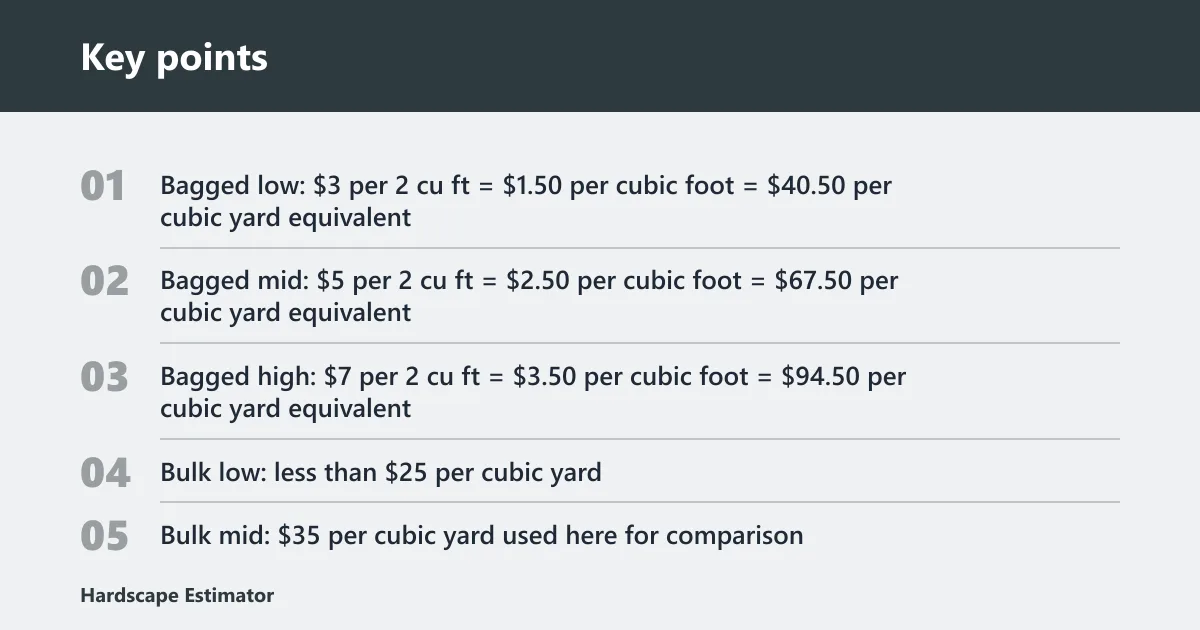
- Bagged low: $3 per 2 cu ft = $1.50 per cubic foot = $40.50 per cubic yard equivalent
- Bagged mid: $5 per 2 cu ft = $2.50 per cubic foot = $67.50 per cubic yard equivalent
- Bagged high: $7 per 2 cu ft = $3.50 per cubic foot = $94.50 per cubic yard equivalent
- Bulk low: less than $25 per cubic yard
- Bulk mid: $35 per cubic yard used here for comparison
- Bulk high: $45 per cubic yard
Bagged mulch is usually the higher-cost material by volume. The real question is whether convenience, cleaner storage, and smaller buy quantities offset that premium on the actual project.
Project cost estimator
| Project | Mulch needed | Bagged low | Bagged mid | Bagged high | Bulk low + $50 delivery | Bulk mid + $50 delivery | Bulk high + $50 delivery |
|---|---|---|---|---|---|---|---|
| 50 sq ft at 2 in. | 8.33 cu ft / 4.17 bags / 0.31 yd | $15 for 5 bags | $25 for 5 bags | $35 for 5 bags | $57.72 | $60.80 | $63.89 |
| 100 sq ft at 2 in. | 16.67 cu ft / 8.34 bags / 0.62 yd | $27 for 9 bags | $45 for 9 bags | $63 for 9 bags | $65.43 | $71.61 | $77.78 |
| 200 sq ft at 2 in. | 33.33 cu ft / 16.67 bags / 1.23 yd | $51 for 17 bags | $85 for 17 bags | $119 for 17 bags | $80.86 | $93.21 | $105.56 |
| 500 sq ft at 2 in. | 83.33 cu ft / 41.67 bags / 3.09 yd | $126 for 42 bags | $210 for 42 bags | $294 for 42 bags | $127.16 | $158.02 | $188.89 |
| 108 sq ft at 3 in. | 27 cu ft / 13.5 bags / 1 yd | $42 for 14 bags | $70 for 14 bags | $98 for 14 bags | less than $75 | $85 | $95 |
What the table shows
For very small jobs, bags often win even though the material costs more per volume, because no delivery charge is involved and partial-yard ordering can be awkward. Around a cubic yard and above, bulk usually starts to look better, especially at mid and high bag pricing.
Delivery can add about $50, though that varies by region and distance. That one line item is why a 50-sq-ft refresh often favors bags while a 500-sq-ft re-mulch often favors bulk.
Cost per covered square foot also shifts with depth. At 2 inches, one 2-cu-ft bag covers 12 square feet. A $5 bag therefore costs about $0.42 per square foot of coverage. A $35 bulk yard with $50 delivery totals $85 and covers 162 square feet at 2 inches, or about $0.52 per square foot. Remove delivery on a larger order, and bulk drops fast.
Is it better to buy mulch by the bag or in bulk?
Bagged mulch is usually better for small beds, touch-ups, and scattered areas under about 1 cubic yard total, while bulk is usually cheaper once the project reaches about 1 cubic yard or more. The deciding factors are delivery fee, leftover handling, bed layout, and whether partial-yard ordering creates waste.
Where bagged mulch makes more sense
Bagged mulch works well for:
- Small flower beds and foundation strips
- Tree rings and shrub islands spread across the lot
- Seasonal top-up work at 1 inch depth
- Projects where leftovers need to stay dry and contained
There is also a practical transport angle. Estimate the trip by total cubic feet and bag count, not by assumed bag weight, because moisture content changes carrying effort a lot. Ten 2-cu-ft bags equal 20 cubic feet of cargo volume. Twenty bags equal 40 cubic feet.
Where bulk usually wins
Bulk mulch is sold by the cubic yard and is often delivered by truck. It usually wins on larger, continuous areas such as broad planting beds, long fence lines, and full-yard spring refreshes. If the job needs 27 cubic feet or more, bulk deserves a direct cost check every time.
Suppose a back bed and side-yard strip add up to 220 square feet at 2 inches. The project needs 220 × 2 ÷ 12 = 36.67 cubic feet, or 1.36 cubic yards. Seventeen to nineteen bags may fit the plan, but one bulk order often costs less even after delivery.
Leftovers, partial-yard orders, and storage
Leftover bags are often more practical than a partial bulk order when the shortfall is small. Two extra bags can sit neatly in a garage corner and be used for touch-ups later. A half-yard dumped on a driveway is cheaper by volume than bags, but only if every bit gets used.
That is why the best buy depends on the project. A small overbuy in bags can be smarter than a large overbuy in bulk.
Best uses for bagged mulch
Small beds and foundation plantings
Bagged mulch fits the common homeowner job: one or two beds, modest square footage, and a need for clean handling. On a 50- to 100-sq-ft project, the bag count is low enough that loading, unloading, and spreading stay manageable.
Trees, shrubs, and ring mulching
Bagged mulch also suits tree and shrub rings because these areas are often separate from each other. It is easier to carry a few bags to each planting than to wheel a large bulk pile across the yard. Just keep the ring wide and pull mulch back about 6 inches from the trunk.
Patch jobs and seasonal refreshes
If the old layer is still partly there, a 1-inch top-up can restore coverage without buying a full-yard delivery. This is one of the strongest cases for bags, especially when the work is spread over several weekends.
When bulk is usually the better value
Bulk usually makes more sense for broad beds, long borders, and any project near or above the 13.5-bag mark for 2-cu-ft bags. That threshold equals one cubic yard, which is where truck delivery begins to compete well against repeated bag purchases.
Frequently asked questions
How much bagged mulch do I need for my flower beds?
Multiply bed square footage by depth in inches, then divide by 12 to get cubic feet. Divide that result by the bag size. For example, a 100-sq-ft flower bed at 2 inches needs 16.67 cubic feet, which is 8.34 bags at 2 cubic feet each, so buy 9 bags.
How many bags of mulch equal one cubic yard?
One cubic yard equals 27 cubic feet. That means it equals 13.5 bags if each bag contains 2 cubic feet, 18 bags if each bag contains 1.5 cubic feet, and 27 bags if each bag contains 1 cubic foot. This is the key conversion for bagged-versus-bulk pricing.
How much does bagged mulch cost compared with bulk mulch?
Budget-grade wood mulch can cost about $3 per 2-cubic-foot bag, while quality hardwood or dyed-wood mulch can cost up to $7 per bag. Budget-quality bulk mulch can cost less than $25 per cubic yard, while top-grade cedar or cypress mulch costs around $45 per cubic yard, plus possible delivery.
What depth should I spread mulch around trees and flower beds?
Flower and garden beds generally need 1 to 2 inches of mulch. Around trees and shrubs, the first application averages 3 inches deep. More is not better. Too much mulch can hold excess moisture, reduce air flow into the root zone, and encourage shallow root growth.
How much delivery fee should I expect when buying mulch in bulk?
A common example is about $50 for delivery, though the real charge varies by region and distance. That fee matters most on small projects. On a half-yard or three-quarter-yard order, delivery can erase bulk’s lower material price. On multi-yard orders, it usually matters less per square foot covered.
What happens if I put too much mulch around trees?
Overmulching can cause shallow root growth and moisture problems, especially if mulch is piled against the trunk. Keep the layer around 3 inches for a first application and pull it back about 6 inches from the trunk. Mounding mulch against bark can promote rot and insect issues.