Free Fill Dirt Near Me: Is It Worth It and Safe?
Reject any pile with organics, trash, or an unknown excavation source. Bad fill can settle, hold water, and crack patios, driveways, and lawn grading. This guide shows when free fill dirt makes sense, how to screen it, and which questions to ask before you accept a load.
When free fill dirt actually saves you money
Yes, sometimes. Free fill dirt is worth taking when the source is clean, the truck can reach your site, and the project needs bulk fill rather than finished planting soil. It stops being a bargain when hauling, loading, fuel, and compaction cost more time and money than buying delivered clean fill.
When zero purchase price is a real savings
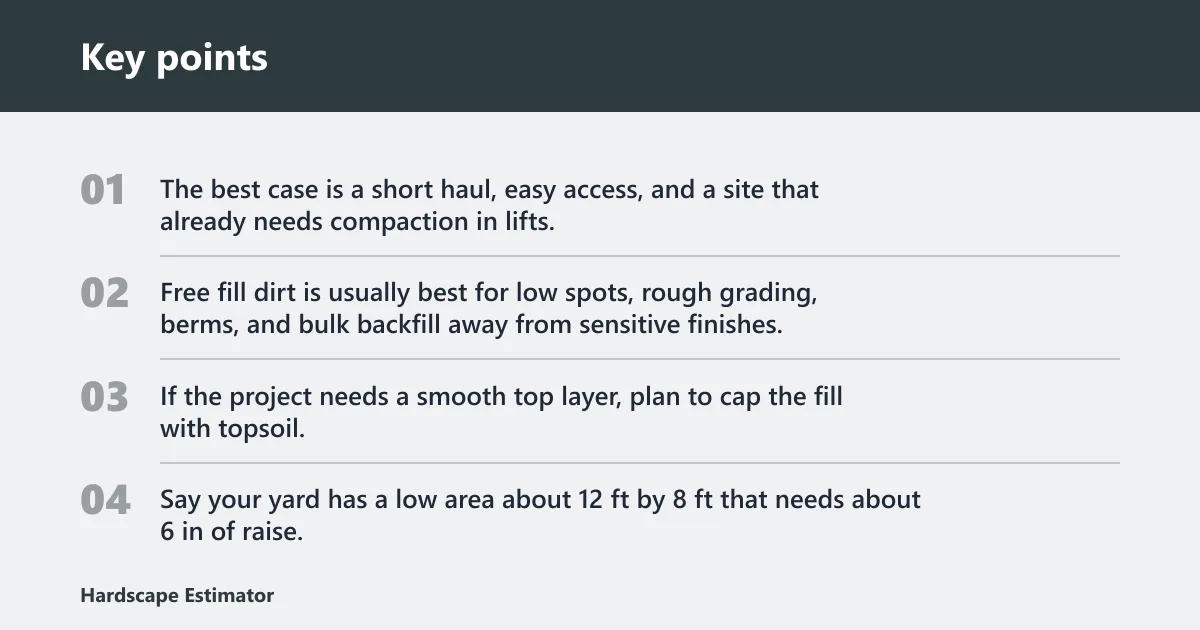
A free load can save money on small grading jobs, berms, and backfilling where the dirt only needs to be stable and reasonably clean. The best case is a short haul, easy access, and a site that already needs compaction in lifts. In that case, the dirt is the cheap part.
When hauling and compaction erase the benefit
The hidden cost is not the soil. It is the trip, the time to load it, the trailer or dump truck capacity, and the labor needed to place and compact it. A trailer that holds 2 cubic yards may need several trips for a modest yard project, and loose placement often leads to settlement later.
Best-fit uses for small yard projects
Free fill dirt is usually best for low spots, rough grading, berms, and bulk backfill away from sensitive finishes. It is far less suited to planting beds, finished lawn prep, or any area where drainage must be exact. If the project needs a smooth top layer, plan to cap the fill with topsoil.
Say your yard has a low area about 12 ft by 8 ft that needs about 6 in of raise. That takes roughly 2.4 cubic yards of fill before compaction loss. If the free load is 8 miles away and the trailer only carries 1.5 cubic yards safely, the haul may cost more than a delivered load from a local supplier.
What can go wrong with free fill dirt?
The main risks are contamination, debris, settlement, and drainage problems. Free fill dirt can be safe enough for some yard work, but only if it is clean, mostly mineral soil, and taken from a source that makes sense. Unknown fill near a demolition site is a poor choice for residential use.
Contamination and debris problems
Free fill can sometimes contain lumber, roots, trash, asphalt chunks, concrete pieces, wire, plastics, or demolition debris. Some loads also carry chemicals, fuel odor, stained soil, or mixed waste from excavation work. Those are red flags because the dirt is no longer just soil; it is unknown fill.
Settlement and drainage failure
Loose fill settles as trapped air and voids collapse. That can leave dips in a lawn, uneven paving, and water running toward a house instead of away from it. Poor grading can create ponding at the surface, while poor compaction can leave soft spots under walkways or patios.
Foundation and utility risks
Do not treat free fill as a simple material around foundations, septic areas, or utility runs. Soil placed too high can interfere with drainage, cover vents, or change slope at the wall. If digging or importing fill requires a local utility check or permit, that comes before delivery.
Fill dirt acceptance checklist
This checklist is for deciding whether a free load is worth taking. It separates the source questions, the pile inspection, and the rejection triggers. If any red flag shows up, the safest answer is no.
| Check area | Accept if | Reject if |
|---|---|---|
| Source-screening questions | It comes from landscaping, basement excavation, pool digging, or similar clean earthwork | It comes from demolition, industrial work, unknown dumping, or mixed-site cleanup |
| On-site inspection | Soil is mostly mineral, with small rocks only, and no visible trash or staining | You see lumber, asphalt, wire, drywall, plastic, oily patches, or strong odors |
| Handling fit | You can load, haul, place, and compact it with your equipment and time | You would need extra trips, special loading help, or cleanup beyond the free load |
| Project fit | The area needs bulk fill, rough grading, or backfill, not finished planting soil | The area is a bed, turf zone, drain path, or foundation-adjacent area with tight specs |
-
Ask the source.
Find out where the dirt came from and what was on that site before excavation. A clean residential excavation is very different from a demolition lot or an active construction cut.
-
Ask what was mixed in.
Ask directly about roots, sod, rock, clay, concrete, asphalt, and any imported debris. The answer should be plain and specific, not vague.
-
Check the delivery method.
Confirm whether it is loose in a truck, stockpiled in a pile, or already sorted. Loading method matters because a mixed pile often hides debris deeper down.
-
Inspect before accepting.
Look for trash, odor, staining, and large chunks that do not belong in fill dirt. If the pile looks mixed, do not assume the top layer tells the whole story.
-
Match it to the job.
Use it only where bulk fill and compaction matter more than finish quality. If the area needs planting soil, drainage precision, or support near a structure, choose a better material.
How should you inspect a pile before you accept it?
Clean fill dirt should look and smell like ordinary soil, with no trash, chemical odor, or obvious demolition waste. If the pile contains debris, stained soil, or mixed materials, treat it as contaminated fill and reject it for residential use. The inspection is quick, but it needs to be strict.
What clean fill dirt should look and smell like
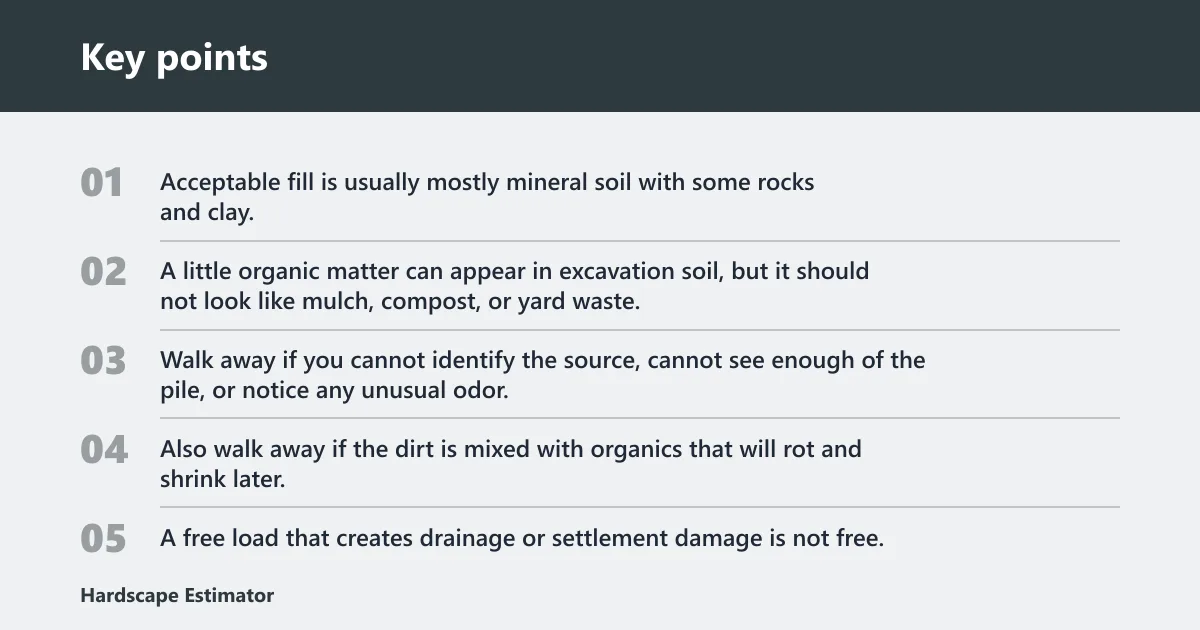
Acceptable fill is usually mostly mineral soil with some rocks and clay. It should not have a sour, oily, rotten, or chemical smell. A little organic matter can appear in excavation soil, but it should not look like mulch, compost, or yard waste.
What contaminated fill dirt can look like
Contaminated fill may show lumber fragments, bricks, insulation, blacktop pieces, wire, plastic, drywall, or strange color bands. It may also be wet in a way that suggests runoff or buried waste. If the source is an active demolition or excavation site, the risk is higher and the burden of proof should be on the source.
When to walk away
Walk away if you cannot identify the source, cannot see enough of the pile, or notice any unusual odor. Also walk away if the dirt is mixed with organics that will rot and shrink later. A free load that creates drainage or settlement damage is not free.
Suppose the pile looks fine from the outside, but a shovel cut exposes shredded plastic and a diesel smell 10 in down. Reject that load even if the top layer looks like ordinary soil. Hidden contamination is the problem, not the price tag.
Free fill dirt near worksheet
The worksheet below turns a free load into a real project cost. Use it before you say yes. If the total is close to the price of delivered clean fill, the free option may not be the better option.
| Cost item | How to estimate it | Example value |
|---|---|---|
| Hauling | Miles round trip × fuel cost + vehicle wear | 18 miles × $0.75 per mile = $13.50 |
| Loading time | Minutes spent loading × your time cost | 1.5 hours × $25 per hour = $37.50 |
| Trailer capacity | Loads needed = total cubic yards ÷ trailer capacity | 4.5 yd³ ÷ 1.5 yd³ = 3 trips |
| Compaction labor | Time to place in lifts and compact each lift | 2 hours × $25 per hour = $50.00 |
| Cleanup | Sorting trash or removing debris, if present | $0 if clean; more if debris appears |
Add those numbers together. In the example above, the hidden cost is about $101 before the dirt itself. If the free pile forces more trips, a larger trailer, or disposal of debris, the cost rises fast.
When should you use fill dirt instead of topsoil?
Use fill dirt for grading, raising elevation, and backfilling. Use topsoil for the finished upper layer where grass or plants will grow. They are not interchangeable. Fill dirt gives bulk and shape; topsoil gives a better growing surface.
Grading and raising low areas
For low spots, fill dirt is the right base material because it is meant to build volume. Place it in thin layers and compact each lift so the surface does not sink later. If the area slopes toward a structure, verify that the new grade still drains away from it.
Backfilling around structures
Fill dirt can be used for backfill where the goal is support and height, not planting quality. Keep it away from sensitive drainage paths unless the design allows it. Around a house, the safer approach is to confirm local rules and the intended finished grade before importing soil.
Where topsoil belongs instead
Topsoil belongs on the finished surface for turf and planting beds. It has more organic matter than fill dirt and is better for root growth, but it is not the right material for building height or a stable base. A common layering pattern is fill dirt below, topsoil above.
- Use fill dirt. For berms, low spots, and rough grade changes.
- Use topsoil. For lawns, beds, and any planted finish surface.
- Do not swap them. Organic topsoil under a fill lift can shrink and settle.
Frequently asked questions
Is free fill dirt actually safe to use in my yard?
It can be, but only if the source is clean, the pile is mostly mineral soil, and there is no trash, odor, or suspicious debris. Safe use depends on where it came from and where it will go. For residential yards, the biggest risks are contamination, drainage changes, and settlement.
What should I check before taking free fill dirt?
Check the source, the visible debris level, the smell, and whether the material looks like ordinary soil. Ask if the pile came from excavation, landscaping, or demolition work. Confirm that your trailer, access route, and loading plan can handle the volume without turning the “free” load into an expensive project.
How do I know if fill dirt is clean enough for landscaping?
Clean enough for landscaping means no visible trash, roots, lumber, asphalt, or demolition debris, and no unusual odor or staining. Even then, it should usually stay below topsoil, not replace it. If the area will be planted, topsoil should be placed over the fill so roots have a better growth layer.
Can I use free fill dirt around my house foundation?
Use caution. Fill near a foundation can change drainage, cover utilities, or create settlement issues if it is placed loose. Before importing soil near a house, check local code or permit rules, and make sure the finished slope still moves water away from the structure.
How much will hauling and equipment cost if the dirt is free?
The dirt may be free, but hauling, fuel, loading time, trailer trips, and compaction can easily become the real cost. A short example can add up to more than $100 before any cleanup. The right comparison is free fill versus delivered clean fill, not free dirt versus nothing.
What permits or restrictions apply if I dump or receive fill dirt?
Local rules can control imported soil, dump sites, grading changes, and utility checks before digging. Some areas also restrict where fill may be placed because of drainage or slope impacts. Before accepting or dumping any load, confirm the local requirements that apply to your property and project type.