What Is the Best Polymeric Sand for Wide Joints?
For wide paver joints, use polymeric sand rated for the joint width you have. For joints around 1/4 to 1/2 in., choose a coarse-grade product, and skip standard fine sand near the upper end of that range. If width and depth do not match the label, the joint can wash out, crack, or fail early. This guide shows how to choose by joint width, depth, and edge shape, plus when a joint is too wide for sand alone.
Wide-joint selection matrix
The safest choice starts with three checks: joint width, joint depth, and joint edge shape. A bag label with a maximum joint width is more useful than a brand name, because the same product can behave very differently in a 1/4 in. slot versus a 1/2 in. gap with tapered sides.
| Joint width | Joint depth | Paver type and edge shape | Safest product category | Use or avoid |
|---|---|---|---|---|
| 1/8 to 1/4 in. (3 to 6 mm) | At least 1 in. compacted | Concrete pavers with straight or lightly beveled edges | Standard polymeric sand | Good fit when joints are clean and dry |
| 1/4 to 3/8 in. (6 to 10 mm) | At least 1 to 1 1/2 in. compacted | Concrete pavers, brick, and many block paving units | Coarse or wide-joint polymeric sand | Check the label for the published maximum width |
| 3/8 to 1/2 in. (10 to 13 mm) | At least 1 1/2 in. compacted, with full side support | Wide, fairly straight joints with stable edges | Wide-joint polymeric sand | Use only if the label allows the width and the joint is deep enough |
| Over 1/2 in. (13 mm) | Varies, but usually not enough for reliable sand-only lockup | Irregular natural stone, voided joints, or tapered gaps | Alternative joint filler or mortar-based system | Usually too wide for standard polymeric sand; treat as a different detail |
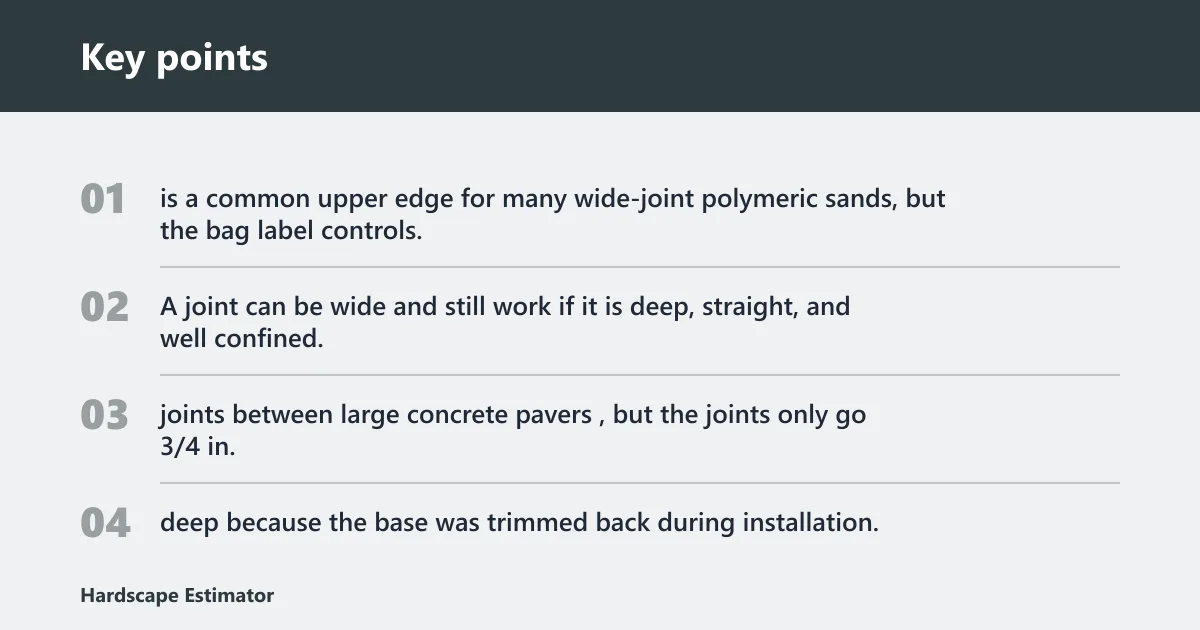
As a working rule, about 1/2 in. is a common upper edge for many wide-joint polymeric sands, but the bag label controls. A joint can be wide and still work if it is deep, straight, and well confined. A shallow 3/8 in. joint may fail sooner than a 1/2 in. joint with full depth.
Say a patio has 1/2 in. joints between large concrete pavers, but the joints only go 3/4 in. deep because the base was trimmed back during installation. That gap may look acceptable on paper, yet the shallow fill gives the hardened sand too little sidewall grip, so cracking and washout become more likely after rain and freeze-thaw.
What counts as a wide joint?
A wide joint is any joint that sits above the normal range on the product label, usually above about 1/4 in. or 6 mm for many standard sands. The exact breakpoint varies by manufacturer, but once a joint gets close to 3/8 to 1/2 in., standard fine polymeric sand is a weak choice unless the label explicitly allows it.
Practical width breakpoints
For selection, split the job into three bands: standard, wide, and too wide. Standard means about 1/8 to 1/4 in.; wide means about 1/4 to 1/2 in.; and too wide means over 1/2 in. or any gap that is irregular enough that the sand cannot stay packed at a constant depth.
Imperial and metric ranges
- 1/8 in. = about 3 mm
- 1/4 in. = about 6 mm
- 3/8 in. = about 10 mm
- 1/2 in. = about 13 mm
Width alone is not enough. A 3/8 in. joint with straight sides can hold far better than a 1/4 in. joint that flares at the top and narrows below, because the top can break out while the lower portion stays buried.
Does joint depth matter?
Yes. Joint depth matters as much as width because polymeric sand needs enough contact area to lock the paver sides and resist movement. Shallow wide joints fail first: they leave less material to cure, less side friction, and less resistance to washout.
Minimum compacted depth
A common rule of thumb is to fill polymeric sand to at least about 1 in. deep for standard joints and about 1 1/2 in. deep for wider joints. Deeper is better when the product label allows it, but the key is a fully packed joint rather than a thin cap sitting over an empty void.
Depth-to-width ratio
Depth should rise with width. If a joint is 1/2 in. wide, a depth near 1 1/2 in. gives a better depth-to-width ratio than a 3/4 in. fill. When the ratio gets too low, the sand acts like a crust instead of a locked joint, and surface cracking becomes more likely.
How shallow joints fail
Failure usually shows up first at the top edge. The joint may hairline crack, open at the corners, or break loose after a hose rinse or heavy storm. In freeze-thaw climates, shallow fills can also pop out in strips because water gets under the crust and expands.
- Measure the narrowest width. Check several joints, not just one. Use the smallest consistent width as the number that controls product choice, because the tightest section still has to fill and cure.
- Check the full depth. Probe the joint to see whether it stays uniform or drops into voids. If depth varies a lot, the weak spots will govern performance.
- Match label limits. Select only a product whose maximum width covers the widest regular joint and whose minimum depth can be met everywhere. If the label does not fit the job, do not force it.
Which paver types work best?
Concrete pavers with straight or lightly beveled edges are the easiest match for polymeric sand in wide joints. Porcelain, natural stone, and some brick or block paving details need more caution because the edge shape and joint consistency often decide whether the sand stays locked.
Concrete pavers and block paving
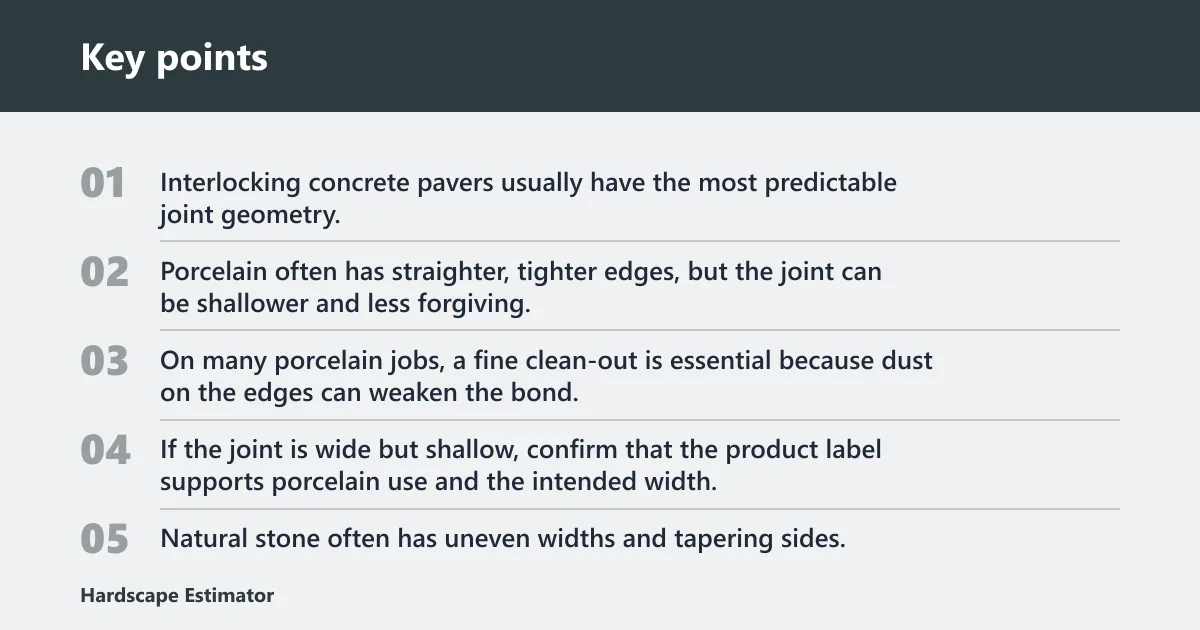
Interlocking concrete pavers usually have the most predictable joint geometry. Block paving with regular, square edges can also work well, especially when the joints are uniform and the bedding is stable. These are the best candidates for standard or wide-joint formulas, depending on width.
Porcelain pavers
Porcelain often has straighter, tighter edges, but the joint can be shallower and less forgiving. On many porcelain jobs, a fine clean-out is essential because dust on the edges can weaken the bond. If the joint is wide but shallow, confirm that the product label supports porcelain use and the intended width.
Natural stone and irregular edges
Natural stone often has uneven widths and tapering sides. That irregular shape makes depth-to-width ratio more important than the nominal width alone. If a joint is wide at the top and voided below, polymeric sand may bridge the opening instead of filling it, which can leave weak spots.
A common mistake on a first pass is to judge a natural-stone patio by average width alone. Suppose most joints measure 3/8 in., but a few flare to 5/8 in. at the surface. Those wider, tapered joints may need a different filler or a detail repair, even if most of the patio could accept wide-joint sand.
How base and drainage change the choice
Base and drainage conditions change the risk level. Polymeric sand works best where water drains off the surface, the base is stable, and the joint can dry between wetting cycles. It is a weaker fit when the installation stays damp, sees standing water, or faces repeated freeze-thaw cycling.
Permeable versus non-permeable installs
On non-permeable installations, the sand is meant to shed water after activation and cure into a firm joint. On permeable systems, standard polymeric sand may clog drainage paths or fail if the joint is expected to pass water. The product and the paving system need to match.
Slope, runoff, and freeze-thaw
Good slope helps polymeric sand last because runoff clears the surface faster. Flat areas that hold water raise the risk of washout and incomplete hardening. In freeze-thaw zones, any joint that stays wet is more likely to crack or open at the top edge.
When polymeric sand is the wrong fit
Move away from polymeric sand when joints are too wide, too shallow, badly voided, or too irregular to pack cleanly. Also move away when the system needs true permeability or when the edge detail leaves no reliable sidewall support. A different jointing material is safer than forcing a marginal fit.
What the bag label should say
The bag label should list a maximum joint width, installation temperature range, surface condition limits, and curing instructions before rain or traffic. If those details are missing, treat the product as a standard sand, not a wide-joint solution.
- Read the maximum width. Confirm the label gives a width limit in inches or millimeters. That number should include your widest normal joint, not just the average.
- Check weather limits. Most products specify a minimum and maximum application temperature and a rain-free curing window. Use those limits, because water too early can wash fines from the joint.
- Confirm substrate condition. The joint should be dry, clean, and free of debris before fill and activation. Dirt, moisture, and haze all reduce bond quality and cleanup quality.
Coverage and yield for wide joints
Coverage drops quickly as joint width grows. The same bag that covers a narrow patio can lose much of its yield when the joint widens from 1/8 in. to 1/2 in., because joint volume rises in direct proportion to width and depth. Product density also affects yield, so label coverage should be treated as approximate.
| Joint width | Joint depth | Approx. coverage trend | What changes |
|---|---|---|---|
| 1/8 in. | 1 in. | Highest coverage | Least material per square foot |
| 1/4 in. | 1 in. | About half the coverage of 1/8 in. | Joint volume roughly doubles |
| 3/8 in. | 1 1/2 in. | Much lower coverage | Width and depth both increase demand |
| 1/2 in. | 1 1/2 in. | Lowest coverage among these examples | Often needs extra bags and a waste allowance |
A practical planning rule is to add about 10% to 15% for waste, cleanup loss, and joints that turn out wider than expected. That extra buy matters more on wide-joint work, because the material disappears faster once width passes 1/4 in.
For a rough estimate, think in ratios: if a 1/4 in. joint uses one bag, a 1/2 in. joint at the same depth can use about twice as much material. If depth also increases from 1 in. to 1 1/2 in., the demand rises again.
Frequently asked questions
What is the best polymeric sand for wide joints?
The best polymeric sand for wide joints is the coarse or wide-joint formula whose label matches your actual joint width and depth. For many installs, that means a product rated around 1/4 to 1/2 in., with enough depth to pack fully and enough straight edge support to resist cracking.
Which polymeric sand works for 1/2 inch joints?
A 1/2 in. joint usually needs a wide-joint polymeric sand, not a standard fine sand. The label should explicitly allow 1/2 in. width, and the joint should be deep enough, clean, and stable. If the gap is tapered or shallow, move to a different filler.
Can I use regular polymeric sand in large gaps?
Usually no. Regular polymeric sand is made for narrower joints, often up to about 1/4 in. depending on the label. In large gaps, the sand can shrink, crack, or wash out because it lacks the side support and pack density that wider joints need.
What joint width is too wide for polymeric sand?
Over 1/2 in. is often too wide for standard polymeric sand, and some jobs are too wide even below that if the joints are irregular or shallow. The label limit controls, but gaps with voids, taper, or loose edges usually need another jointing method.
Does polymeric sand need a minimum depth in wide joints?
Yes. Wide joints need more depth, not less, because the cured sand needs enough body to lock the paver sides. A common target is at least 1 in. for standard joints and about 1 1/2 in. for wider ones, unless the product label says otherwise.
How do I keep polymeric sand from cracking in wide joints?
Use a product rated for the width, pack it to full depth, and make sure the joint edges are clean and stable. Cracking is more likely when the joint is shallow, tapered, or exposed to early water. Proper compaction and careful misting also matter.