Can You Haul Pavers in a Pickup Truck Without Overloading It?
Yes, if the paver load stays under the truck’s payload rating and rear-axle limit. A full pallet often weighs about 2,500 to 3,500 lb, which can exceed the payload of many half-ton pickups. Ignore those limits and you can overload the suspension, exceed tire ratings, and make braking and steering worse. This guide shows how to check payload, axle load, and paver stack weight before you load the bed.
What adds up to your truck’s actual loaded weight
Yes, but only when the total load fits the truck’s payload rating and axle limits. Bed space alone does not answer the question. A short bed can hold a pallet by volume and still be overloaded by weight, especially once passengers, tools, fuel, pallet wood, wrap, and straps are counted.
Why bed space can look fine while the truck is still overloaded
Pavers are heavy. A bed may have enough floor area for a pallet, but the truck can still be past payload before the bed is full. That is why the weight-first method works better than a size-first method. The limiting number is the door-sticker payload, not the bed length.
Say your truck has an 1,800 lb payload sticker and you have a 180 lb driver, a 140 lb passenger, and 100 lb of tools and fuel. That leaves 1,380 lb for the paver load before any safety margin. A pallet estimated at 2,800 lb does not fit, even if it fits in the bed.
What counts toward the load total
- Driver and passengers
- Tools, bags, coolers, and other cargo
- Fuel already in the tank
- Pavers themselves
- Pallet wood, wrap, banding, and packaging
- Any blocks, dunnage, or load bars used to secure the stack
The safe method is simple: add people, gear, and the estimated pallet weight, then compare that total to the payload rating with a margin left over.
What weight matters first?
The first number to check is the door-sticker payload rating. It is based on the truck’s GVWR minus its empty curb weight as configured from the factory. After that, check rear-axle load and tire load ratings, because pavers usually put most of the added weight on the back of the truck.
Door-sticker payload rating
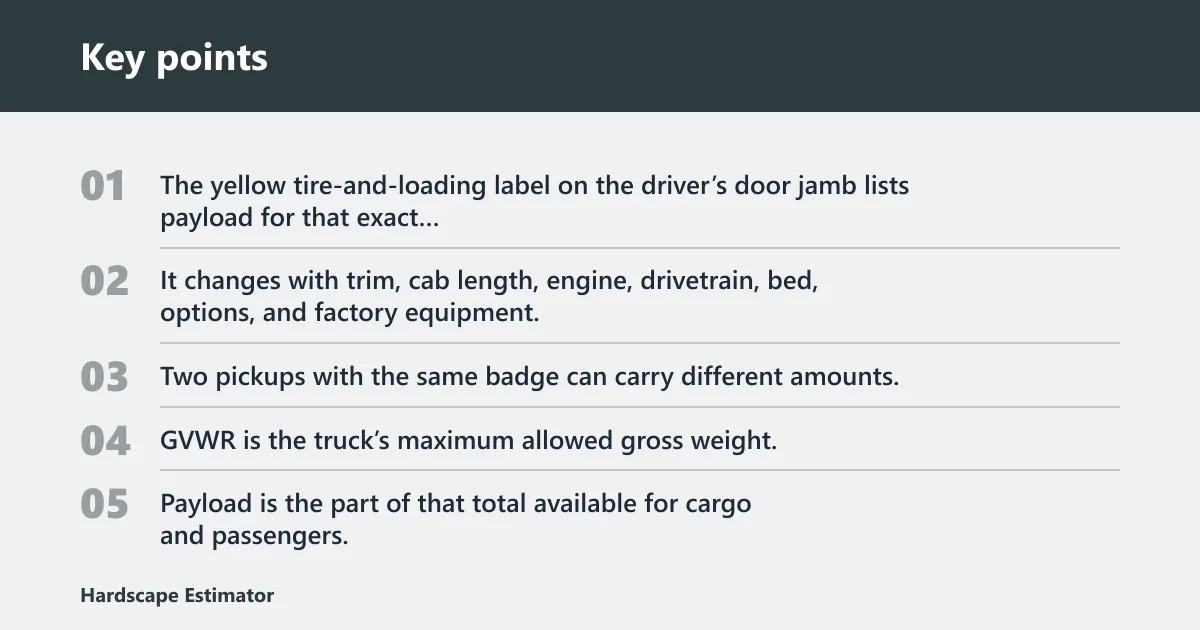
The yellow tire-and-loading label on the driver’s door jamb lists payload for that exact truck. It changes with trim, cab length, engine, drivetrain, bed, options, and factory equipment. Two pickups with the same badge can carry different amounts, so the sticker matters more than a brochure number.
GVWR, rear axle load, and tire limits
GVWR is the truck’s maximum allowed gross weight. Payload is the part of that total available for cargo and passengers. Rear-axle load matters because a pallet placed near the tailgate can put most of its weight on the rear axle. Tires matter because they carry the actual load at the road.
The rear axle is often the first problem. Concrete pavers loaded near the tailgate shift a large share of their weight onto the back suspension and rear tires. A truck can stay under total payload and still overload the rear axle or one tire if the stack is too far rearward or uneven. The actual rear GAWR is on the certification label on the driver’s door jamb, and the practical way to check loaded rear-axle weight is to weigh the truck with the load aboard and compare the result to that label.
Why the rear axle is usually the first problem
Bed volume does not tell you where the weight lands. A pallet set at the back of the bed acts like a lever. The farther rearward it sits, the more load the rear axle sees and the lighter the front axle becomes. That can reduce steering grip and make braking less predictable.
Suspension squat is not just a comfort issue. If the rear sits low, the truck may be near or past the axle or tire limit. The rating still controls the answer, even if the truck feels drivable at low speed.
How much does a pallet of pavers weigh?
A pallet of concrete pavers commonly weighs about 2,500 to 3,500 lb, depending on the paver size, thickness, shape, brand, and pallet coverage. Smaller pavers and thinner units weigh less. Large-format or thick pavers can push the pallet weight up fast.
Common paver sizes and thickness differences
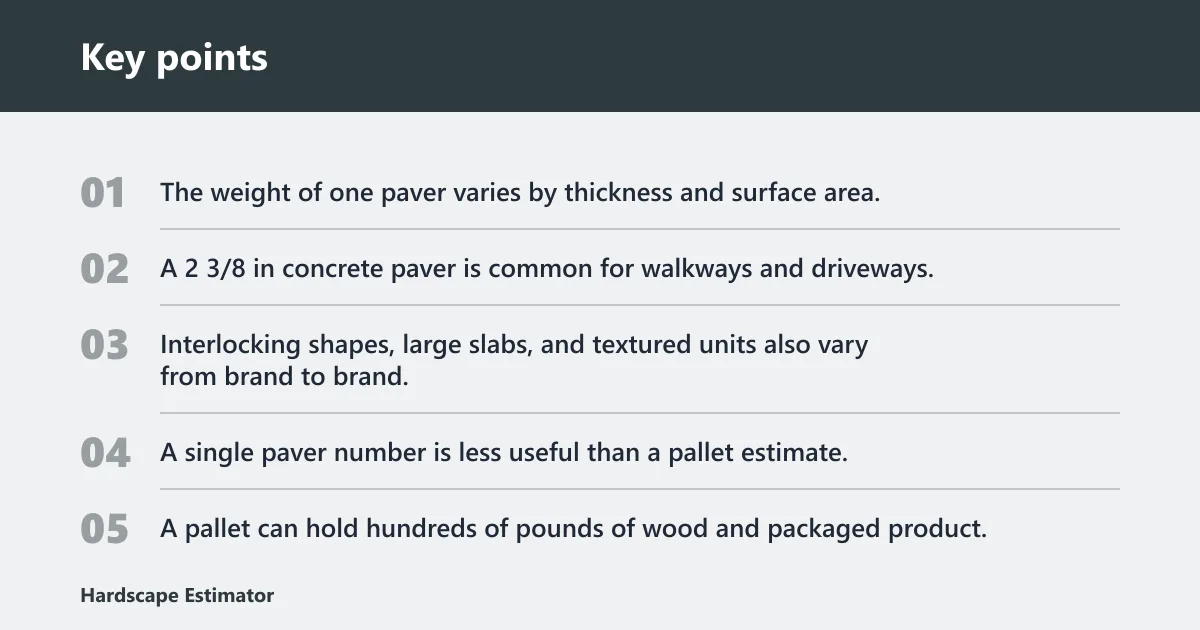
The weight of one paver varies by thickness and surface area. A 2 3/8 in concrete paver is common for walkways and driveways, but the exact count per pallet and total weight change by product line. Interlocking shapes, large slabs, and textured units also vary from brand to brand.
A single paver number is less useful than a pallet estimate. A pallet can hold hundreds of pounds of wood and packaged product, so the total load is what matters for truck safety.
Pallet wood, wrap, and packaging weight
Pallet wood, plastic wrap, corner boards, and banding add weight. That extra mass is usually not large compared with the pavers, but it matters when the truck is near its limit. Packaging can be the difference between a marginal load and a legal one.
For planning, a practical estimate is to add 50 to 100 lb for pallet and packaging on a small to medium pallet, and more if the supplier uses heavier skids or extra wrap. The exact amount should come from the supplier’s pallet data when available.
Why concrete pavers vary by brand and shape
Concrete is dense, but brand geometry changes the total. A smooth rectangular paver, a tumbled paver, and a slab-style unit can weigh differently even at similar dimensions. Hollow features, chamfers, and texture patterning also shift the count per pallet and the total pallet mass.
Paver hauling decision table
Use this table to plan the load, then verify it against the door sticker. The “estimated pallet weight” figures are common planning ranges for concrete pavers and packaging combined. Always compare the total to the truck’s actual payload, rear-axle rating, and tire limits before loading.
| Paver type | Common size / thickness | Estimated pallet weight | Typical pickup fit | Go / no-go |
|---|---|---|---|---|
| Small walkway pavers | 4 x 8 x 2 3/8 in | 2,000 to 2,600 lb | Long bed half-ton only if payload allows | Go only with a high payload rating |
| Standard driveway pavers | 6 x 9 x 2 3/8 in | 2,500 to 3,200 lb | Usually too heavy for most half-tons | No-go for many light-duty pickups |
| Thick driveway pavers | 4 x 8 x 3 1/8 in | 3,000 to 3,600 lb | Best suited to heavy-duty pickup or trailer | Trailer usually needed |
| Large-format slabs | 12 x 24 in or larger | 3,500 lb and up | Rarely a pickup payload fit | Trailer needed |
A common first-timer mistake is to compare the pallet to bed length and stop there. A 6.5 ft bed may fit the skid neatly, but if the truck’s remaining payload is only 1,200 lb, the load is still too heavy. Size fit is useful. Weight fit decides the answer.
How do you load pavers safely in the bed?
Load pavers flat on the bed floor whenever possible, keep the stack low, and place it as far forward as practical without blocking safe driving. Secure the load so it cannot shift under braking or turning. Flat stacking is usually more stable than a tall, narrow stack or loose units.
Flat stack or on edge?
Flat is usually better because it lowers the center of gravity and spreads the load across more bed area. Stacking on edge can save space, but it raises the center of mass and can let the load move more easily. A tall stack also increases the chance of damage to the pavers.
Where to place the load for better balance
Place the pallet or stack slightly forward of the rear axle when the bed layout allows it. That helps reduce axle overload and improves steering balance. Do not crowd the tailgate if the truck already sits low in the rear. The back axle needs margin more than the bed needs empty space.
Picture a half-ton with a 5.5 ft bed and a pallet set right at the tailgate. The bed may look tidy, but the rear suspension squats hard and the front gets light. Move the same load forward, and the axle balance improves, but only if the payload rating still allows the total weight.
Straps, load bars, and shift control
Use ratchet straps or load bars to keep the pallet from shifting under braking. A palletized load should not slide, tip, or bounce. If the pavers are loose, use blocking and tie-downs that control movement in all directions. Stop and recheck tension after the first few miles.
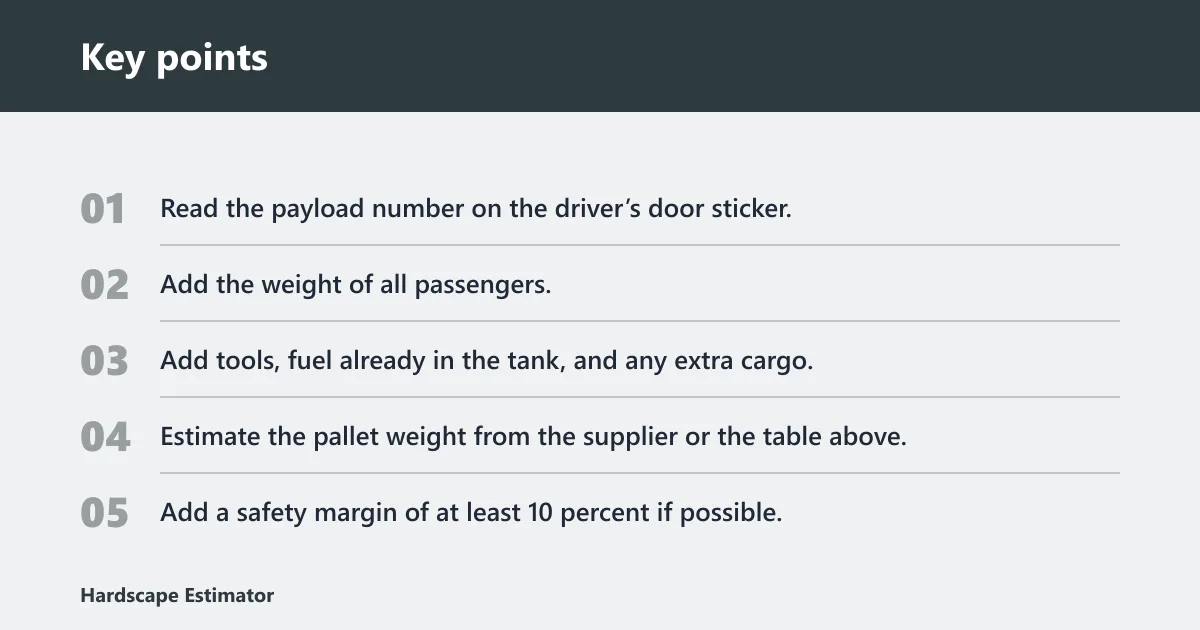
- Read the payload number on the driver’s door sticker.
- Add the weight of all passengers.
- Add tools, fuel already in the tank, and any extra cargo.
- Estimate the pallet weight from the supplier or the table above.
- Add a safety margin of at least 10 percent if possible, but do not use that margin to ignore the truck’s rated limits.
- Compare the total to payload, rear-axle rating, and tire limits.
- Load the pallet low, keep weight forward, and strap it down.
When should you use a trailer instead?
Use a trailer when the pallet weight plus passengers and gear exceed the truck’s payload, or when the rear axle and tires run out of capacity before the total payload does. A trailer adds its own GVWR and hitch limits, which is often the safer path for a full pallet of concrete pavers.
When the pallet weight exceeds payload
If the remaining payload is below the estimated pallet weight, the answer is no. That rule is direct and easy to check. A half-ton truck with about 1,500 to 1,800 lb of payload often cannot carry a full pallet once people and tools are included.
When rear squat or tire rating becomes the limit
Even if the total payload looks close, rear-axle and tire limits may stop the plan first. A load that sits behind the axle can push the rear tires beyond their capacity. If the truck squats badly or the tire load index is too low, switch to a trailer or make a smaller delivery.
Hitch and trailer GVWR checks
Do not assume a trailer solves every problem. The tow vehicle still has a hitch rating, tongue-weight limit, and combined weight limit. The trailer itself must also be rated for the pallet. For larger paver orders, a properly rated trailer is usually the cleaner choice.
Suppose a contractor-grade half-ton has about 2,050 lb of payload and the crew adds about 400 lb of passengers and tools. That leaves 1,650 lb. A 2,700 lb pallet is over the limit, so a trailer or a separate delivery is the correct move.
What happens if I overload my pickup truck with pavers?
Overloading can strain the suspension, overload the rear tires, lengthen braking distance, and reduce steering control. It can also damage the truck or the pavers if the load shifts. The risk rises quickly when the load is near the tailgate, where the rear axle sees most of the added weight.
Do not speed, make sudden turns, or brake hard with a high paver load. Keep road speed modest and take corners carefully. If the truck feels unstable, the load is too heavy, too far back, or not secured well enough.
Frequently asked questions
How many pavers can fit in my pickup truck bed?
Bed fit depends on paver size, pallet dimensions, and bed length, but fit alone does not make the load safe. A pallet may fit in a short bed and still exceed payload by a wide margin. Count weight first, then check whether the bed can physically accept the stack.
Do pavers weigh more than gravel or topsoil in a pickup?
Yes, pavers are much denser than gravel or topsoil. A pickup bed can hold a large volume of loose material, but a pallet of concrete pavers concentrates far more weight in the same space. That is why a truck can carry loose fill but not a full pallet of pavers.
Should I stack pavers flat or on edge in the bed?
Flat is usually the safer choice because it keeps the center of gravity lower and spreads the weight more evenly across the bed floor. Stacking on edge can raise the load and make shifting more likely. The only real exception is when the supplier’s packaging requires a different layout.
How do I know if my truck will exceed payload with pavers?
Subtract the weight of passengers and cargo from the door-sticker payload, then compare the remainder to the pallet estimate. If the estimate is higher, the truck is over payload. Also check rear-axle and tire ratings, because those can be exceeded before payload is used up.
Do I need a trailer instead of a pickup for pavers?
Use a trailer when the pallet weight does not fit inside the truck’s remaining payload, or when rear-axle and tire limits are too tight. A trailer is also the better choice for heavier pavers, multiple pallets, or any load that would leave the truck riding low in the rear.