Landscape Fabric vs Cardboard for Weed Control
Cardboard is the better short-term weed barrier for beds and new planting areas. Weed fabric is commonly reported to last longer under stone paths and rock beds, but only if it is covered with about 2 to 3 in. of mulch or stone. Bad placement lets weeds punch through, shifts material, and turns a cheap project into repeated cleanup and replacement. This guide compares both materials by project type and gives simple estimating rules for overlap, cover depth, and replacement timing.
| Factor | Landscape fabric | cardboard for weed control | Winner |
|---|---|---|---|
| Lifespan | Commonly 5 to 20 years, depending on conditions. | Usually a few months to 3 years. | Landscape fabric |
| Best fit | Rock beds, gravel paths, pavers, shrubs, trees, and some planting beds. | New beds, garden conversions, and soil-building projects. | Tie |
| Water and air movement | Permeable, but performance varies by woven, non-woven, perforated, or spun type. | Allows water through at first, then softens and breaks down. | Landscape fabric |
| Installation and maintenance | Needs seam overlap, careful cutting, and later cleanup if roots or fines build up. | Simple to place, but must be overlapped and covered well to stay put. | cardboard for weed control |
| Performance under stone, gravel, and hardscape | Lasts longer under stone paths and rock beds when covered with about 2 to 3 in. of mulch or stone. | Not a good long-term base under gravel or stone; breaks down too quickly for a long-lived path. | Landscape fabric |
| Temporary or renovation use | More material than needed if the area will be reworked soon. | Useful as a temporary smothering layer and better when the bed is temporary or being rebuilt. | cardboard for weed control |
| Soil-building / biological improvement | Slows the soil-building goal. | Breaks down and adds to the bed plan. | cardboard for weed control |
| Existing perennials / planting holes | Useful if plant holes are already established. | Hard to install cleanly around crowns and stems; each cut is a weak spot. | Landscape fabric |
| Barrier stability on slopes | Holds up better if pinned and covered correctly. | Tends to shift unless heavily mulched and secured. | Landscape fabric |
Weed fabric vs cardboard: the core trade-off
Both materials suppress weeds by blocking light at the soil surface, so neither one is a permanent fix. Weed fabric lasts longer and is better under stone, gravel, and other hardscape layers; cardboard is better when the bed is temporary, being rebuilt, or expected to improve biologically as it breaks down.
The trade-off shows up in how the project will be used. A gravel path needs a barrier that can stay in place under traffic and rock weight, while a new flower bed can tolerate a barrier that softens, decomposes, and is refreshed later.
How each material blocks light
Weed fabric and cardboard both work by reducing light at the soil surface. That stops many new weed seedlings and slows top-growth weeds that try to root into the barrier or find a seam.
They fail in different ways. Fabric can tear, clog, or open at seams; cardboard can soften, collapse, or fail where the overlap is too narrow and light leaks through.
Why neither option stops every weed
Neither option stops every weed forever because roots can enter through seams, tears, or openings cut for plants. Existing perennial roots, rhizomes, and windblown seeds can also appear above the barrier after installation.
Say your 8-by-12 ft front bed gets cardboard with thin bark over it. If the mulch depth drops at the edge, light reaches the seam first, and weeds return there before the center of the bed fails.
Where the trade-off shows up in real projects
In a rock bed, the longer service life of weed fabric usually matters more than easy removal. In a new planting bed, cardboard’s shorter life is often acceptable because the bed is meant to change as plants settle in and soil builds.
In a path, underlayment stability matters. In a slope, holding the barrier and cover material in place matters even more, because movement exposes edges and creates thin spots.
Weed control decision matrix
| Project scenario | Weed fabric | cardboard for weed control | Recommended pick | Estimated mulch depth needed |
|---|---|---|---|---|
| New planting bed | Works if the bed will stay fixed and plants are spaced for cuts | Best for a fresh bed or conversion | cardboard for weed control | 3 to 6 in. |
| Existing perennials | Useful if plant holes are already established | Hard to install cleanly around crowns and stems | Weed fabric | 2 to 4 in. over the barrier |
| Gravel path | Recommended under gravel or paths | Breaks down too quickly for a long-lived path | Weed fabric | 2 to 4 in. of cover above fabric, plus gravel depth |
| Rock bed | Good under river rock or other stones for separation | Not suited to long-term stone cover | Weed fabric | 2 to 4 in. |
| Slope | Holds up better if pinned and covered correctly | Tends to shift unless heavily mulched and secured | Weed fabric | 2 to 4 in. |
| Root or rhizome containment | Can help control rhizome spread around plants like raspberries | Breaks down before containment needs are finished | Weed fabric | 2 to 4 in. |
| Temporary renovation | More material than needed if the area will be reworked soon | Useful as a temporary smothering layer | cardboard for weed control | 3 to 6 in. |
| Soil-building bed | Slows the soil-building goal | Breaks down and adds to the bed plan | cardboard for weed control | 3 to 6 in. |
New planting bed, existing perennials, and soil-building beds
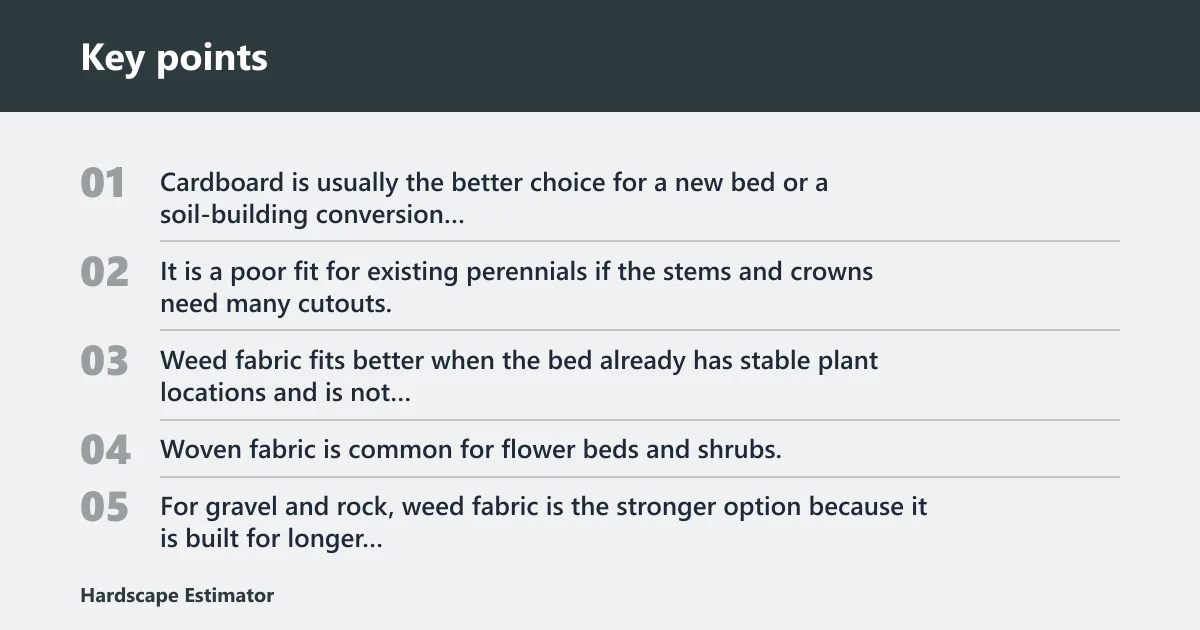
Cardboard is usually the better choice for a new bed or a soil-building conversion because it is meant to break down. It is a poor fit for existing perennials if the stems and crowns need many cutouts, because each cut is a weak spot.
Weed fabric fits better when the bed already has stable plant locations and is not likely to be reshaped soon. Woven fabric is common for flower beds and shrubs; perforated fabric is better where frequent planting holes are needed, such as vegetable gardens.
Gravel paths, rock beds, slopes, and rhizomes
For gravel and rock, weed fabric is the stronger option because it is built for longer service under mineral cover. Cardboard can be used under mulch in a temporary path, but it is not a good long-term base under gravel or stone.
Under shrubs, trees, and some spreading plants, fabric can also help control rhizome spread. On a slope, the more durable barrier is usually the safer choice because thin, shifting cover exposes seams and invites weeds back.
Does weed fabric let water through?
Yes, but not all fabric behaves the same way. Weed fabric is more water-permeable than plastic barriers, yet woven, non-woven, perforated, and spun products do not all move water and air at the same rate, so the right type depends on the planting and surface above it.
Woven weed fabric
Woven fabric is generally a good choice for flower beds and shrubs because it is more durable than some other types and still allows some exchange of water and air. It is a better fit where the bed will not be disturbed often.
Non-woven weed fabric
Non-woven fabric is often used under rock mulches and pathways. It is less suitable for vegetable gardens and flower beds because it can restrict water movement more than woven types, especially when fine material clogs the surface.
Perforated weed fabric
Perforated fabric is described as ideal for vegetable gardens because it is made for transplant holes and frequent planting. The openings make layout easier, but they also mean the installer has to match the hole pattern to the crop spacing.
Spun weed fabric
Spun fabric is made from bonded polyester fiber. Its durability depends on thickness, and its porosity depends on weight and density, so it sits between product families rather than acting like one fixed material.
How cardboard sheet mulch performs
Cardboard works best as a short-term weed barrier when it is plain brown cardboard only, overlapped tightly, and covered with enough mulch to keep light out and the sheets from moving. It is biodegradable, but that also means the barrier weakens as moisture, soil contact, and time break it down.
Plain brown cardboard only
Use plain brown cardboard only. Glossy coatings, tape, labels, and plastic windows create weak points and slow breakdown in unwanted ways. Flat sheets also make it easier to cover seams and estimate how much material is needed.
Overlap and seam coverage
Cardboard needs overlapped seams to block light. If the edges meet without overlap, weeds often show up first at the joints because those are the easiest places for light and water to reach the soil surface.
A common first-timer mistake is covering a 10-by-10 ft bed with sheets that barely touch. That leaves a line of daylight at every seam, and the bed weeds from the edges inward instead of staying covered.
Moisture, breakdown, and failure timing
Cardboard typically lasts from a few months to 3 years, with the shorter end more likely when the layer stays wet, thin, or poorly covered. Heavy irrigation, soil contact, and active soil life speed breakdown, which can be useful in a renovation but not in a path or rock bed.
Mulch weight needed to hold it down
Cardboard should be covered with 3 to 6 inches of mulch. That cover keeps it from blowing away, helps hold the seams down, and blocks light while the sheet is still intact.
What mulch depth should go on top?
Use 2 to 4 inches over weed fabric and 3 to 6 inches over cardboard. The cover layer protects the barrier from UV and movement, adds light suppression, and keeps edges from lifting in wind or runoff.
2 to 4 inches over fabric
Weed fabric normally needs 2 to 4 inches of mulch on top. That depth is enough to protect the fabric and reduce exposure, while still keeping planting beds manageable and not burying low stems too deeply.
3 to 6 inches over cardboard
Cardboard needs more cover because it is lighter and breaks down faster. The extra mulch helps keep the sheet in place, seals overlaps, and gives the barrier time to do its job before it softens.
How depth affects weed suppression
Too little cover lets light hit seams and edges. Too much cover can bury crowns or make the surface feel soft and unstable, especially around existing plants. The right depth depends on whether the project is built for long-term structure or short-term suppression.
How depth affects material quantity
Depth changes the estimate quickly. A 10-by-12 ft bed needs about 120 sq ft of coverage before overlap waste, and irregular shapes usually need extra material because cuts around curves and posts create more seams and scraps.
For cardboard, overlap can increase sheet count noticeably. For fabric, 6 to 12 inches of seam overlap should be included in the takeoff so the finished coverage does not shrink when the pieces are pinned and trimmed.
Choose weed fabric if… / Choose cardboard for weed control if…
Choose weed fabric if the project is meant to last, sits under rock, gravel, or pavers, or includes shrubs, trees, or established plant holes. Choose cardboard for weed control if the bed is new, temporary, or intended to become a soil-building planting area with a shorter service life.
Choose weed fabric if…
- The surface is a gravel path, rock bed, or paver base.
- The bed will stay in place for years with limited reshaping.
- You need a barrier that can handle repeated foot traffic or stone cover.
- The planting layout already exists and the fabric type matches the use.
Choose cardboard for weed control if…
- You are starting a new planting bed or garden conversion.
- The goal is short-term smothering before adding soil or compost.
- You want the barrier to break down rather than remain in place.
- The area will be refreshed or rebuilt within a few seasons.
Cases that call for neither option
If the area needs frequent digging, shallow transplants, or repeated layout changes, a permanent barrier can become a maintenance burden. In those cases, the better answer may be a different bed design, heavier planting, or a managed mulch system without a full sheet barrier.
Suppose a 6-by-20 ft gravel side yard has a 2% slope and repeated weed flushes at the edge. Weed fabric is the better base, but only if the edge is buried, the seams overlap, and the cover depth stays even enough that the slope does not expose the fabric.
Frequently asked questions
Is weed fabric better than cardboard for weed control?
Weed fabric is better for long-term control under rock, gravel, pavers, shrubs, and trees. Cardboard is better for short-term suppression in new beds and conversions. Neither one stops weeds forever, so the better choice depends on whether the project needs permanence or soil-building.
How long does cardboard last under mulch?
Cardboard typically lasts from a few months to 3 years under mulch, depending on moisture, soil contact, thickness, and how well it is covered. Thin spots, open seams, and low mulch depth shorten its life quickly, especially in wet or high-traffic areas.
Will weed fabric stop weeds permanently?
No. Weed fabric can last about 5 to 20 years, but it does not stop every weed forever. Roots can reach seams, tears can form, and organic debris can build on top, creating a new rooting layer above the fabric.
Can I use cardboard under gravel or rock?
Cardboard is not a good long-term underlayment for gravel or rock. It breaks down too quickly and can shift before the stone layer settles. Weed fabric is the better choice for stone surfaces because it is made for longer separation under mineral cover.
How do I keep cardboard from blowing away?
Use plain brown cardboard, overlap the seams, wet it before covering, and add 3 to 6 inches of mulch on top. The cover weight is what holds the sheets in place. Without enough mulch, the barrier can lift, fold, or expose gaps at the edges.