How Much Does Paver Waste Add to Total Patio Cost?
Paver waste is commonly estimated at about 5% to 15% of the material side of a patio budget, and the extra cost tends to rise quickly as the patio gets larger or the pattern gets tighter. Simple layouts stay near the low end. Complex layouts push the allowance higher because waste includes cuts, breakage, and layout inefficiency, not only damaged pavers. This guide turns that percentage into a dollar figure and separates material waste from cutting labor.
Waste cost formula and quick reference table
Paver waste usually adds a small line item on square patios and a larger one on cut-heavy layouts. A practical allowance is 5% to 10% for straight, low-cut work and 10% to 15% for diagonals, herringbone, circles, borders, and tight curves. The dollar impact depends on patio size and paver price per square foot.
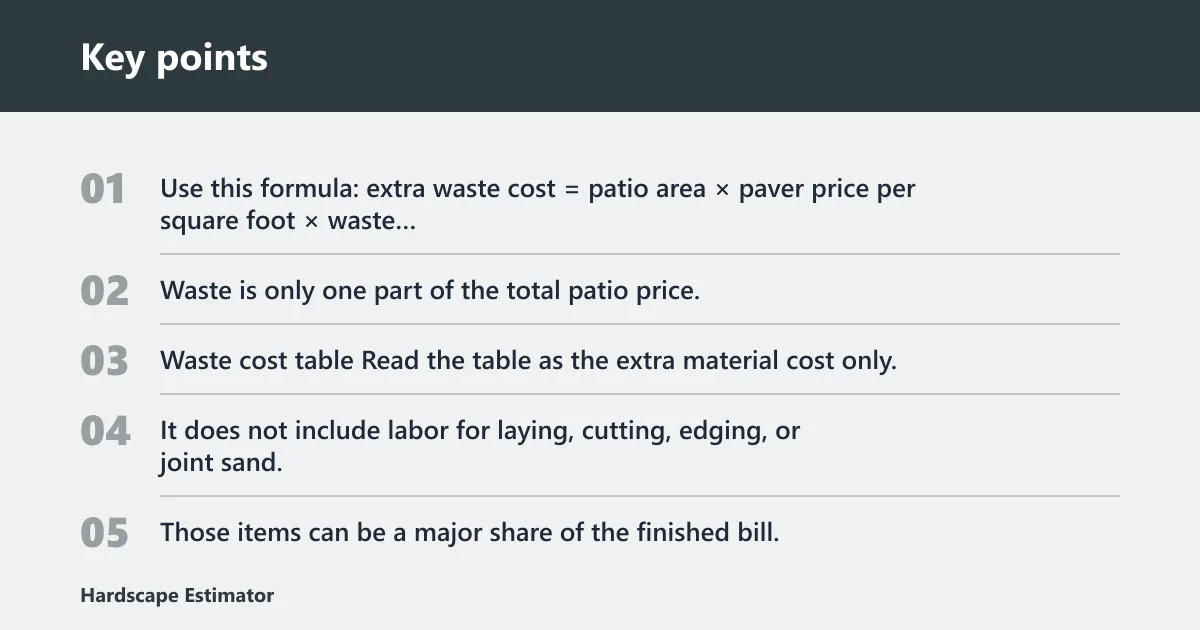
Use this formula:
extra waste cost = patio area × paver price per square foot × waste percentage
So a 400 sq ft patio with pavers at $15 per sq ft and 10% waste adds $600 in extra material cost. The same patio at $25 per sq ft adds $1,000. Waste is only one part of the total patio price, but it is easy to price once the area and layout are known.
Waste cost table
| Patio area | Waste rate | Extra cost at $8/sq ft | Extra cost at $15/sq ft | Extra cost at $25/sq ft |
|---|---|---|---|---|
| 100 sq ft | 5% | $40 | $75 | $125 |
| 100 sq ft | 10% | $80 | $150 | $250 |
| 100 sq ft | 15% | $120 | $225 | $375 |
| 280 sq ft | 5% | $112 | $210 | $350 |
| 280 sq ft | 10% | $224 | $420 | $700 |
| 280 sq ft | 15% | $336 | $630 | $1,050 |
| 400 sq ft | 5% | $160 | $300 | $500 |
| 400 sq ft | 10% | $320 | $600 | $1,000 |
| 400 sq ft | 15% | $480 | $900 | $1,500 |
| 500 sq ft | 5% | $200 | $375 | $625 |
| 500 sq ft | 10% | $400 | $750 | $1,250 |
| 500 sq ft | 15% | $600 | $1,125 | $1,875 |
Read the table as the extra material cost only. It does not include labor for laying, cutting, edging, or joint sand. Those items can be a major share of the finished bill. For most U.S. homeowners in 2026, a professionally installed paver patio typically costs around $10 to $30 per square foot, and high-end stone can reach $50 per square foot.
Base materials matter too. Crushed stone, bedding sand, geotextile fabric, and edge restraint can add roughly $1.40 to $2.20 per square foot in one cited breakdown, and those layers are critical to flatness over time.
What waste percentage should I budget?
Start at 5% for a simple rectangle and move toward 10% or 15% as the layout adds cuts. Straight-running fields use fewer partial pieces, while diagonals, herringbone, circles, borders, and tight curves use more full pieces and create more offcuts. Waste is a planning number, not a fixed rule.
Simple layouts
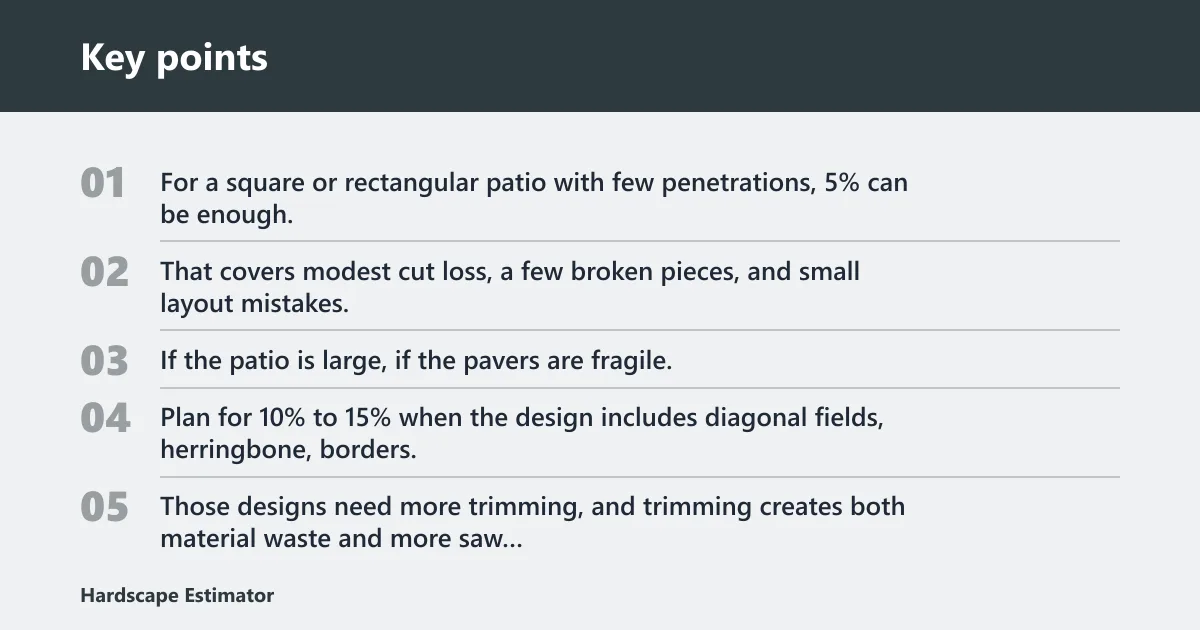
For a square or rectangular patio with few penetrations, 5% can be enough. That covers modest cut loss, a few broken pieces, and small layout mistakes. If the patio is large, if the pavers are fragile, or if the supplier sells by pallet with limited color runs, 10% is safer.
Complex layouts
Plan for 10% to 15% when the design includes diagonal fields, herringbone, borders, inlays, or curved edges. Those designs need more trimming, and trimming creates both material waste and more saw time. A 15% allowance is often the safer starting point when the shape is irregular or the finish has many transitions.
Say your patio is 280 sq ft with a simple rectangular field. At $15 per sq ft and 5% waste, the extra material cost is $210. If the same patio uses a diagonal layout and waste is about 15%, the extra material cost comes out to about $630. The layout change alone adds $420 before labor changes are counted.
Paver patio cost itself usually ranges from $8 to $25 per square foot nationally, with concrete pavers often around $8 to $15 per square foot installed and natural stone often around $15 to $50 per square foot installed. That range matters because the same waste percentage costs more on premium material.
Does herringbone cost more?
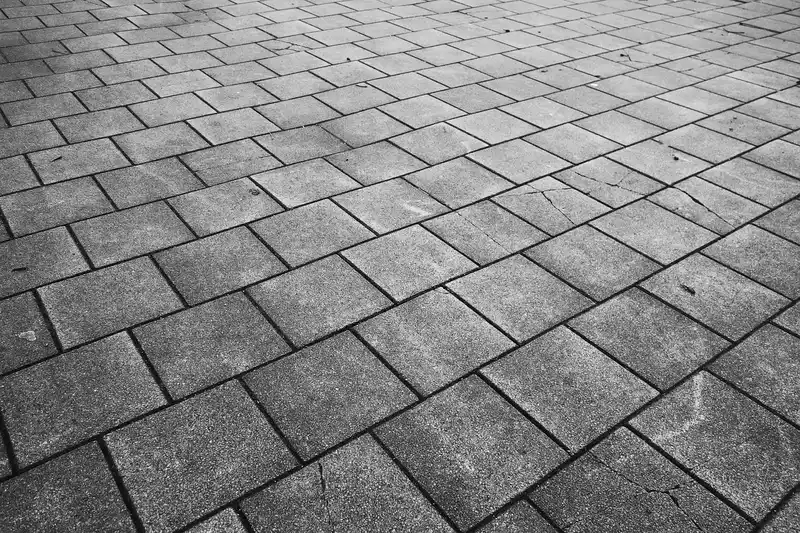
Yes, herringbone usually costs more than running bond because it creates more cuts and more saw time. The pattern is often chosen for strength in traffic areas, so the added cost can be justified by function. The key point is that labor rises even when the waste percentage stays the same.
Running bond versus herringbone
Running bond uses longer uninterrupted lines and typically wastes less material. Herringbone locks pieces together and often needs more edge trimming, especially around the perimeter and at transitions. That means the installation can need more labor hours even if the material overage only rises by a few percentage points.
Where the money changes
The extra cost from herringbone comes from two places: more pavers consumed by cuts and more labor time for layout and cutting. Labor for paver installation is often $4 to $11 per square foot or $50 to $80 per hour, and that work includes compaction, screeding the sand, laying, and cutting pavers.
A common first-timer mistake is to compare only waste percentages and ignore the saw time. A herringbone patio may waste more material than a straight pattern, but the bigger budget jump can come from labor if the shape is full of corners or border changes.
Suppose two patios both measure 400 sq ft and both use $15 pavers. A running bond field at 5% waste adds $300 in material overage. A herringbone layout at 15% adds $900. The difference is $600, and the labor line may rise too because of the extra cutting.
Curves, borders, and inlays
Curves and borders increase both waste and labor because more pieces need trimming and fitting. Inlays and custom edge treatment can push waste above a simple rectangular field even when the total square footage stays the same. These features do not always make a project a bad choice, but they change the cost structure.
Curves and circles
Curves and circles create the most cut-heavy work because straight pavers rarely fit the shape without trimming. That raises offcut volume and slows installation. If the patio includes a rounded seating edge or a circular pad, budget more than a flat rectangle of the same area.
Borders and inlays
Borders and inlays add partial pieces at the edges and intersections. Those short pieces increase the chance of breakage and make material use less efficient. They also increase layout time because the installer has to preserve spacing and joint alignment across different directions.
Picture a 320 sq ft patio with a stone border around a rectangular field. The border may look small on paper, but it adds short cuts all the way around the perimeter. That extra cutting can add less to material waste than a full pattern change, yet still raise the labor line enough to matter.
The Chicago range of $8 to $26, or roughly $2,560 to $8,320 before steps, walls, or removal of an old surface, is a useful reminder that the base patio price can move fast before waste is added. Design complexity pushes that number upward.
Same pallet, future repairs, and matching
Ordering from the same pallet or batch matters because color consistency can shift across production runs. Later reorders may not match the original shade exactly, even if the size and style are the same. Spare material is usually a color-match decision first and a repair budget second.
Same batch ordering
If the project is a one-time install, it is usually better to order enough from the same pallet than to rely on a second shipment later. That reduces the risk of visible shade variation. For larger patios, confirm that the supplier can provide enough material from one batch or from closely matched lots.
Extra material for repairs
For future repairs, a small reserve can make sense. Keep the note separate from the install estimate, because repair overage is not the same as installation waste. The practical question is whether the homeowner wants matching replacements later or is comfortable with a close but not exact match.
Do not build future repair overage into the patio total unless it is clearly labeled as spare material. Otherwise the estimate becomes misleading. A modest reserve is a storage decision, not part of the installed square-foot price.
Do different paver sizes change waste and breakage? Yes. Larger units can reduce the number of joints, but they may be heavier to handle and more prone to breakage during cuts. Smaller units often fit curves better, which can reduce offcuts in complex shapes. The best choice depends on the pattern and the geometry of the patio.
Frequently asked questions
How much does paver waste add to a patio budget?
For many patios, waste adds 5% to 15% to the paver material line, and the dollar impact depends on size and material price. Complex layouts can push it higher.
What percent of extra pavers should I budget for a patio?
Budget 5% for a square or rectangular patio, 10% for many standard projects, and 15% when the design uses diagonals, herringbone, curves, borders, or inlays. If the layout is highly irregular, the safer number can be above 15% because cutting loss and breakage rise together.
Does herringbone waste cost more than straight paver patterns?
Usually yes. Herringbone needs more cuts than running bond, so it creates more offcuts and takes more labor time. The material overage may be modest on a small patio, but the labor increase can be larger than the waste percentage suggests, especially on edges and corners.
How do curves and borders affect paver waste and total cost?
Curves and borders increase both waste and labor because more pieces need trimming, fitting, and checking for alignment. That raises the number of cut pavers and the time spent on the saw. The finished look can be worth it, but the estimate should reflect the added work.
Should I price waste as extra pavers or as a cost per square foot?
For estimating, use both. Price the patio by square foot, then multiply the paver material portion by the waste percentage. That keeps the budget tied to area while showing the extra money caused by layout choice. It is the clearest way to compare patterns.
Can I reduce waste by ordering from the same batch or pallet?
Yes, but the main benefit is color consistency, not lower waste. Ordering from one batch reduces the risk that a later reorder looks different in the patio. It also helps if a few pavers need replacing after installation, because matching spare pieces are easier to use.
What line items besides pavers increase a patio estimate?
Labor, excavation, hauling, base materials, sand, edging, drainage work, grading, steps, seat walls, fire features, and sealing can all raise the total. Labor and base work are especially important because they support flatness and durability. That is why a paver patio can cost far more than the pavers alone.