Do You Need Drainage Pipe Behind a Retaining Wall Base?
Yes, if the wall retains more than about 3 ft of soil, sits in clay, catches runoff, or supports a driveway, install a perforated drain pipe at the base. Gravel alone is only enough for short, free-draining walls. Poor drainage can force water against the wall, stain the face, and shorten service life fast. This guide covers the decision rule, the site conditions that make pipe non-optional, and when gravel alone may be enough.
Direct answer: when the base needs pipe
A retaining wall base often needs drainage pipe, but not every wall needs the same setup. Short, low-risk walls on sandy or otherwise free-draining soil may work with gravel alone. Once the wall gets taller, sits in clay, or catches roof runoff or hillside water, a perforated base pipe becomes the safer choice.
Short answer by wall risk level
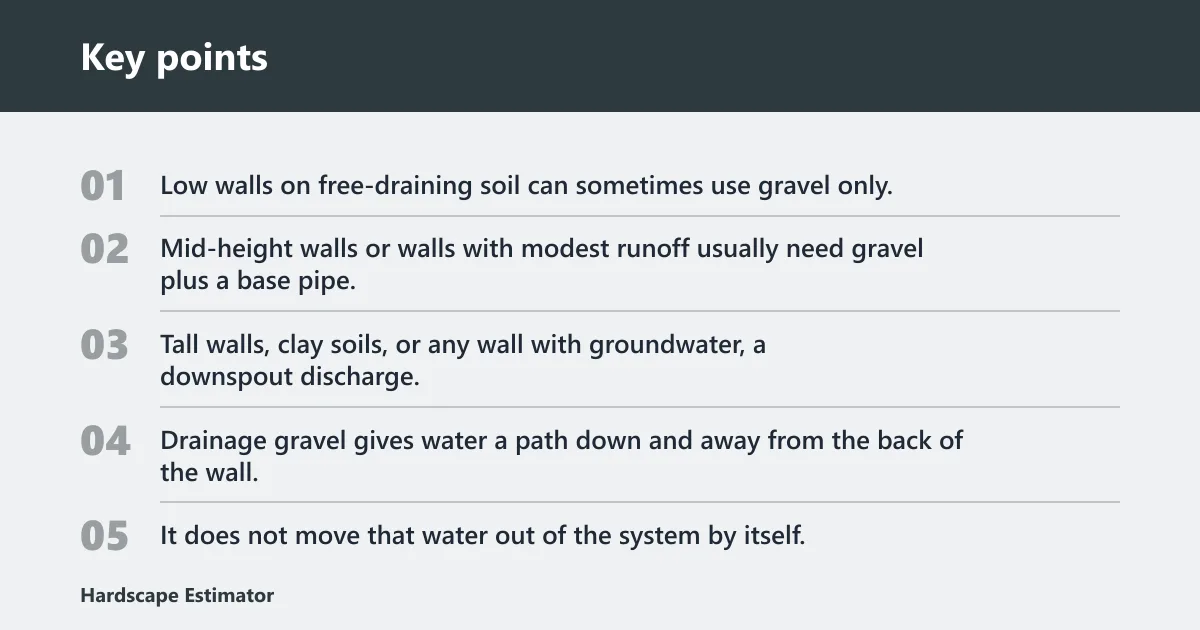
Think in three levels. Low walls on free-draining soil can sometimes use gravel only. Mid-height walls or walls with modest runoff usually need gravel plus a base pipe. Tall walls, clay soils, or any wall with groundwater, a downspout discharge, or heavy slope above it should move to engineer review.
What gravel alone can and cannot do
Drainage gravel gives water a path down and away from the back of the wall. It does not move that water out of the system by itself. If the water has no outlet, it can still collect at the base, raise pressure, and load the wall from behind.
The real failure mechanism is hydrostatic pressure. When soil saturates, water adds weight and force. That pressure can lead to bulging, leaning, cracking, or collapse.
Quick estimator note: line item or included
For estimating, count the drain pipe as a separate line item when the wall needs a defined outlet, a longer run, or a larger pipe size. If the wall is short, free-draining, and the plan uses only gravel with no pipe, include drainage stone in the wall drainage allowance instead of a pipe line.
Retaining wall decision matrix
Use this matrix to sort the wall before pricing drainage. The goal is simple: match wall height, soil type, slope above the wall, and nearby water sources to one of three outcomes. If the site pushes water toward the wall, the answer moves from gravel only to gravel plus pipe, or to engineer review.
| Wall height | Soil type | Slope above wall | Nearby water sources | Outcome | Estimating note |
|---|---|---|---|---|---|
| Up to 3 ft | Sandy or free-draining | Flat or slight | No downspout, no spring, no groundwater | Gravel only | Count drainage stone; pipe may be omitted if discharge is not needed. |
| Up to 3 ft | Clay or mixed fill | Any noticeable slope | Minor runoff nearby | Gravel plus base pipe | Price pipe, outlet fittings, and fabric as separate drainage items. |
| 3 to 4 ft | Sandy or free-draining | Uphill slope above wall | Roof runoff or upslope gutter flow | Gravel plus base pipe | Include a continuous pipe run and a daylight outlet or approved discharge point. |
| Over 4 ft | Any soil with poor drainage | Any slope that feeds the wall | Groundwater, spring flow, or a downspout discharge | Engineer review | Do not assume gravel alone is enough; pipe size, outlet, and wall design need review. |
| Over 4 ft | Clay | Any slope | Any concentrated water source | Engineer review | Expect drainage pipe as a separate item, but the wall design should be checked before pricing. |
Suppose a 3 ft 6 in wall sits in clay and the lot slopes toward it from the driveway. That moves the wall out of the gravel-only category. The safer estimate is gravel plus a base pipe, with the outlet counted as part of the drainage package.
How to read the matrix
- Start with wall height.
- Check soil. Clay pushes the answer toward pipe.
- Look uphill. Any slope that sheds water toward the wall raises risk.
- Find water sources. Downspouts, spring flow, and groundwater matter more than a dry lawn.
- Choose the outcome and price drainage separately when pipe is required.
When can gravel alone work?
Gravel alone can work on short walls in free-draining soil when the site does not collect water. That means low wall height, little slope above the wall, and no nearby runoff source. Even then, the drainage stone still has to be clean and continuous enough to move water downward.
Low walls on free-draining soil
For a short wall on sandy soil, gravel can be enough if the backfill drains quickly and the area above the wall does not send water into the excavation. The risk stays lower because less soil presses against the wall and less water remains trapped behind it.
Little slope above the wall
When the ground above the wall is flat or nearly flat, less water is driven toward the wall during rain. That makes gravel-only drainage more believable. Add slope, and the wall starts collecting more runoff and more pressure.
No concentrated water nearby
If there is no downspout, no spring seep, and no visible groundwater, the wall may not need a pipe on every job. Still, the drainage stone must extend behind the wall, and the design should leave a path for water to leave the backfill area instead of staying trapped.
When is a perforated pipe non-optional?
A perforated drain pipe becomes non-optional when the wall is at higher risk for water buildup. Clay soil, taller walls, uphill runoff, and nearby water sources all push the system toward pipe. For walls at or above 4 feet, one source says pipe is absolutely necessary.
Clay or poorly draining soil
Clay soil holds much more water than sandy fill. It drains slowly, so the wall stays loaded after rain for longer. In those conditions, gravel by itself is usually not enough to move water out fast.
Taller walls and added surcharge
As wall height goes up, pressure rises too. A 6-inch pipe for walls over 4 feet or for heavy water flow; another source says a 4-inch perforated drain pipe is standard for regular walls. Taller walls also deserve engineer review because drainage and structure work together.
Downspouts, groundwater, or uphill runoff
Water from a roof downspout, seepage from uphill ground, or shallow groundwater can overload the backfill. Those are the situations where pipe is doing real work, not just sitting in the wall build. If the pipe cannot carry water to daylight or another outlet, it does not solve the problem.
A common first-timer mistake is burying a perforated pipe behind a wall and stopping there. The pipe needs a discharge point lower than the wall so water can leave the system. Without that outlet, water can still collect in the backfill and press on the blocks.
Pipe size, slope, and outlet details
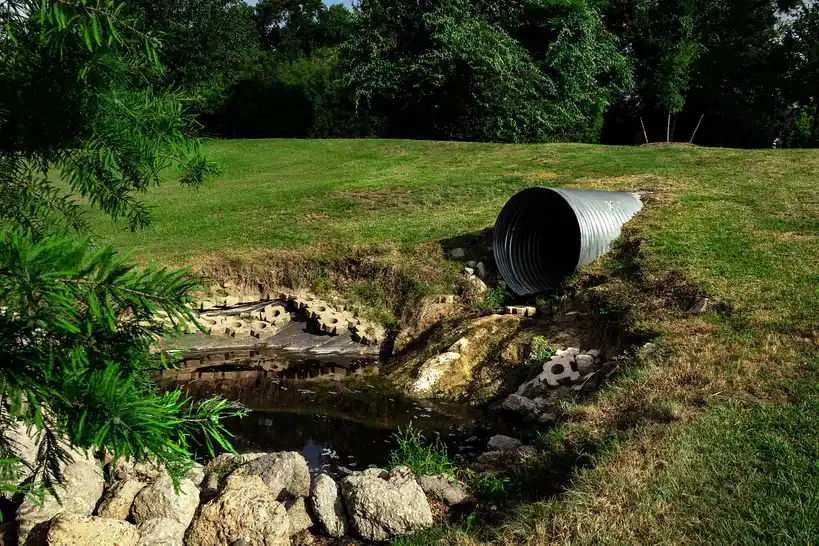
For most retaining walls, a 4-inch perforated drain pipe is the standard size. A 6-inch pipe is commonly used when the wall is taller or when water flow is heavier. Place the pipe at the base of the wall, or at the footing, and route it so the water can drain out of the system.
4-inch vs 6-inch pipe
The 4-inch size fits most standard wall drainage layouts. The 6-inch option is better when the wall is over 4 feet or when the site sends more water toward the wall than average. Bigger pipe gives water more passage area, which matters when flow is heavy.
Hole orientation and slope
Pipe holes should face down. That helps collect water from the gravel zone while reducing sediment entry. The pipe should slope at least 1% toward an outlet, and another says about 1 inch for every 8 feet. Either way, the pipe needs a steady fall.
Daylight outlet and discharge points
Drainage pipe should daylight or discharge to a suitable drainage outlet. A base pipe that ends inside the wall fill is not a real drainage solution. The outlet should be lower than the wall so gravity can move the water away from the retained soil.
Can you use a drain pipe with a downspout behind a retaining wall? Yes, but only if the discharge is designed to stay clear of the wall backfill and local rules allow it. A downspout should not dump water where it can soak the wall footing or the gravel zone.
Weep holes as an exit option
Weep holes are another way to let water leave the wall. They are placed low on the wall and one source says they may be spaced every 4 to 6 feet. They can help, but they are not a universal substitute for a base pipe on taller or wetter sites.
Drainage gravel and fabric
Drainage gravel is the backfill that gives water a free path. Use clean 3/4-inch crushed stone with no fines. Angular aggregate is preferred because it leaves open spaces for water to move. Soil fines are the enemy here; they clog voids and slow drainage.
Drainage zone thickness
One source gives a 12-inch wide gravel drainage zone as standard. Other sources say the drainage stone should extend 12 inches behind the blocks and continue from the base to within 6 inches of the top of the wall. For taller walls, one source recommends 18 inches of gravel.
That zone should do more than sit behind the bottom row. It should run up the wall so water has room to move toward the outlet or weep holes instead of building up against the blocks.
Filter fabric placement and purpose
Filter fabric keeps soil fines out of the drainage gravel and pipe. A non-woven geotextile is a common choice. Wrap the gravel zone, or wrap the pipe area as the detail calls for, so soil does not clog the stone and reduce drainage over time.
Picture a 4 ft wall above a backyard slope with a downspout emptying nearby. Gravel alone would be a weak bet there. The better layout is clean stone, filter fabric, and a base pipe that can daylight away from the wall.
What fails when drainage is missing?
Without drainage, water collects behind the wall and creates hydrostatic pressure. That pressure can bulge the wall, lean it forward, crack units, or cause collapse. The damage often starts small, but it grows once water has nowhere to go.
Hydrostatic pressure buildup
Water adds weight to the soil and presses on the wall face. Wet soil also stays heavy longer than dry soil. If the wall cannot release that water through gravel, pipe, or weep holes, the pressure keeps building after rain.
Visible warning signs
Look for staining, a damp line near the base, slight bulging, cracked blocks, or a wall that has started to lean. Those are signs that drainage is not working the way it should. They can show up before a full failure.
Repair cost versus prevention
It is usually cheaper to install drainage during construction than to fix a failed wall later. Once a wall starts moving, the repair may require partial teardown, new backfill, and a new drainage layout. That is why the base drainage decision matters at the estimate stage.
Frequently asked questions
Do you need drainage pipe behind a retaining wall base?
Most retaining walls need a perforated drain pipe at the base when the wall is taller, the soil drains poorly, or the site collects runoff. Gravel alone can work on short, free-draining walls, but the pipe is the safer choice once water has a clear path to build up behind the wall.
Can gravel alone drain behind a retaining wall?
Yes, but only in limited cases. Gravel alone is more likely to work for short walls on sandy soil with little slope above the wall and no concentrated water source. It still needs clean stone and a path for water to move out of the backfill area.
When is a perforated drain pipe absolutely necessary?
It is absolutely necessary for walls at or above 4 feet. It also becomes non-optional when the site has clay soil, uphill runoff, groundwater, or a nearby downspout. Those conditions raise water load and make a base outlet much more important.
How far should the drain pipe slope behind a retaining wall?
The pipe should slope at least 1% toward an outlet. Another says about 1 inch for every 8 feet. The key is simple: the pipe must keep moving water toward daylight or another discharge point so it does not sit in the wall fill.
Where do the holes face on perforated drain pipe?
The holes should face down. That orientation helps collect water from the gravel zone while limiting sediment entry from above. The pipe still needs clean stone around it and a route to daylight or a drainage outlet so the water can leave the system.
What size pipe is used behind a retaining wall?
A 4-inch perforated drain pipe is the standard size for most walls. Use 6-inch pipe for walls over 4 feet or where heavy water flow is expected. The larger pipe helps when the wall has more drainage demand than a standard layout can handle.
What happens if a retaining wall has no drainage pipe?
Water can build up behind the wall and create hydrostatic pressure. That can cause leaning, bulging, cracking, or collapse. Even if the wall stays standing for a while, trapped water can shorten service life and make the wall harder and more expensive to repair later.
What type of soil makes retaining wall drainage more important?
Clay soil makes drainage more important because it holds water and drains slowly. Poorly draining fill has the same problem. In those conditions, the wall is more likely to stay wet behind the face, so gravel plus a base pipe is usually the better choice.