Paver Waste: How Much Extra to Order
A common rule of thumb is to order about 5% extra for a simple rectangular running-bond patio, about 8% to 10% for most projects with edge cuts, and about 10% to 15% for diagonals, curves, driveways, or hard-to-match pavers. Order too little and the job can stop for a second shipment or a mismatched lot. Order too much and money stays on the pallet. This guide separates cut loss, breakage buffer, and repair reserve, then shows the math to turn area, pattern, and price into a final order quantity and cost.
Three overage buckets
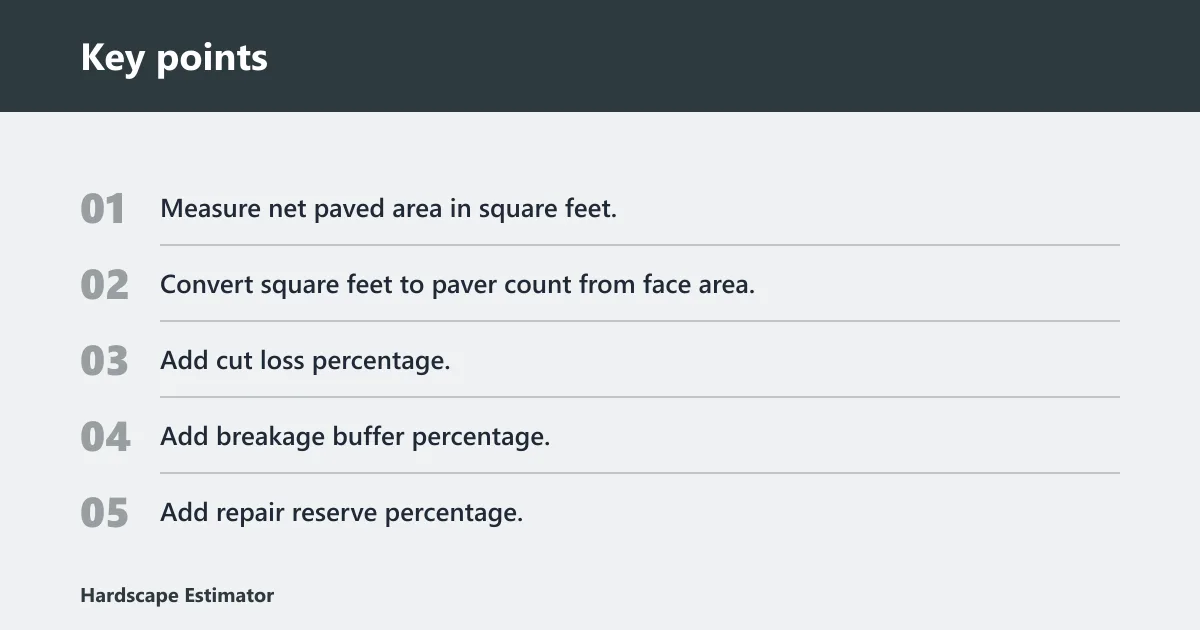
Cut loss, breakage buffer, and repair reserve
A paver waste factor is the percentage ordered above the net field area. Many people use one number for everything, but that masks why the extra is needed. For ordering, split the overage into three buckets: cut loss for trim pieces, breakage buffer for handling and jobsite damage, and repair reserve for future replacements.
Cut loss is the big variable. Straight layouts with full units along most edges waste less. Curves, diagonals, soldier courses, inlays, and small accent fields create more offcuts that cannot always be reused.
Breakage buffer is different. It covers chipped corners, split cuts, transport damage, and a few bad pieces during installation. This bucket is usually small, but it should be named instead of buried inside a vague waste percentage.
Repair reserve is not installation waste at all. It is spare stock kept after the job for future utility work, stain replacement, or a cracked unit near a threshold. On some jobs, especially where the color or finish may change between production runs, the repair reserve matters as much as the install waste.
Why one percentage hides ordering mistakes
A flat “10% extra” can be too much for a plain stack-bond patio and too little for a diagonal walkway with radius cuts. It also hides whether the extra is being used now or stored for later.
That matters when the order gets close to a full layer or full pallet. A percentage may say 1,012 pavers, but the yard may sell by pallet packs of 1,080. In that case, pallet rounding drives the final quantity, not the waste percentage alone.
The final order formula
Use this sequence:
- Measure net paved area in square feet.
- Convert square feet to paver count from face area.
- Add cut loss percentage.
- Add breakage buffer percentage.
- Add repair reserve percentage.
- Round up to whole pavers, then to full layers or pallets if required.
Written as a formula:
Final order = net paver count × (1 + cut loss + breakage buffer + repair reserve), then round up to packaging.
For example, if the net field needs 900 pavers and the job includes about 6% cut loss, 2% breakage buffer, and 3% repair reserve, the math works out to about 900 × 1.11, or 999 pavers. If the pallet layer breaks at 1,000, order 1,000. If the pallet pack is 1,080, order 1,080.
How much extra paver waste should you order?
For a simple straight patio or walkway, a common starting point is around 5% extra. Move to 8-10% when edge cuts become common, and 10-15% for diagonals, curves, driveways, or mixed layouts. Keep repair stock separate so the installation allowance does not get confused with future replacement inventory.
Simple straight patios and walkways
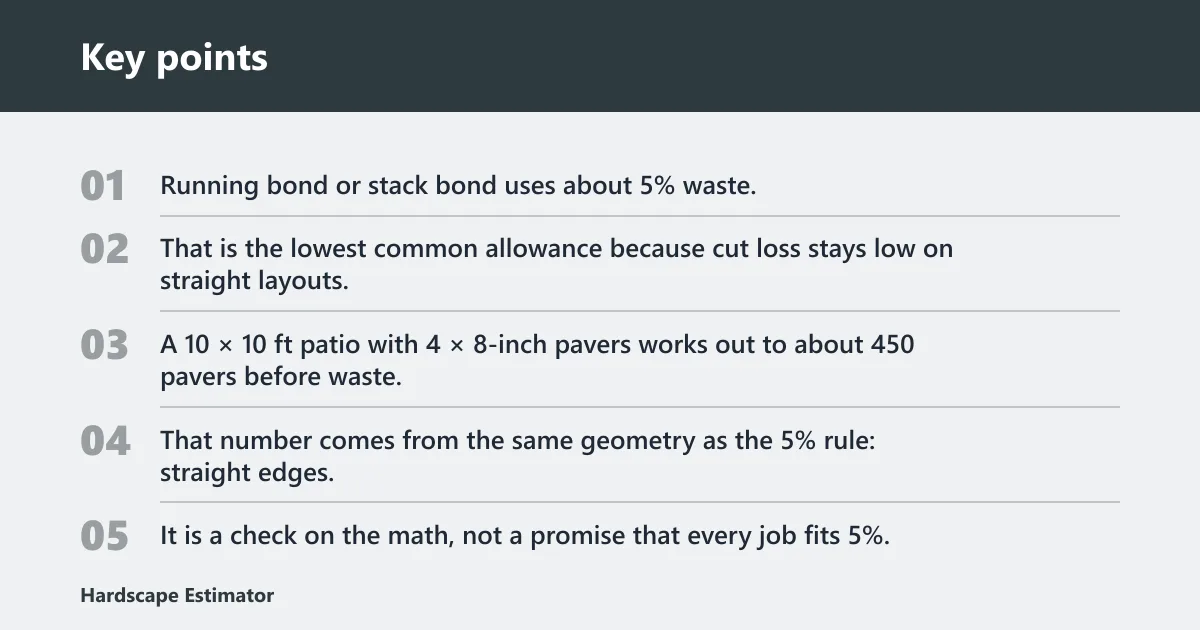
Running bond or stack bond uses about 5% waste. That is the lowest common allowance because cut loss stays low on straight layouts. A 10 × 10 ft patio with 4 × 8-inch pavers works out to about 450 pavers before waste, or about 473 pavers with 5% waste.
That number comes from the same geometry as the 5% rule: straight edges, a simple field pattern, and little trim loss. It is a check on the math, not a promise that every job fits 5%. A patio boxed by steps, columns, or planters will need more.
Diagonal layouts, borders, and curved edges
Diagonal fields waste more because the edge cuts are triangular and harder to reuse. Layouts with curves often need about 10% waste, and 45-degree herringbone is often estimated toward the upper end of the 10% to 15% range.
Curves and irregular borders also push waste up even if the main field is simple. A common first-timer mistake is counting a curved walkway as a plain rectangle, then finding that every outside edge creates slivers and every inside curve creates repeated cut loss.
Driveways and heavy-cut patterns
Driveways usually need a larger ordering buffer even when the field shape is simple. The pattern is often herringbone for interlock, edge confinement is stricter, and later replacements can be harder to match if a unit is discontinued.
Herringbone commonly needs about 10% to 15% extra, with 45-degree layouts typically toward the higher end. Circular patterns can need about 20% waste. For traffic areas, base depth and drainage should be set by site conditions and expected loads; if the driveway will carry vehicles, that base design is a contractor or engineer call.
Ordering buffer table
Recommended extra by project type
| Project type | Example pattern or edge condition | Cut waste | Breakage buffer | Repair reserve | Total extra | Order formula |
|---|---|---|---|---|---|---|
| Straight patio | Running bond or stack bond, rectangular perimeter | 3% | 1% | 1% | 5% | Net count × 1.05 |
| Diagonal patio | 45° field with straight edges | 6% | 2% | 2% | 10% | Net count × 1.10 |
| Herringbone driveway | 45° herringbone, traffic-rated field | 8% | 3% | 2% | 13% | Net count × 1.13 |
| Curved walkway | Radius edges and repeated trim cuts | 7% | 2% | 2% | 11% | Net count × 1.11 |
| Border-heavy design | Main field plus soldier course and accent panels | 7% | 2% | 3% | 12% | Net count × 1.12 |
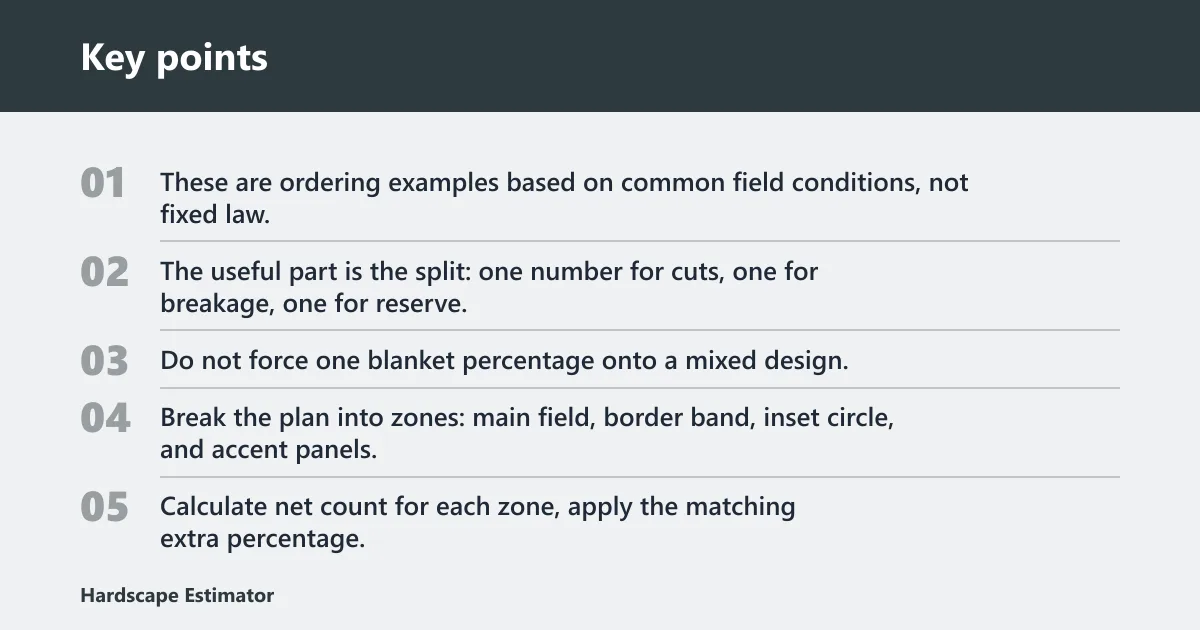
These are ordering examples based on common field conditions, not fixed law. The useful part is the split: one number for cuts, one for breakage, one for reserve.
How to use the table with mixed layouts
Do not force one blanket percentage onto a mixed design. Break the plan into zones: main field, border band, inset circle, and accent panels. Calculate net count for each zone, apply the matching extra percentage, then add the zones together.
Suppose a patio has 160 sq ft of running bond field and 40 sq ft of border-heavy work around a fire pit. The field may deserve 5% total extra while the border section deserves 12%. That gives a closer order than calling the whole 200 sq ft job “10% waste.”
When pallet rounding changes the answer
Round up in stages. First round to whole pavers. Then check whether the supplier sells by layer, cube, or pallet. If the percentage-based count lands just above a pallet break, the final order may jump more than expected.
Say your count comes to 978 pavers, and the product ships in 120-unit layers with 960 on a full pallet. If the yard sells full pallets only, one pallet is not enough, so the next full-pallet quantity controls. If the yard will add a layer, the order would round up to 1,080.
How do you calculate how many pavers you need?
Calculate net area first, then convert that area to paver count using the paver face area. After that, add cut loss, breakage, and reserve, then round up to packaging. For a standard 4×8 paver, the conversion is about 4.5 pavers per square foot.
Area in square feet
For rectangles, area is length × width. A 12 ft × 15 ft patio is 180 sq ft.
Irregular jobs should be split into simple shapes, then added together. For circles or curves, measure carefully from the plan instead of guessing from the longest span.
Face area and pavers per square foot
The checkable formula is:
Pavers per sq ft = 144 ÷ face area in square inches
A 4 × 8 paver has a face area of 32 sq in. So 144 ÷ 32 = 4.5 pavers per sq ft. That matches the standard rule that a 4×8 paver needs about 4.5 pavers per square foot.
Paver size changes the count even when square footage stays the same.
Worked example with a 4×8 paver
Use a 16 ft × 12 ft patio in herringbone.
- Area: 16 × 12 = 192 sq ft.
- Pavers per sq ft: 4.5.
- Net paver count: 192 × 4.5 = 864 pavers.
- Add 10% total extra for a diagonal herringbone-type layout: 864 × 1.10 = 950.4.
- Round up: 951 pavers, or the next package break.
The arithmetic checks out.
Different paver sizes and pack assumptions can change the count. The point is to use the face-area formula for the actual unit being ordered, then apply the layout allowance that matches the plan.
How much waste do herringbone and diagonal patterns need?
Diagonal and herringbone layouts usually need more extra than straight bond because they create repeated edge cuts that cannot always be reused. As a working range, start near 10% for many diagonal or curved layouts, move toward 15% for 45° herringbone, and use more where circles or dense borders raise trim loss.
Why 45-degree layouts create more trim loss
A 45-degree field hits every straight edge at an angle. That produces wedges, triangles, and short pieces. Some can be reused on the opposite side, but many cannot, especially once a border or soldier course changes the edge condition.
That is why 45° herringbone is often estimated near the upper end of the common range for cut-heavy layouts. Angle plus edge condition is what raises the order.
Typical ranges by pattern
Running bond and stack bond usually sit around 5% on simple straight work. Herringbone commonly needs about 10% to 15% extra. Circular patterns can need about 20% waste. Basketweave and other modular fields often land between those points depending on border conditions and whether the modules repeat cleanly at the perimeter.
A 10×10 patio with 10% waste needs about 495 standard 8×4 pavers. That lines up with 100 sq ft × 4.5 = 450 net pavers, then 450 × 1.10 = 495.
Borders, soldier courses, and small inlays
Small accent fields can be waste-heavy even when the total area is small. Every transition line creates extra cuts. Soldier courses often force narrow fit pieces against house walls, steps, or curves.
Picture a 220 sq ft patio with a simple running-bond center and a 1-ft border around the perimeter. The center might still justify only 5% total extra, but the border band could need 10% to 12% by itself because every corner and return produces short offcuts.
Does paver size affect how many extra to order?
Yes. Paver size changes the base count per square foot, the number of edge cuts along a border, and the chance that a damaged unit matters. Small modular pavers raise the unit count; large-format pavers reduce count but can increase handling loss and make each broken piece more expensive.
Large-format units vs small modular pavers
Smaller units mean more pieces per square foot, which increases the raw count and can change how edge cuts work out on some shapes. Larger units lower the count, but one broken slab removes more coverage at once and may be harder to blend into repairs later.
Why paver count changes even when area does not
The area stays the same. The count does not. With the face-area formula, a unit with a smaller face area produces more pavers per square foot. That affects the final order directly because all extra percentages are applied to the net count.
It also affects borders. Along a given perimeter, more small pieces can mean more joints but finer adjustment. Fewer large pieces can mean fewer cuts overall, or harder cuts if the border is tight and irregular. The plan decides which effect matters more.
Breakage handling and cut efficiency
Breakage buffer should respond to unit type. Thin units, textured edges, or large-format pieces may justify a slightly larger handling allowance than a simple chamfered modular paver. That is still separate from the repair reserve.
Should you order extra pavers from the same pallet or batch?
Yes, when possible. Spare pavers should come from the same production run or at least the same batch range so color and surface texture stay closer. A second order placed later can bring noticeable variation, extra freight, or no match at all if the unit has changed.
Production runs and color consistency
Pavers from one production batch are usually closer in shade than pavers ordered later from a different run. That matters most with blended colors, tumbled finishes, and jobs where a future repair will sit in full view.
Ordering enough the first time also avoids the stop-start cost of a second delivery. Underordering can leave installers waiting while the yard hunts for matching stock.
Second-order mismatch risk
A second order brings three risks: batch mismatch, freight inefficiency, and discontinued units. Even if the nominal color name is still sold, the blend may not match the first shipment closely.
How much repair stock to store
For many residential jobs, a separate repair reserve of 1% to 3% is practical. The higher end makes more sense for hard-to-match colors, imported lines, or projects with visible edge units that may be disturbed later for utility work.
Store the reserve dry and labeled with the product name, size, finish, and purchase date. Keep full units, not only cutoffs.
How much does paver waste add to total cost?
Waste adds cost in direct proportion to the extra pavers ordered, then sometimes jumps again when pallet rounding pushes the order to the next pack break. The clean way to price it is to calculate the net count first, price the extra pavers separately, and then check whether packaging forces a higher buy.
Converting extra pavers into dollars
Start with a count-based example. If the selected project type needs 10% total extra, the order becomes 990 pavers, so the extra is 90 pavers.
If those pavers cost $1.20 each, the waste and reserve add 90 × $1.20 = $108. That is the cost effect of the overage alone, before freight or pallet rounding.
Example with unit price and pallet rounding
Suppose the same 990-paver result must be rounded to 1,080 because the supplier sells full layers only. That adds 180 pavers above the net count, not 90. At $1.20 each, the overage cost becomes 180 × $1.20 = $216.
This is where many estimates go wrong. The percentage looked modest, but packaging changed the purchase cost.
Why underordering can cost more than modest overage
A small reserve can be cheaper than a second shipment. If the first order misses by 40 pavers and the yard charges separate freight or cannot match the batch, the real cost is not just the missing units. It is freight, delay, and possible visible variation in the finished surface.
Questions like how much do pavers cost, how much are pavers, or how much does system pavers cost do not have one site-wide answer. Unit price depends on size, thickness, finish, region, and pack quantity. The estimating method stays the same: net count, then extra buckets, then packaging, then dollars.
What else belongs in a complete paver order?
A full order includes more than field pavers. Add edge restraint in linear feet, bedding sand at about 1 inch, compacted base gravel under the pavers, and polymeric sand for the joints. Those materials are separate from paver waste and should be listed as separate line items.
Edge restraint in linear feet
Edge restraint is measured in linear feet, not square feet. Measure the exposed perimeter that needs confinement. A patio with one side tight to a foundation may need restraint on only the other sides, while a free-standing walkway needs restraint on both edges and its ends.
Bedding sand at about 1 inch
Bedding sand is about 1 inch deep under the pavers. ASTM C33 coarse concrete sand is a common spec reference for this setting bed. Do not fold bedding sand into the gravel base quantity; they are different materials with different roles.
Base gravel depth and polymeric sand coverage
Pavers are usually set over 4 to 6 inches of compacted gravel base. For some jobs, especially driveways, the base may be deeper; many guides describe a compacted 4 to 8 inch layer with depth varying by project type. Local soil, drainage, freeze-thaw exposure, and vehicle loads control the design, so traffic areas should be sized by a contractor or engineer.
Polymeric sand is the joint filler. Coverage depends on joint width and paver thickness, so use the bag chart for the selected unit. A tight-joint modular paver and a large chamfered unit with wider joints will not use the same amount.
Frequently asked questions
How many extra pavers should I add for a patio or walkway?
For a simple rectangular patio or walkway in running bond or stack bond, about 5% extra is a common starting point. If the job has curves, diagonal lines, planters, steps, or border bands, move into the 8-10% range and separate any future repair stock from the installation allowance.
How many extra pavers should I keep for future repairs?
About 1% to 3% of the final field count is a practical repair reserve for many residential jobs. Keep that stock separate from cut and breakage waste. Use the higher end when color matching may be hard later or where utility work could force a patch in a visible area.
How much does paver waste add to total patio cost?
Multiply the extra paver count by the unit price, then check whether pallet or layer rounding forces a larger purchase. For example, 90 extra pavers at $1.20 each add $108. If packaging pushes the order higher, the overage cost rises with the rounded quantity, not the percentage alone.