Grass Seed Guide: How Much, When, and How to Use It
Measure the areas you will actually seed, use the label seeding rate for your planting goal, and apply the seed evenly with a spreader: many homeowner lawn products are commonly reported around 4–8 lb per 1,000 sq ft for a new lawn and 2–4 lb for overseeding, while broader species ranges are often reported around 5–10 and 2–5. For planting windows, cool-season grasses are often seeded from late August into fall, while warm-season grasses are often seeded from late May into early summer after soil warms. Seed too lightly and thin areas stay bare. Seed too heavily and you waste money, crowd seedlings, and invite disease. This guide turns lawn size, grass type, and planting goal into exact pounds, bag counts, and best planting windows.
The core formula is simple: seed needed = lawn area in sq ft ÷ 1,000 × seeding rate in lb per 1,000 sq ft. Then round up to whole bags.
The first decision is new lawn or overseeding. If you are seeding bare ground or rebuilding a failed lawn, use a new-lawn rate. If existing grass already covers most of the soil and you only need to thicken it, use an overseeding rate.
The final authority is the seed label, not the big coverage number on the front of the bag. Front-panel claims often assume one planting goal, one rate, and one kind of seed. The label is where the product-specific application rate, purity, germination, and coating details appear.
How much grass seed do you need?
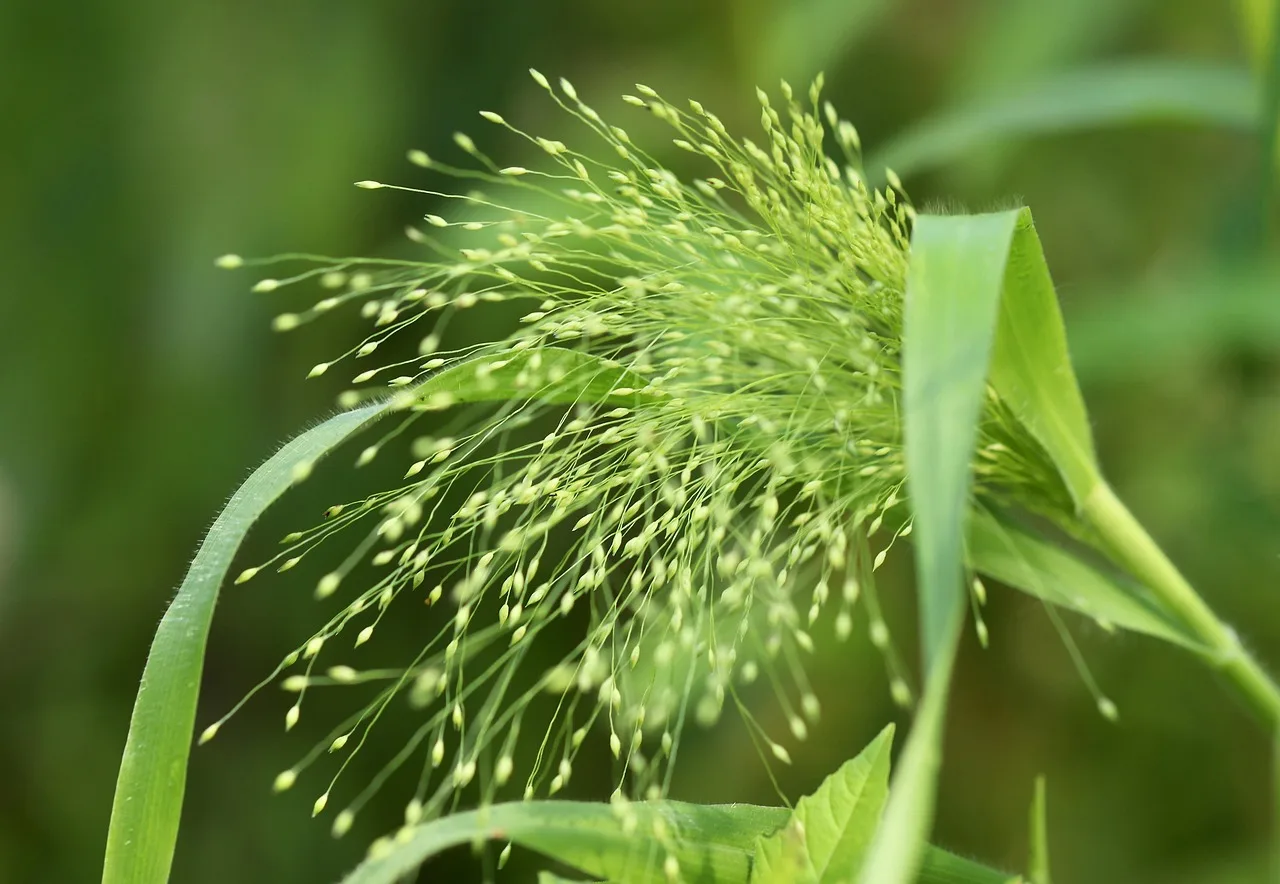
Measure only the areas that will actually be seeded, convert that planting area to square feet, and multiply by the label rate in pounds per 1,000 square feet. Then round up to whole bags.
Measure planting area, not property size
Start with gross lawn area, then subtract patios, driveways, planting beds, sheds, decks, pools, and any other non-seeded space. Buying from total lot size is one of the fastest ways to overbuy.
Use plain area math:
- Rectangle: length × width
- Circle: 3.14 × radius × radius
- L-shaped yard: split it into two rectangles, then add them
Worked square-foot examples
Rectangle example: a back lawn that is 60 ft by 40 ft is 2,400 sq ft. If the patio takes 12 ft by 16 ft, subtract 192 sq ft. Planting area = 2,400 − 192 = 2,208 sq ft.
Circle example: a round front island of turf with a 15 ft radius is 3.14 × 15 × 15 = 706.5 sq ft. Round reasonably for estimating: 707 sq ft.
L-shaped example: split the yard into a 30 ft by 40 ft rectangle and a 20 ft by 25 ft rectangle. Area = 1,200 + 500 = 1,700 sq ft. If a 10 ft by 10 ft shed pad sits inside one section, subtract 100. Planting area = 1,600 sq ft.
Turn square footage into pounds and bags
Once square footage is set, use the seeding formula. A 5,000 sq ft tall-fescue lawn at 8 lb per 1,000 sq ft needs 40 lb. That is a direct application of the formula: 5,000 ÷ 1,000 × 8 = 40.
If needed for edges, odd shapes, or spreader overlap, add a small waste allowance. At 10%, that same job becomes 40 × 1.10 = 44 lb. If buying 20 lb bags, round up to 3 bags, because 2 bags only provide 40 lb.
Say your front and back yard total 4,320 sq ft after subtracting the driveway and beds, and the label rate for a tall fescue blend is 6 lb per 1,000 sq ft for a new lawn. The math is 4,320 ÷ 1,000 × 6 = 25.92 lb. If you add 10% for a buffer, the purchase target becomes 28.51 lb, so rounded purchase options are three 10 lb bags or two 20 lb bags.
Which seeding rate should you use?
Use the new-lawn rate on bare soil, mostly bare soil, or a full renovation. Use the overseeding rate when existing turf already covers enough ground to thicken the stand rather than rebuild it.
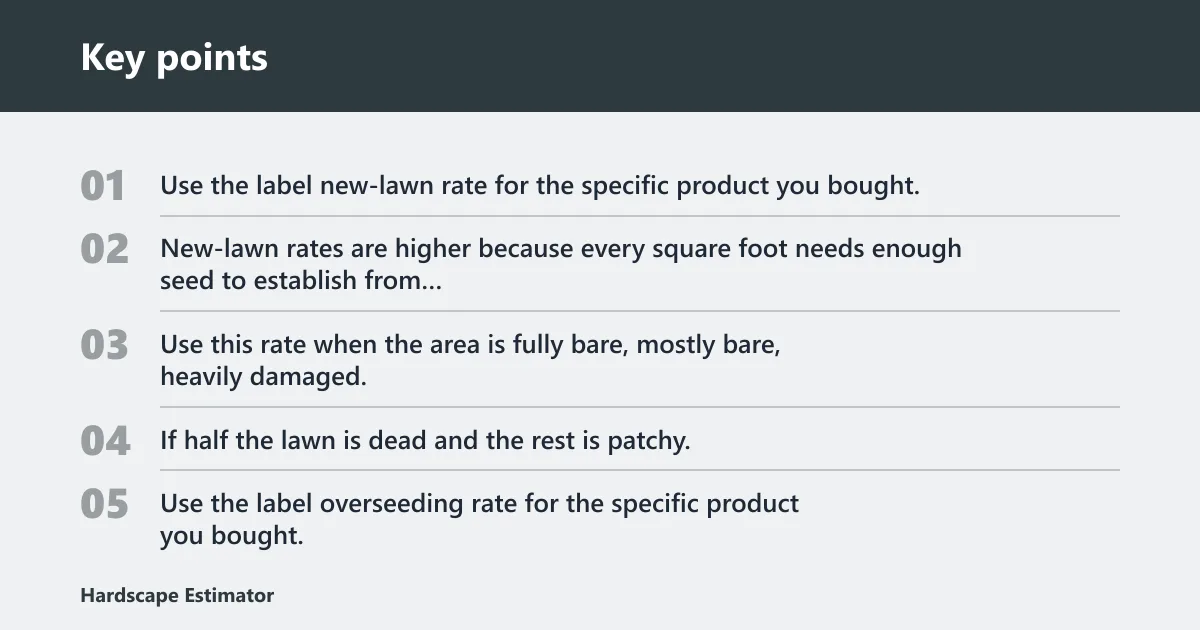
Use the new-lawn rate for bare or mostly bare areas
Use the label new-lawn rate for the specific product you bought. New-lawn rates are higher because every square foot needs enough seed to establish from scratch.
Use this rate when the area is fully bare, mostly bare, heavily damaged, or being stripped and restarted. If half the lawn is dead and the rest is patchy, that is usually closer to renovation math than overseeding math.
Use the overseeding rate for existing turf with decent coverage
Use the label overseeding rate for the specific product you bought. The goal is to thicken thin turf, repair small gaps, and improve density without burying the existing stand under excessive seed.
If the lawn still has broad, even coverage and sunlight does not hit large bare sections, overseeding is usually the right category. If bare soil is visible from the street across most of the lawn, move up to new-lawn rates or treat it as a renovation.
When to choose the low end or high end
Choose the low end of the range when turf density is already decent, the seedbed is clean and well prepared, and the goal is light thickening. Choose the high end when the stand is thin, damage is widespread, or the seed has to fill more open soil.
A common first-timer mistake is using the low overseeding rate on a lawn that is technically green but only covers half the soil surface. That often leaves a spotted result, because the rate matched a healthy lawn, not a failing one.
What changes the rate besides lawn size
Species matters first. Seed size differs sharply between grasses, so pounds per 1,000 sq ft do not match from one species to another. Kentucky bluegrass uses much lower new-lawn rates than tall fescue because the seed is smaller.
Blends matter too. A bag that mixes tall fescue with ryegrass or bluegrass may have a label rate that differs from any single-species chart. Coated seed matters as well, because part of the bag weight may be coating rather than plantable seed.
Grass seed table
Calculator table
| Lawn area | Grass type | New-lawn rate | Overseeding rate | Pounds needed | Bag counts | 10% waste allowance |
|---|---|---|---|---|---|---|
| 1,250 sq ft | Tall fescue | 6–10 lb/1,000 | 3–5 lb/1,000 | New lawn: 7.5–12.5 lb; Overseed: 3.75–6.25 lb | At 10 lb bags: 1 bag new lawn at low-mid rates; 1 bag overseeding | New lawn: 8.25–13.75 lb; Overseed: 4.13–6.88 lb |
| 2,500 sq ft | Kentucky bluegrass | 2–3 lb/1,000 | 1–2 lb/1,000 | New lawn: 5–7.5 lb; Overseed: 2.5–5 lb | At 7 lb bags: 1–2 bags new lawn; 1 bag overseeding | New lawn: 5.5–8.25 lb; Overseed: 2.75–5.5 lb |
| 5,000 sq ft | Tall fescue | 6–10 lb/1,000 | 3–5 lb/1,000 | New lawn: 30–50 lb; Overseed: 15–25 lb | At 20 lb bags: 2–3 bags new lawn; 1–2 bags overseeding | New lawn: 33–55 lb; Overseed: 16.5–27.5 lb |
| 5,000 sq ft | Tall fescue at 8 lb/1,000 | 8 lb/1,000 | 4 lb/1,000 | New lawn: 40 lb; Overseed: 20 lb | At 10 lb bags: 4 bags new lawn, 2 bags overseeding; At 25 lb bags: 2 bags new lawn, 1 bag overseeding | New lawn: 44 lb; Overseed: 22 lb |
| 6,000 sq ft | Perennial ryegrass | 5–10 lb/1,000 | 3–5 lb/1,000 | New lawn: 30–60 lb; Overseed: 18–30 lb | At 25 lb bags: 2–3 bags new lawn; 1–2 bags overseeding | New lawn: 33–66 lb; Overseed: 19.8–33 lb |
| 8,000 sq ft | Zoysiagrass | 1–2 lb/1,000 | Use label | New lawn: 8–16 lb | At 10 lb bags: 1–2 bags | 8.8–17.6 lb |
Bag math often changes the purchase more than the seed math does. A 10-pound bag may cover about 1,250 square feet for a new lawn, but the same 10-pound bag may cover roughly 2,500 square feet when overseeding. That difference comes from the rate. The bag did not change, the pounds per 1,000 sq ft did.
Grass seed table
| Lawn condition | Use lower rate | Use higher rate | Recommended category |
|---|---|---|---|
| Healthy turf, minor thinning, little visible soil | Yes | No | Overseeding |
| Thin turf, scattered gaps, fair existing coverage | Sometimes | Yes | Overseeding |
| Large bare patches, more soil showing than turf | No | Yes | New lawn or renovation |
| Full soil prep on bare ground | No | Yes | New lawn |
| Dense lawn, only cosmetic fill-in needed | Yes | No | Overseeding |
Grass seed rates by grass type
Cool-season grasses
Cool-season grasses include tall fescue, Kentucky bluegrass, ryegrass, and fine fescue. They generally fit cooler climates and are usually seeded in late summer or fall.
- Tall fescue: 6–10 lb per 1,000 sq ft for a new lawn; 3–5 lb per 1,000 sq ft for overseeding
- Kentucky bluegrass: 2–3 lb per 1,000 sq ft for a new lawn; 1–2 lb per 1,000 sq ft for overseeding
- Perennial ryegrass: 5–10 lb per 1,000 sq ft for a new lawn; 3–5 lb per 1,000 sq ft for overseeding
- Fine fescue: use the label if buying a blend
Tall fescue is a common homeowner choice because the rate is straightforward and the seed is widely sold alone or in blends. Kentucky bluegrass is slower to establish and often appears in mixes, so label rates deserve extra attention.
Warm-season grasses
Warm-season grasses fit hotter summers and milder winters. Seeded types usually go in later than cool-season grasses, after weather and soil have warmed.
- Bermudagrass (hulled): 1–3 lb per 1,000 sq ft for a new lawn
- Bahia: a common rule of thumb is that labeled rates often fall in the low single-digit pounds per 1,000 sq ft; check the product label
- Buffalograss: labeled rates vary enough that the package rate should guide the final number
Why blends and coated seed change coverage
Blends can change the rate because the seed mix changes the number of seeds per pound. Coated seed can change it because some of the bag weight is coating. Equal bag weights do not always mean equal planting area.
That is also where cost changes quickly. Moving a 5,000 sq ft project from a 4 lb overseeding rate to an 8 lb new-lawn rate doubles the seed needed from 20 lb to 40 lb before waste is added.
What is the best time to plant grass seed?
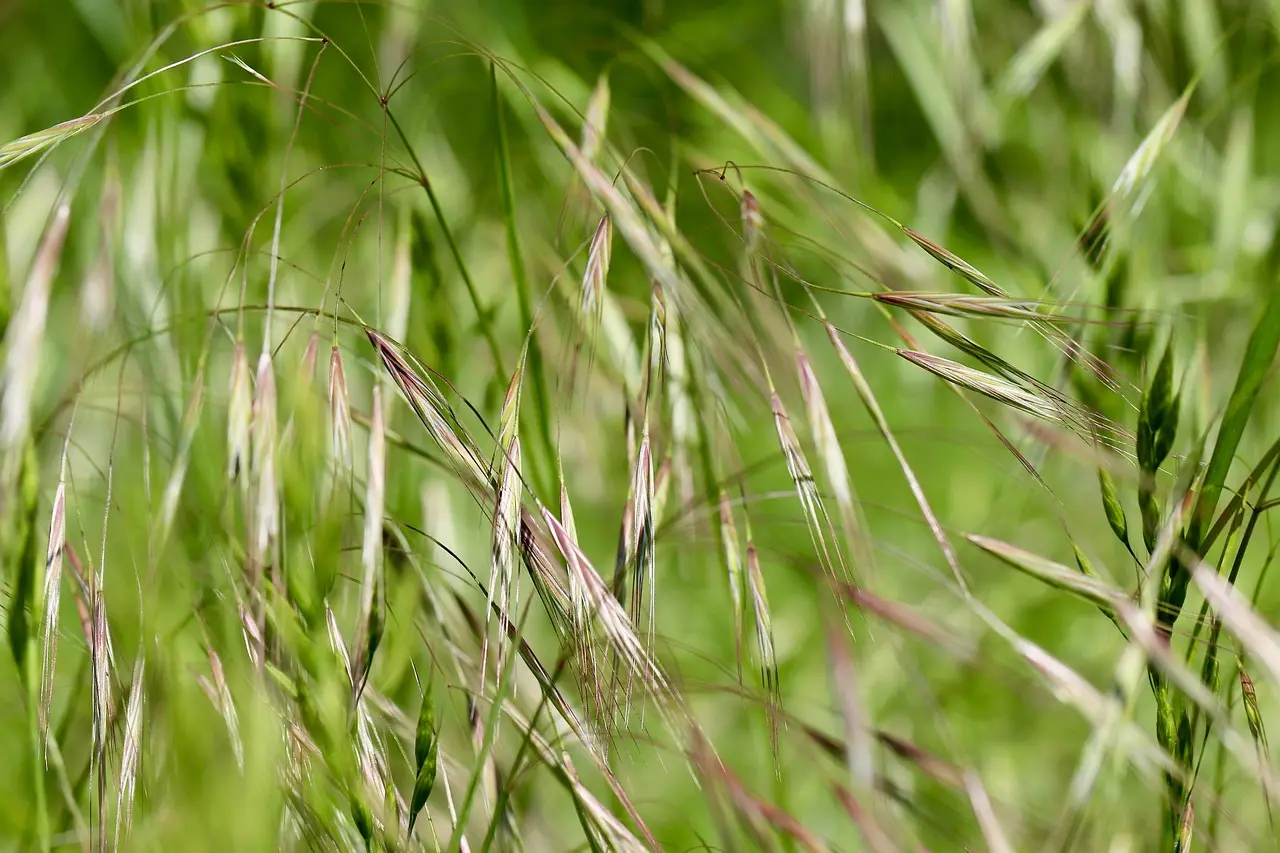
Plant cool-season grasses in late summer to fall, and plant warm-season seed in late spring to early summer. Spring can work for some cool-season seedings, but it is usually a weaker option because young grass must face summer heat before it has fully established.
Cool-season timing
For cool-season lawns, fall is the preferred window. That timing favors tall fescue, Kentucky bluegrass, perennial ryegrass, and fine fescue.
Cooler air, still-warm soil, and lower weed pressure often help establishment. Late-fall seeding can miss the rooting window, while spring seeding leaves young plants more exposed to summer stress.
Warm-season timing
Warm-season grasses should be planted after weather and soil have warmed.
Planting too early can delay or reduce germination. Planting too late cuts the time available for establishment before cooler weather arrives.
Can spring work for cool-season lawns?
Yes, but usually as a second-choice window. Spring is more reasonable for patch repair, small areas, or missed fall projects than for a full new lawn. The tradeoff is simple: less time to mature before heat.
Picture a 3,000 sq ft bare side yard seeded with Kentucky bluegrass in spring. The rate may be correct, the watering may be steady, yet summer arrives before the stand thickens. That is a timing problem, not necessarily a seed problem.
How do you read the seed label correctly?
The label is the decision point because it gives the product’s actual application rate and the seed-quality details behind that rate. Front-of-bag coverage is only a broad sales claim. If the label and the front panel disagree, use the label.
Application rate beats front-of-bag coverage
Many bags advertise total square-foot coverage in large print. That number may reflect overseeding, ideal conditions, or a specific species mix. It is not enough by itself.
Convert the label rate back to the core formula. If a bag says 10 lb covers 1,250 sq ft for a new lawn, that is 10 ÷ 1.25 = 8 lb per 1,000 sq ft. If the same bag says 10 lb covers 2,500 sq ft for overseeding, that is 4 lb per 1,000 sq ft. Those are the real estimating numbers.
Purity, germination, and what they change
The label also lists purity and germination. Higher percentages generally mean more of the bag is viable seed of the named grass. Lower percentages can help explain why two products with the same bag weight list different coverage or rates.
Look for other crop and weed seed entries as well. Those fields do not change the formula directly, but they do change product quality and the amount of desirable grass seed inside the bag.
Coating and bag weight
Seed coating is one of the main reasons equal bag weights can plant different areas. A coated 20 lb bag may contain less pure seed by weight than an uncoated 20 lb bag, so the label rate takes priority over any generic chart.
How should grass seed be applied and watered?
Apply seed to a prepared surface, aim for even spread, and water immediately after planting so the top surface stays consistently moist through germination. Good seed-to-soil contact matters as much as the rate, because seed that rests on thatch, hard crust, or loose debris often dries out before it roots.
Seedbed prep and contact
Remove debris, loosen the top surface, and correct obvious ruts or crusted soil before seeding. Seed that sits on hard, slick, or matted ground often dries out or washes away instead of rooting.
For overseeding, mow low enough to help seed reach the soil. For new lawns, rake lightly after spreading if the label allows it. The goal is contact, not burial.
Spreader pattern and even distribution
- Calculate the total pounds needed for the measured area.
- Set the spreader by the label, not guesswork.
- Split the seed into two equal loads.
- Make one pass in one direction, then a second pass across it.
- Touch up edges and odd corners last.
That two-pass method helps prevent stripes and heavy bands. It also makes overlap easier to control.
Water after planting
Water right after seeding, then keep the top surface evenly moist during germination. Light, repeated watering is usually better than long dry gaps followed by flooding.
After seedlings are established, irrigation can gradually shift deeper and less frequent. The first priority is simple: do not let the top layer dry out while seed is trying to sprout.
What causes grass seeding to fail?
Most failures trace back to one of four problems: too much seed, wrong seasonal timing, poor seedbed contact, or buying by a front-of-bag coverage claim instead of the label rate. All four can happen even when the lawn area was measured correctly.
Too much seed
More seed does not guarantee a thicker lawn. Over-application can crowd seedlings, reduce airflow, and create uneven establishment. The result can be weak plants competing in the same few inches of soil.
That is also pure cost waste. If a 5,000 sq ft area only needs 20 lb for overseeding but 40 lb gets spread, the second 20 lb did not double the result. It only doubled the material used.
Wrong season
Seeding warm-season grasses too early or cool-season grasses too late cuts establishment time. A good seed at the wrong time often performs worse than an average seed planted in the proper window.
Poor prep or weak watering
Seed on compacted ground, heavy thatch, or dry crusted soil may never root well. Uneven watering can be just as damaging. One side germinates, the other side stalls, and the lawn comes in patchy even at the correct rate.
Buying from the bag headline
Coverage claims can be useful for quick shelf comparison, but they are not the final estimate. The label rate should guide the purchase, especially with blends, coated seed, and products that list different new-lawn and overseeding coverage on the same bag.
Frequently asked questions
How many pounds of grass seed per 1,000 square feet should I use?
Use the label first. Tall fescue commonly runs 6–10 new and 3–5 overseeding, while Kentucky bluegrass runs much lower at 2–3 new and 1–2 overseeding.
Should I use the new lawn rate or the overseeding rate?
Use the new-lawn rate on bare soil, mostly bare soil, or a full restart. Use overseeding rates where existing turf still covers the ground well enough to thicken rather than rebuild. If large bare areas show across the yard, that usually points toward new-lawn math.
How do I calculate grass seed from square footage?
Measure the seedable area in square feet, subtract patios, driveways, beds, and structures, then use this formula: area ÷ 1,000 × rate in lb per 1,000 sq ft. After that, round up to whole bag counts.
How much extra grass seed should I buy?
An allowance can be practical for overlap, edges, odd shapes, and minor touch-ups. Add it after calculating the base pounds needed, then round up to full bags. That is more accurate than buying a random extra bag without checking bag size.
Can I plant grass seed in spring or should I wait until fall?
For cool-season grasses, fall is usually the stronger choice. Spring can work, but it is usually second-best because seedlings have less time to mature before summer heat. Warm-season grasses are different and fit late spring to early summer.
When should I water grass seed after planting?
Water immediately after seeding, then keep the top surface consistently moist during germination. The exact schedule depends on weather and soil, but the aim is steady moisture without long dry gaps. Once seedlings are established, watering can gradually shift to fewer, deeper soakings.