How Much Raised Bed Soil Do I Need?
Raised bed soil volume equals length × width × depth in feet, then divide by 27 for cubic yards. Add 10% for settling, then buy the nearest bag count or bulk amount above that total. If you guess low, the bed comes up short and plants sit in shallow mix that dries out fast. This guide shows the exact math, bag and bulk conversions, settling allowance, and minimum usable depth by crop.
Read dimensions from inside, not outside
The calculator answer is simple: enter the inside length, inside width, and planned fill depth. It returns cubic feet and cubic yards, then turns that volume into bag counts. Measure the bed from the inside of the boards, not the outside frame size.
Depth and bag size do the most damage to your estimate. Depth changes the total fast, and bag yield changes the purchase count just as fast. Most homeowners underestimate the quantity, so the safer habit is to round up after adding a settling buffer.
What this calculator tells you
For a rectangular bed, the volume formula is length × width × depth. Convert inches to feet by dividing by 12 before calculating. Convert cubic feet to cubic yards by dividing by 27. Bag count is calculated by dividing volume by bag size.
A standard 4×8 bed with 10-inch sides holds around 26 cubic feet. A 4×8 bed at 12 inches deep needs 32 cubic feet of soil, which is about 1.19 cubic yards.
How much raised bed soil do I need?
Start with the inside dimensions of the bed, then choose the actual fill depth you plan to use. Multiply the three feet-based measurements, not the outside frame dimensions. Add 10% for settling after watering, and if the soil surface will be planted heavily, 10% to 15% extra is often safer.
How to measure the bed
- Measure the inside length in inches.
- Measure the inside width in inches.
- Choose the usable soil depth in inches.
- Divide each inch measurement by 12 to convert to feet.
- Multiply length × width × depth.
- Divide by 27 if you want cubic yards.
- After adding the settling buffer, round up before you buy.
Say your bed measures 4 ft by 2 ft inside and you want 12 inches of fill. The math is 4 × 2 × 1 = 8 cubic feet. Add 10% for settling and the buying target becomes 8.8 cubic feet, so you would round up to the next bag or bulk amount.
How much soil do I need for common bed sizes?
These examples use a 12-inch fill depth and inside measurements. That makes the math easy to compare across bed sizes. If your bed depth is different, replace the 1-foot depth in the formula with your actual depth in feet.
Common bed size examples
4×4 bed: 4 × 4 × 1 = 16 cubic feet. With a 10% settling buffer, plan on 17.6 cubic feet.
4×8 bed: 4 × 8 × 1 = 32 cubic feet. With a 10% settling buffer, plan on 35.2 cubic feet.
3×6 bed: 3 × 6 × 1 = 18 cubic feet. With a 10% settling buffer, plan on 19.8 cubic feet.
4×12 bed: 4 × 12 × 1 = 48 cubic feet. With a 10% settling buffer, plan on 52.8 cubic feet.
6×8 bed: 6 × 8 × 1 = 48 cubic feet. With a 10% settling buffer, plan on 52.8 cubic feet.
8×8 bed: 8 × 8 × 1 = 64 cubic feet. With a 10% settling buffer, plan on 70.4 cubic feet.
Raised bed soil purchase table
This table turns common bed sizes into a buying list. The bag counts are rounded up, because partial bags do not finish a bed. For bagged soil, use the bag size printed on the package, whether that is 0.75 cu ft, 1.0 cu ft, or 1.5 cu ft.
| Inside bed size | Fill depth | Volume in cubic feet | 10% settling buffer | 0.75 cu ft bags | 1.0 cu ft bags | 1.5 cu ft bags |
|---|---|---|---|---|---|---|
| 4 ft × 4 ft | 12 in | 16.0 | 17.6 | 24 | 18 | 12 |
| 4 ft × 8 ft | 12 in | 32.0 | 35.2 | 43 | 36 | 24 |
| 3 ft × 6 ft | 12 in | 18.0 | 19.8 | 27 | 20 | 14 |
| 4 ft × 12 ft | 12 in | 48.0 | 52.8 | 64 | 53 | 36 |
| 6 ft × 8 ft | 12 in | 48.0 | 52.8 | 64 | 53 | 36 |
| 8 ft × 8 ft | 12 in | 64.0 | 70.4 | 94 | 71 | 47 |
For bulk ordering, convert the settled total to cubic yards by dividing by 27. A 4×8 bed at 12 inches deep needs about 1.19 cubic yards before settling, and 1.31 cubic yards after a 10% buffer.
How deep should raised bed soil be?
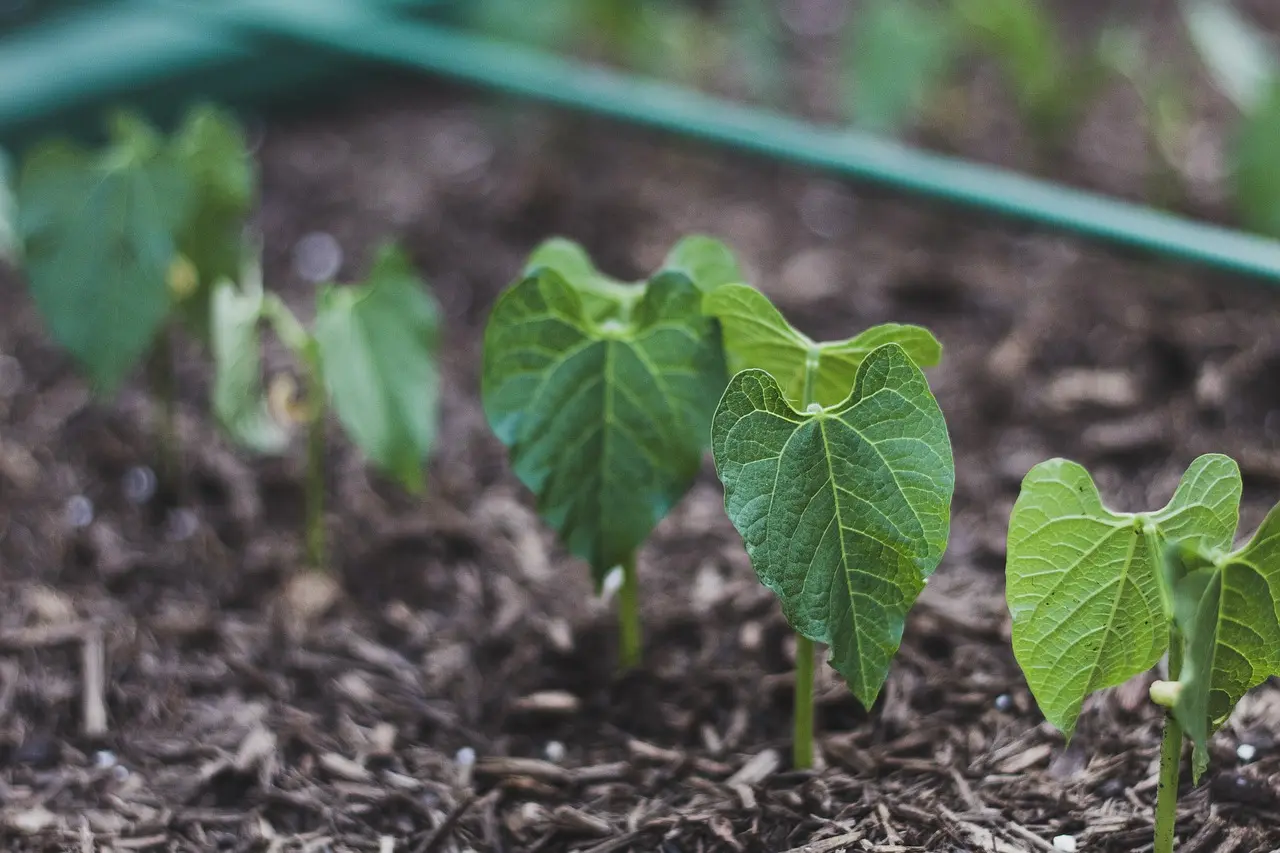
Usable soil depth depends on the crop. Not every bed needs to be filled to its full physical height. Many beds are built taller than the planting layer that the crop actually needs.
Depth by crop
6 inches: Fine for shallow herbs and quick greens, but it limits water storage and root room. It is too shallow for many vegetables.
10 inches: Works for some leafy crops, but drying can be fast in warm weather.
12 inches: A usable minimum for most vegetables. Gardening Know How states most vegetables need 12 inches as a practical minimum.
14 to 16 inches: Better for root crops that need deeper, looser soil. Carrots and similar crops are more likely to fork or stop early in a shallow bed.
18 inches: Better for heavier crops and for beds that need more rooting volume and moisture reserve.
A common first-timer mistake is filling a 12-inch bed to only 6 inches and then planting tomatoes or carrots in it. The plants may live, but the bed dries fast and the roots run out of usable depth early.
What soil mix should go in a raised bed?
Raised bed mix, Mel’s Mix, and similar blends are better choices than plain topsoil alone. Plain topsoil packs down too easily for many raised beds, which reduces air space and slows drainage. A blend with compost and an aeration material gives roots more room and keeps the surface from sealing over after watering.
Common mix options
Raised bed mix: Usually a blended product made for garden beds. It is meant to drain better than straight topsoil.
Mel’s Mix: A loose blend used in square-foot style beds. GardenCalc provides a 60/30/10 recommended soil mix.
Topsoil plus compost plus coarse sand or perlite: A common practical blend when you need structure, organic matter, and aeration.
GardenCalc says a 1.2m × 2.4m bed needs 864 litres at 30cm deep, and a 4ft × 8ft bed at 12 inches deep needs about 906 litres. That is the same bed size expressed two ways, and it shows how quickly the numbers grow when the bed is filled to a full planting depth.
When should you buy bags instead of bulk?
Bulk delivery becomes cheaper when the delivered price per cubic yard is lower than the bagged total once the delivery fee is included. The break-even point depends on the supplier, the delivery charge, and the bag size you are comparing. At larger volumes, bagged soil usually becomes inefficient.
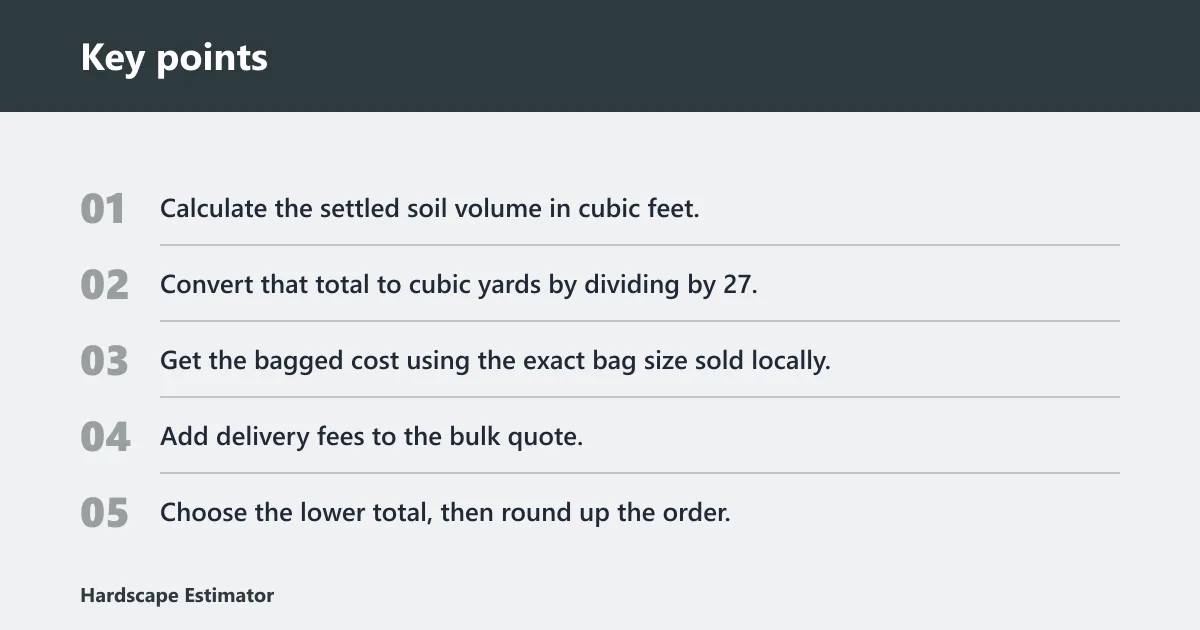
How to compare the buy format
- Calculate the settled soil volume in cubic feet.
- Convert that total to cubic yards by dividing by 27.
- Get the bagged cost using the exact bag size sold locally.
- Add delivery fees to the bulk quote.
- Choose the lower total, then round up the order.
Suppose a 4×8 bed needs 35.2 cubic feet after settling. That equals about 1.31 cubic yards. If the local supplier sells bulk soil by the yard and the delivery fee is modest, bulk is often cheaper than buying thirty-six 1 cu ft bags or twenty-four 1.5 cu ft bags. If the delivery fee is high and the bed is small, bags can still win.
Partial-fill strategies that still work
If the bed is very deep and the crop only needs 12 to 18 inches of usable soil, the lower section can sometimes be filled with low-cost organic material or a coarse base layer, then capped with quality growing mix. Do not use that shortcut where it reduces the actual root zone. The top planting layer still needs enough depth, drainage, and nutrition for the crop.
Frequently asked questions
How much soil do I need for a 4x2x1 raised bed?
A 4×2×1 bed needs about 8 cubic feet of soil. Add 10% for settling and plan on 8.8 cubic feet. That works out to 9 one-cubic-foot bags, 12 bags at 0.75 cu ft, or 6 bags at 1.5 cu ft, rounded up.
How much soil do I need for a 6x3x1 raised bed?
A 6×3×1 bed needs 18 cubic feet of soil. Add 10% for settling and the buying target becomes 19.8 cubic feet. That rounds to 20 one-cubic-foot bags, 27 bags at 0.75 cu ft, or 14 bags at 1.5 cu ft.
How many bags of soil do I need for a 4×8 raised bed?
A 4×8 bed at 12 inches deep needs 32 cubic feet of soil, and about 35.2 cubic feet with a 10% settling buffer. That is about 36 bags at 1 cu ft, about 43 bags at 0.75 cu ft, or about 24 bags at 1.5 cu ft.
How much garden soil do I need for my raised bed?
Garden soil depends on the bed’s inside dimensions and the crop’s usable depth. A shallow herb bed needs less than a tomato or carrot bed. Measure the bed from the inside, set the depth by crop, and add 10% for settling before ordering.
How much dirt do I need for my raised bed?
“Dirt” and soil are often used loosely, but for planting the better choice is a raised bed mix, not plain topsoil. Calculate the volume the same way: inside length × inside width × depth in feet, then divide by 27 if you need cubic yards.
How much garden soil do I need calculator?
A good calculator asks for inside dimensions, planned fill depth, and bag size. It should return cubic feet, cubic yards, and rounded bag counts. The best ones also add a settling allowance so the bed does not come up short after the first watering.