What Is Screened Topsoil? Uses and When to Choose It
Screened topsoil is topsoil passed through a screen to remove rocks, roots, and debris, making it a smoother surface-grade material for lawn repair, sod prep, and light leveling, usually placed in 2 to 4 in layers for sod preparation. Using the wrong soil can leave bumps, poor rooting, drainage trouble, and wasted labor. This guide explains what screened topsoil is, how it differs from regular topsoil and compost, and when it is the wrong choice.
This guide is part of our Screened topsoil: uses, cost, coverage, and buying guide series.
What screened topsoil
Screened topsoil is soil that has been filtered so the finished material is easier to spread and grade. A common version is run through a 3/8-inch screen, which removes larger debris but does not make the product stone-free. It is a surface-grade fill, not a universal planting medium.
How screening removes rocks, roots, and clumps
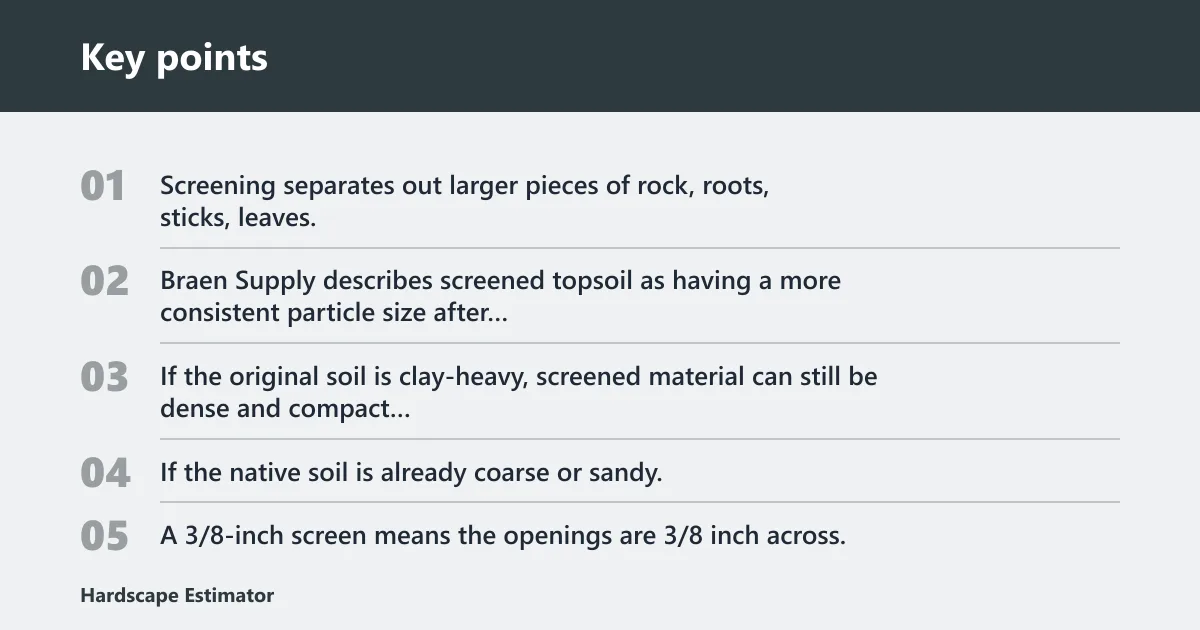
Screening separates out larger pieces of rock, roots, sticks, leaves, and clods so the material flows more evenly under a rake or box blade. Braen Supply describes screened topsoil as having a more consistent particle size after screening, while still reflecting the soil source underneath that processing.
That source matters. If the original soil is clay-heavy, screened material can still be dense and compact more readily than a loamier blend. If the native soil is already coarse or sandy, the screened product may feel much looser and drain faster.
What 3/8-inch screen size means
A 3/8-inch screen means the openings are 3/8 inch across, so smaller particles pass through and larger pieces are removed. That improves spreadability, but it does not promise a perfectly clean product. Small stones can still remain, and finished lots can vary from one supplier to another.
What screened topsoil can still contain
Screened topsoil can still include small rocks, fine roots, and some organic material. One supplier notes that it is not completely rock-free, and another says the material does not include added compost, peat moss, fertilizer, or other soil conditioners. That makes it useful for fill and leveling, but not automatically rich enough for planting on its own.
What is screened topsoil used for?
Screened topsoil is used where a smoother soil surface matters more than high organic content. Screened topsoil is often used for sod prep, shallow lawn fill, overseeding support, and light grading. It is also used to fill low spots and shallow depressions around yards and new construction.
Sod prep and shallow lawn fill
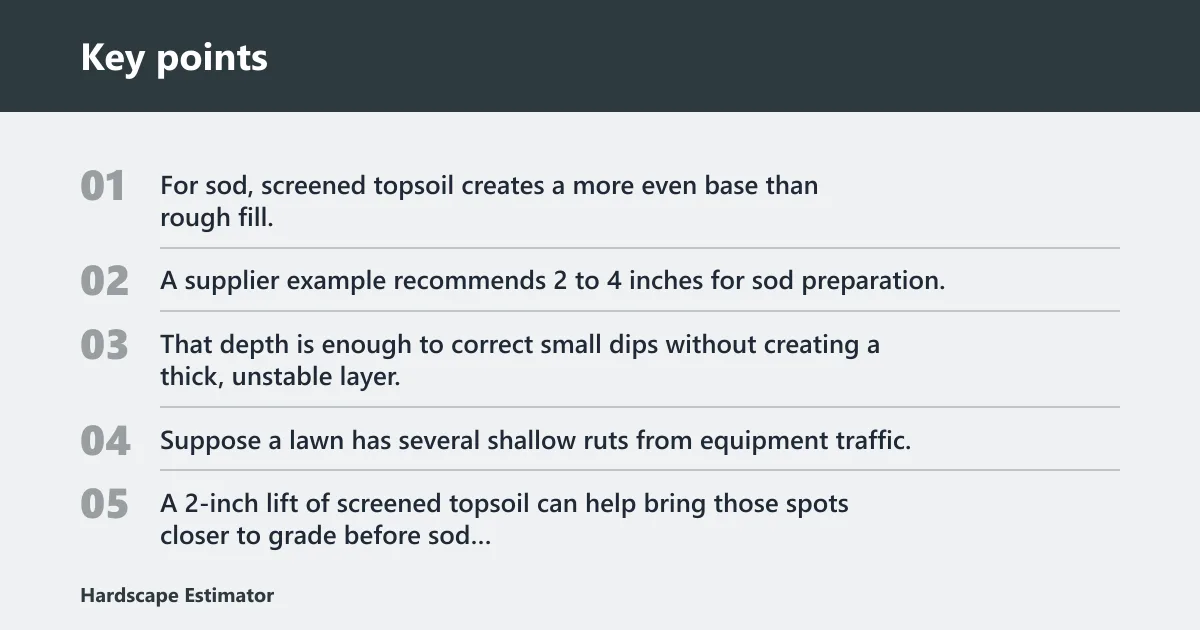
For sod, screened topsoil creates a more even base than rough fill. A supplier example recommends 2 to 4 inches for sod preparation, which helps smooth minor irregularities before the grass is laid. That depth is enough to correct small dips without creating a thick, unstable layer.
Suppose a lawn has several shallow ruts from equipment traffic. A 2-inch lift of screened topsoil can help bring those spots closer to grade before sod or seed goes down. A much deeper fill in the same area can settle unevenly and leave the surface lumpy later.
Overseeding and patch repair
For overseeding, screened topsoil can cover seed lightly enough to improve seed-to-soil contact while still being easy to rake smooth. It is better than rough unscreened soil when the goal is a thin, even cover over bare patches. It is not a substitute for a seed-starting mix where high organic matter is needed.
Light grading and low-spot filling
Screened topsoil is also useful for filling low spots and shallow depressions. Tote-All lists grading and levelling yards, gardens, and construction sites as use cases, and notes that it is a coarse utility soil. That fits this product well: use it for shaping and fill, not for feeding roots.
A common first-timer mistake is to use screened topsoil to correct a deep hollow in one lift. A 6-inch depression filled all at once can settle, especially if the soil is clay-based or placed too wet. Shallow lifts, compacting as needed, and rechecking grade after settling work better.
What does screened topsoil look like?
Screened topsoil usually looks finer and more uniform than raw fill soil, but the exact appearance depends on the source. It often has a crumbly texture with small granules, some fine roots, and occasional tiny stones. Moisture can make it look darker and feel heavier than the same soil when dry.
Texture, moisture, and particle mix
Dry screened topsoil tends to break apart easily and spread with a shovel or rake. Damp material often holds together in soft clumps, especially if it contains clay. The particle mix can range from fairly loamy to noticeably clay-based, so two loads from different pits may look and behave differently.
Why native soil source changes appearance
Screening does not change the original soil type. It only removes larger debris. If the base material comes from a dense native clay source, the finished soil can appear darker, stickier, and more compact. If the source is loamier, it may look lighter and crumble more easily.
Clay-based versus loamier screened blends
Clay-based screened topsoil can hold shape and grade well, but it may drain slowly and compact under traffic. Loamier screened blends are easier for roots to push through and often drain better. Neither one should be treated as identical to compost-rich planting mix.
Screened topsoil vs other soil products
Screened topsoil sits between rough fill and an amended planting mix. It is cleaner and easier to spread than unscreened topsoil, but it is not the same as compost or soil conditioner. The right choice depends on the job’s need for structure, drainage, or more organic matter.
Screened topsoil vs unscreened topsoil
Unscreened topsoil is cheaper in many cases, but it usually contains more rocks, roots, and clumps. That makes it harder to rake smooth and less predictable for fine grading. Screened topsoil costs more because of the screening process, but the payoff is easier placement and a more even finish.
Screened topsoil vs compost
Compost is an organic amendment, not a fill soil. It is used to improve nutrient content and soil structure, especially where planting needs more organic matter. Screened topsoil provides body and grade; compost provides fertility and biological improvement. For many garden beds, the two work together rather than as substitutes.
Screened topsoil vs soil conditioner
Soil conditioner is used to change the way existing soil behaves, often by improving structure, drainage, or organic content. Screened topsoil is a bulk material for fill and surface shaping. If a bed already has enough depth but poor tilth, conditioner may be the better fit. If the grade is wrong, screened topsoil is the first step.
How deep should screened topsoil be under sod?
For sod preparation, a common target is 2 to 4 inches of screened topsoil. That depth helps smooth the finish, correct shallow irregularities, and create a better base for sod roots to contact. Much deeper placement can lead to settling, especially if the soil beneath is weak or compacted.
Recommended 2-4 inch placement depth
That 2 to 4 inch range is enough for most shallow grading work under sod. It gives room to feather in low spots without building a thick new layer on top of a very different subsoil. The result is usually more stable than trying to fill deep hollows with one heavy lift.
When deeper fill creates problems
Deeper fill can create a soft layer that settles after irrigation or rain. If the soil underneath is compacted clay, the new layer may sit on top of a slow-draining base and stay wet longer than expected. That can affect rooting and make the surface uneven again.
How depth affects smoothing and settling
The deeper the layer, the more important compaction and moisture control become. Thin lifts are easier to smooth and less likely to sink. If the job requires more than a shallow correction, it may need staged filling, not a single load spread across the area at once.
Is screened topsoil good for garden beds?
Screened topsoil can be useful in garden beds as a bottom filler or for bulk volume in deep beds, but it should not be the finished growing medium by itself. Beds usually need more organic matter and better structure near the root zone. Leave 12 to 18 inches at the top for a richer amended mix.
When it works as bottom filler
In deep raised beds, screened topsoil can fill the lower portion without wasting expensive compost-rich material. That is practical when the bed is tall and the top layer will supply most of the root environment. It also keeps the bed from requiring a full depth of premium mix.
Why it should not be the whole growing medium
Because screened topsoil from many suppliers contains no added compost, peat moss, fertilizer, or conditioner, it may be too lean for sustained planting by itself. It can also be too dense if the source soil is clay-based. Vegetables, annuals, and many ornamentals do better when the top layer is amended.
How much room to leave for compost-rich mix
For raised beds and garden boxes, the top 12 to 18 inches should be a more suitable growing mix. That upper zone is where roots do the most work. Screened topsoil can occupy the lower portion if the goal is to save cost and still keep the planting layer high quality.
Screened topsoil for grading near a house
Screened topsoil can be used for shallow grading around a house, especially where the goal is to smooth surface grade and fill small depressions. It is also common around new construction, where the yard needs finishing after rough work. The grade still has to shed water away from the structure.
Where it fits in shallow grading work
This material is a good match for shallow corrections near sidewalks, patios, and open yard areas. It spreads more evenly than rough fill and is easier to shape to a consistent pitch. That matters when the goal is clean surface drainage rather than deep structural fill.
Drainage and slope cautions
Screened topsoil is generally not recommended for creating a flat zone against a foundation. Water must move away from the house, not toward it. If the area already ponds, or if a deeper correction is needed to change the drainage pattern, the fix may require a different material or a more formal grading plan.
When a contractor or engineer should review the grade
If the soil near the foundation is holding water, if the grade needs to change significantly, or if the area includes retaining walls, a contractor or engineer should review it. Screened topsoil is a finishing material for small corrections. It is not a substitute for proper drainage design.
Which soil for which job?
This table shows the right fit by project type. Use it to separate fill work from planting work. If the job needs structure, screened topsoil may fit. If it needs organic matter, compost or a compost-rich mix matters more.
| Project type | Recommended material | Ideal depth | What can go wrong | Amend with compost? |
|---|---|---|---|---|
| Sod prep | Screened topsoil | 2 to 4 inches | Uneven grade, settling, poor root contact | Often yes, if the soil is lean |
| Overseeding | Screened topsoil in a thin cover | About 1/4 to 1/2 inch over seed | Seed buried too deeply, crusting on clay soil | Sometimes, if structure is weak |
| Lawn leveling | Screened topsoil | Shallow lifts, often under 2 inches at a time | Settling, bumps after rain, poor drainage in low spots | Usually not the first fix |
| Garden-bed filler | Screened topsoil below the root zone | Bottom fill only | Lean root zone, compacted bed, weak plant growth | Yes, in the top layer |
| New bed growing medium | Amended soil with compost or conditioner | Top 12 to 18 inches | Poor nutrients, low organic matter, drainage problems | Yes |
| Grading near a foundation | Screened topsoil for shallow shaping only | As needed for light correction | Ponding, incorrect slope, settlement against the house | Usually not the main issue |
How to read the table
If the project is about surface shape, screened topsoil is often the right starting point. If the project is about plant health, the answer changes quickly. For beds, the finishing layer should usually be amended. For foundations, drainage direction matters more than soil appearance.
- Decide whether the job is fill, leveling, planting, or drainage control.
- Measure the depth you need in inches, not just by eye.
- Check whether the soil will sit under sod, seed, or a plant root zone.
- Ask if the material needs compost or conditioner for the final layer.
- Allow for settling if the area is being built up more than a shallow amount.
What is screened soil?
Screened soil usually means soil that has been passed through a screen to remove larger debris. In common use, that can overlap with screened topsoil, but the label alone does not guarantee a planting-grade product. The source soil, particle mix, and added amendments still matter.
That is why supplier descriptions should be checked closely. One seller may mean a coarse utility soil for grading, while another may mean a finer topsoil blend for lawns. The word “screened” tells you something about size, not everything about performance.
Frequently asked questions
What is screened topsoil?
Screened topsoil is topsoil that has been filtered through a screen to remove larger rocks, roots, and debris. It spreads more evenly than unscreened soil and is often used for sod prep, lawn leveling, and shallow grading. It can still contain small stones and usually is not amended with compost.
What is the difference between topsoil and screened topsoil?
Topsoil is the soil layer itself, while screened topsoil is topsoil that has been processed to remove larger debris. The screened version is easier to spread and grade, but it is not automatically better for planting. Source soil, clay content, and any amendments still control how it performs.
Is screened topsoil good for grass seed?
Yes, if it is used as a thin cover or a shallow leveling layer over seed. It helps seed contact the soil and can improve surface smoothness. It should not be packed too deep over grass seed, and clay-heavy material can crust or slow germination if placed too thickly.
Can you use screened topsoil for grading around a house?
Yes, for shallow grading and small surface corrections near a house. It can help smooth grade and fill low spots, but it should still slope water away from the foundation. If drainage is already failing or the grade needs major correction, a contractor or engineer should review it.