Screened Topsoil Cost Delivered: What to Expect
Delivered screened topsoil usually costs about $35 to $70 per cubic yard for common driveway-access deliveries, with small loads or tight access pushing it to about $80 to $120+ per cubic yard. A weak quote comparison can leave you short on material or paying hidden delivery fees. This guide breaks down line items, volume, and access charges so you can read a quote and judge the price fairly.
This guide is part of our Screened topsoil: uses, cost, coverage, and buying guide series.
Screened topsoil cost overview
Screened topsoil commonly runs $25 to $50 per cubic yard before delivery, and many delivered orders land higher once trucking, minimums, or access charges are added. It is usually the better choice for lawns, overseeding, and yard work because screening removes larger rocks, roots, and debris that interfere with finish quality.
Typical delivered price per cubic yard
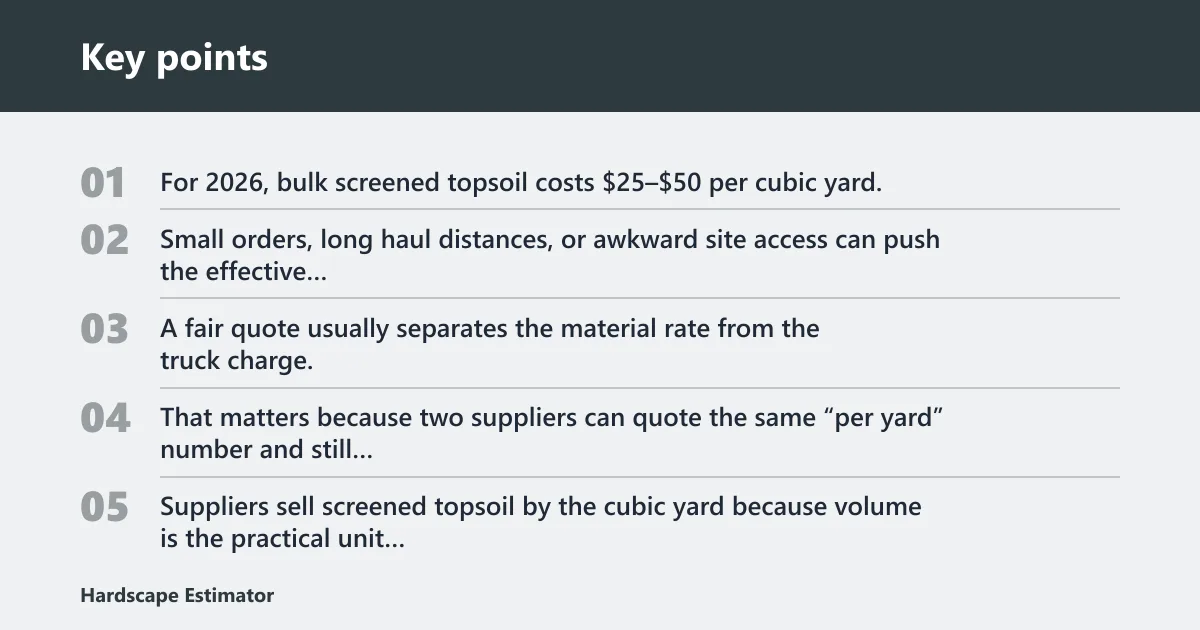
For 2026, bulk screened topsoil costs $25–$50 per cubic yard, while delivered pricing for a normal residential drop often lands in the $35–$70 range once trucking is included. Small orders, long haul distances, or awkward site access can push the effective delivered cost above that range.
A fair quote usually separates the material rate from the truck charge. That matters because two suppliers can quote the same “per yard” number and still produce very different totals after delivery fees and minimum-load rules are added.
Why local suppliers price by the yard
Suppliers sell screened topsoil by the cubic yard because volume is the practical unit for loading and project takeoff. One cubic yard equals 27 cubic feet, and one yard covers 81 square feet at four inches deep. Weight matters for hauling, but volume is what the customer needs for coverage.
One cubic yard of topsoil weighs roughly 2,000–2,200 lbs, and moisture changes that weight. Wet material can be much heavier than dry material, which affects trucking more than the customer’s needed coverage. That is another reason local supplier pricing usually starts with volume and then adds delivery terms.
What a fair quote usually includes
A normal delivered quote should list the material price, the delivery fee, any minimum-order surcharge, and any fuel or access surcharge. It should also identify whether the soil is screened to a particular grade, since a finer screen can cost more and usually leaves a cleaner finish.
A common first-timer mistake is comparing only the posted yard price. Say your quote shows $30 per yard, but the supplier adds a $90 delivery fee and a $40 small-load charge on a 2-yard order. The delivered cost is no longer $60 total; it is $220 total, or $110 per yard.
What changes the delivered price?
Delivered price changes with screen size, soil quality, haul distance, order size, and access. Those factors can shift a quote by a small amount or by a lot, especially when the order falls below a supplier minimum or the truck cannot make an easy drop.
Screen size and soil quality
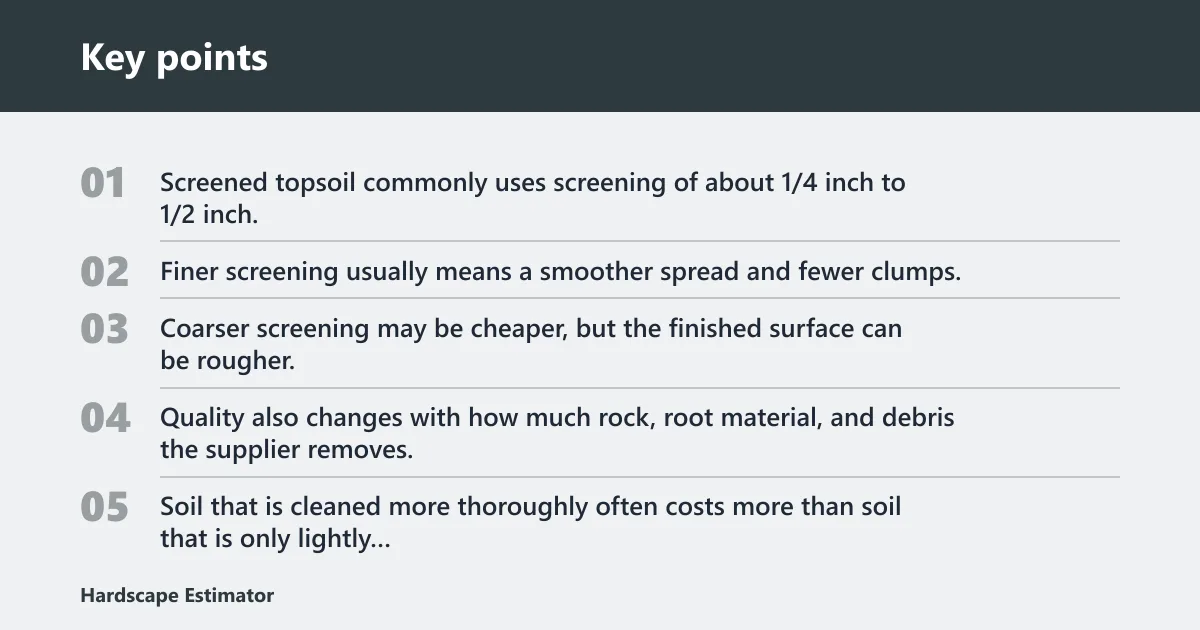
Screened topsoil commonly uses screening of about 1/4 inch to 1/2 inch. Finer screening usually means a smoother spread and fewer clumps, which helps for topdressing and final grading, but it can cost more because it takes more processing. Coarser screening may be cheaper, but the finished surface can be rougher.
Quality also changes with how much rock, root material, and debris the supplier removes. Soil that is cleaned more thoroughly often costs more than soil that is only lightly processed. If a quote is unusually low, it is worth checking what “screened” means at that yard.
Delivery distance and access
Delivery is usually priced on a separate line. A standard dump truck delivery commonly runs $50–$150, and many bulk suppliers have a 2–3 cubic yard delivery minimum. Some use a flat fee, while others base the charge on distance or zone. Tight driveways, long carries, or no-space drop points can add more cost.
Order size, minimums, and surcharges
Larger orders often lower the per-yard price because the delivery fee gets spread across more material. Small orders do the opposite. If you only need one or two yards, a minimum-load surcharge can make the delivered yard price jump sharply even when the raw material price looks normal.
Soil settling matters too. Soil settles 15–20%, so order for the finished depth. It is also wise to add a 5–15% waste buffer for spreading losses, uneven subgrade, and trimming. That extra material often costs less than a second delivery.
Delivered topsoil cost breakdown table
This table shows how the same screened topsoil can land at very different delivered costs depending on order size, delivery fee, and small-load friction. The material rates stay within the common $25–$50 per cubic yard range, while the delivery lines show how trucking changes the total.
| Scenario | Order size | Material price per yard | Delivery fee | Minimum-order surcharge | Total delivered cost | Delivered cost per yard |
|---|---|---|---|---|---|---|
| Small driveway access | 1 yard | $45 | $60 | $35 | $140 | $140.00 |
| Small lawn patch | 2 yards | $40 | $70 | $25 | $175 | $87.50 |
| Typical residential drop | 3 yards | $35 | $75 | $0 | $180 | $60.00 |
| Medium yard order | 4 yards | $30 | $90 | $0 | $210 | $52.50 |
| Large bed preparation | 6 yards | $27 | $110 | $0 | $272 | $45.33 |
| Bulk pickup-size job | 10 yards | $25 | $150 | $0 | $400 | $40.00 |
Is screened topsoil worth the extra cost?
Yes, when the finished surface matters. Screened topsoil is usually worth the extra cost for lawns, overseeding, and yard work because it spreads more smoothly and leaves fewer rocks, roots, and clumps behind. Unscreeened fill topsoil is cheaper at $15–$30 per cubic yard, but it is better for rough fill than for fine finish work.
Best uses for screened topsoil
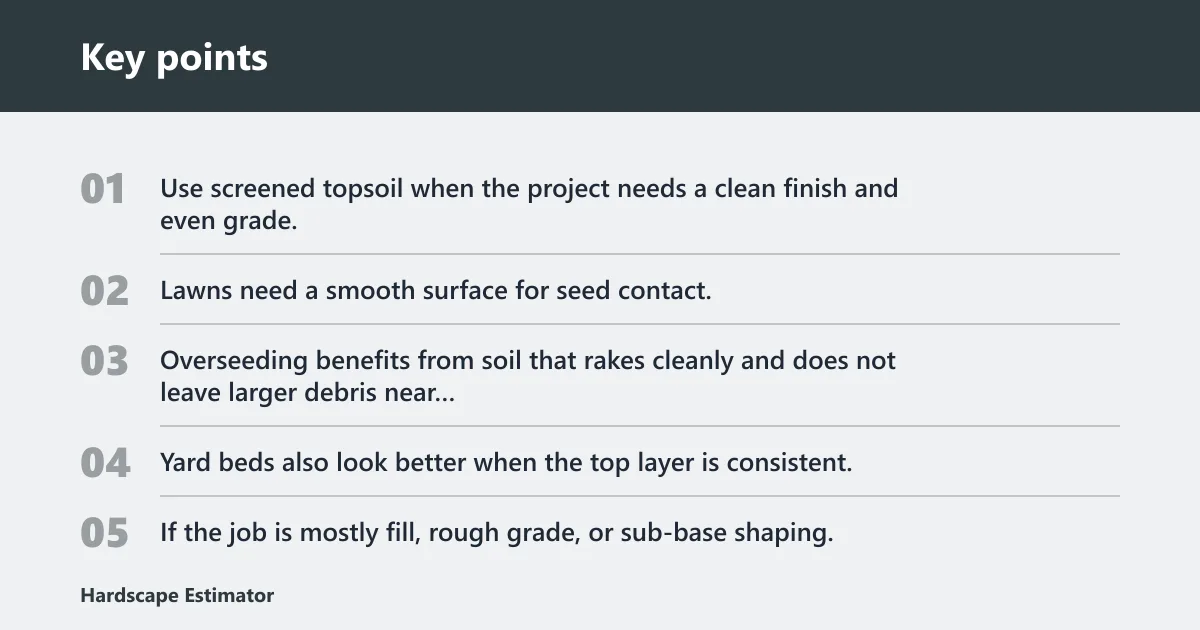
Use screened topsoil when the project needs a clean finish and even grade. Lawns need a smooth surface for seed contact. Overseeding benefits from soil that rakes cleanly and does not leave larger debris near the surface. Yard beds also look better when the top layer is consistent.
When unscreened soil may be enough
If the job is mostly fill, rough grade, or sub-base shaping, unscreened topsoil may be enough. It is cheaper, but the finish will usually be rougher and more variable. For a hidden area where appearance does not matter, the lower material price can make sense.
How finish quality changes the value
The value gap often shows up in labor, not just in material price. Coarser soil can take longer to rake and can leave stones that interfere with seeding or final leveling. Finer screened soil costs more, but it can save time and reduce the chance of rework on a lawn finish.
Suppose a homeowner needs 3 yards for a front lawn topdressing job. If the screened soil costs $15 more per yard than unscreened soil, that is $45 extra on material. If it cuts an hour of cleanup and leaves a better seedbed, the premium is often easier to justify than it would be for hidden fill.
How much is delivery for topsoil?
Delivery for topsoil usually runs $50–$150 per load, and the final charge may be flat, distance-based, or tied to a delivery zone. Small orders are more sensitive to this fee because the trucking charge gets divided across fewer yards. Access problems can add even more.
Flat fee vs distance-based delivery
A flat fee is simpler. The charge stays the same within a service radius. Distance-based pricing changes with mileage or zones, so the farther the site sits from the yard, the higher the delivery charge. Both systems are common, and both can be fair if they are shown clearly on the quote.
Minimum-load surcharge
Many bulk suppliers have a 2–3 cubic yard delivery minimum. If your order falls below that threshold, the supplier may add a small-load surcharge or require you to buy enough material to meet the minimum. That fee is normal, but it should be listed before you approve the order.
Fuel surcharge and access fees
Some suppliers add a fuel surcharge when hauling costs rise. Others charge for limited access, long carry distances, or places where the truck cannot dump close to the work area. Those fees are not always present, but they should be clear if they apply.
Bagged or bulk topsoil?
Bulk topsoil is usually cheaper than bagged topsoil for larger jobs, while bagged material is easier for very small projects. One cubic yard equals 36 standard 0.75 cu ft bags, and bagged topsoil equivalent can cost $150–$200 per yard. For anything beyond a few bags, bulk usually wins on cost.
Bag count per cubic yard
One cubic yard equals 36 standard 0.75 cu ft bags. That count is useful because it shows how quickly bag pricing adds up. Even before hauling or disposal of empty bags, the retail markup can turn a small convenience purchase into a much higher per-yard cost.
Retail markup versus bulk pricing
Bagged topsoil is priced for convenience, not for volume efficiency. Bulk pricing is tied to yardage and truck delivery.
Break-even point for small jobs
The break-even point usually comes well before one full yard. If the job needs only a few bags, the convenience may be worth it. Once the order approaches a full yard, bulk topsoil is usually the lower-cost choice, even after a delivery fee is added.
Picture a side-yard repair that needs 8 bags. That is about 0.22 cubic yard. Bagged material may be the easier buy. But if the project needs 15 to 20 bags, the total cost often starts to close in on a bulk delivery, and bulk becomes the cleaner comparison.
How many yards do you need?
Start with the finished depth, then add a settlement buffer. One cubic yard covers 81 square feet at four inches deep, but soil settles 15–20%, so order enough to achieve the finished depth after compaction. A 5–15% waste buffer is also smart for uneven ground and spreading loss.
Cubic yard to cubic foot conversion
One cubic yard equals 27 cubic feet. That conversion helps when the project area is measured in feet rather than yards. Multiply length by width by depth in feet, then divide by 27 to estimate cubic yards before adding allowance.
Coverage by depth
Coverage changes with depth. A yard covers 81 square feet at four inches deep, but the same yard covers a larger area if spread thinner and a smaller area if spread thicker. That is why spread depth should be part of every quote comparison.
Settling and waste allowance
Order extra when the soil will be finished, leveled, or seeded. The 15–20% settling buffer protects the final depth after compaction and rainfall. The 5–15% waste buffer covers uneven distribution, low spots, and material that stays in the truck or wheelbarrow.
- Measure the area in square feet.
- Choose the finished depth in inches.
- Convert to cubic yards using 27 cubic feet per yard.
- Add 15–20% for settling.
- Add 5–15% for waste and grading loss.
- Compare the final yardage to supplier minimums and delivery fees.
Frequently asked questions
How much does screened topsoil cost per cubic yard delivered?
Delivered screened topsoil usually lands around $35 to $70 per cubic yard for common residential deliveries. Small orders, long drives, or difficult access can push the delivered price to $80 to $120+ per yard because the trucking fee gets spread across fewer yards and minimum charges may apply.
What delivery fee should I expect for topsoil?
A standard dump truck delivery commonly runs $50–$150 per load. Some suppliers use a flat fee, while others charge by distance or delivery zone. If the order is small, a minimum-load surcharge may also appear, and that can move the delivered cost noticeably higher.
Is screened topsoil worth paying more for than unscreened?
Usually yes for lawns, overseeding, and finished yard work. Screened topsoil removes more rocks, roots, and debris, so it spreads cleaner and gives a smoother finish. Unscreened fill topsoil is cheaper at $15–$30 per cubic yard, but it is better for rough fill than for finish-grade work.
How many bags equal one cubic yard of topsoil?
One cubic yard equals 36 standard 0.75 cu ft bags. That number is useful when comparing bagged pricing to bulk delivery. Bagged topsoil equivalent can cost $150–$200 per yard, which is why bulk is usually the better price once a project grows beyond a few bags.
What is the break-even point for bulk topsoil versus bagged soil?
The break-even point is often reached before one full yard, but it depends on the delivery fee and the number of bags needed. If the job needs only a small patch, bags may be simpler. If it needs 15 to 20 bags or more, bulk often becomes the lower-cost choice.
Why do screened topsoil quotes vary so much between suppliers?
Quotes vary because suppliers price different screen grades, soil quality, delivery radius, minimum loads, and access conditions. Some yards remove more debris and use finer 1/4 inch to 1/2 inch screening, which can raise the price. Others keep the material cheaper but charge more for delivery or small orders.
What should be included in a delivered topsoil quote?
A delivered quote should show the material price per cubic yard, the delivery fee, any minimum-order surcharge, and any fuel or access charge. It should also state whether the soil is screened and, if possible, what screen grade is being used. Hidden fees are the main red flag to watch for.
Does finer screening make topsoil more expensive?
Usually yes. Finer screening takes more processing and usually produces a cleaner, smoother product. Soil screened closer to 1/4 inch often costs more than coarser material because it is better suited to lawn finish work and requires more handling to remove rocks and debris.