Can a Pickup Truck Carry 1 Cubic Yard of Topsoil?
Yes—only higher-rated pickups can safely carry 1 cubic yard of topsoil, and only when the payload rating still leaves room for driver, passengers, fuel, and wet-soil weight. Load too much, and you can get rear sag, longer stopping distance, tire damage, and a citation. This guide shows how to check payload, estimate topsoil weight, and decide when 1 cubic yard is too much.
Can a pickup truck carry 1 cubic yard of topsoil?
Sometimes. The number that matters is the payload sticker on the driver’s side doorjamb, not the bed size. One cubic yard of topsoil is often estimated at 2,000 to 3,000 pounds, so many pickups cannot carry it safely once passengers, tools, and fuel are included.
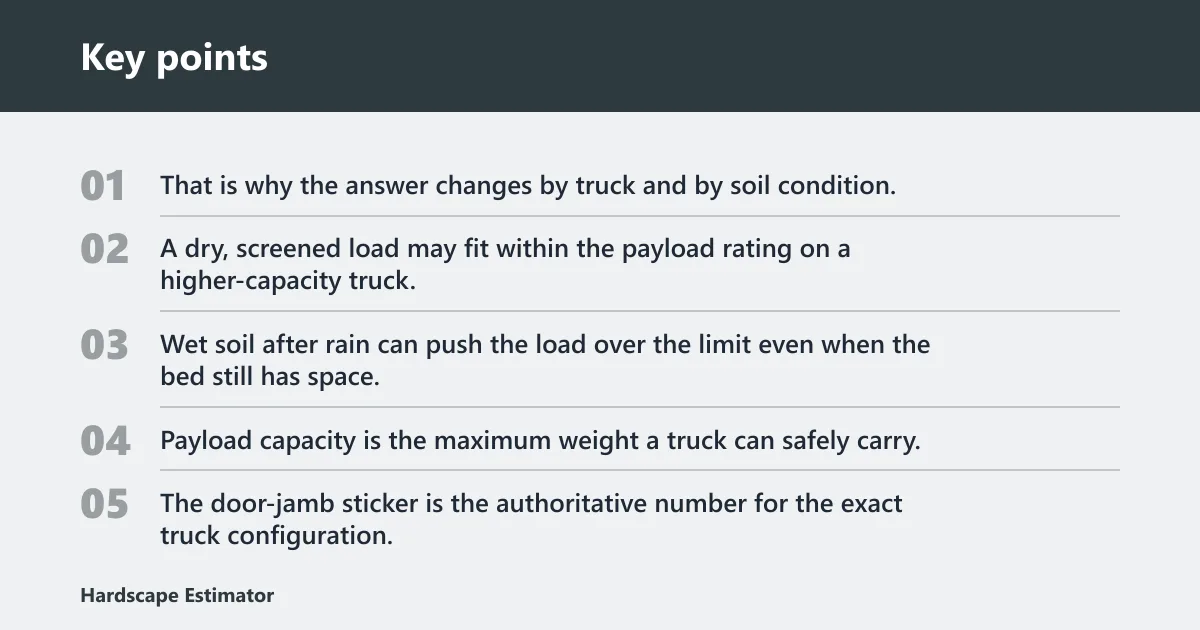
That is why the answer changes by truck and by soil condition. A dry, screened load may fit within the payload rating on a higher-capacity truck. Wet soil after rain can push the load over the limit even when the bed still has space.
Pickup payload rules
Payload capacity is the maximum weight a truck can safely carry, including passengers and cargo. The door-jamb sticker is the authoritative number for the exact truck configuration, and it can change with cab size, engine, drivetrain, and options.
Truck class alone is not enough. A “half-ton” badge does not guarantee the same payload from one truck to the next. Some configurations are rated much higher than others, and accessories such as toolboxes, bed liners, and hitch gear all count against the available payload.
Can your pickup carry 1 cubic yard of topsoil?
| Truck payload range | Assumed topsoil weight per yard | Estimated passenger weight | Remaining payload | Verdict |
|---|---|---|---|---|
| 1,500 to 1,900 lb | 2,000 lb | 300 lb | -800 to -700 lb | No |
| 1,900 to 2,300 lb | 2,000 lb | 150 lb | -250 to 150 lb | Borderline |
| 2,300 to 3,000 lb | 2,000 lb | 150 lb | 150 to 850 lb | Safe |
| 2,300 to 3,000 lb | 3,000 lb | 150 lb | -850 to 850 lb | No / Borderline |
The table is a decision aid, not a substitute for the sticker. If the remaining payload is below the estimated soil weight, the load is too heavy for one trip. In that case, make two trips or reduce the load.
How much does 1 cubic yard of topsoil weigh?
One cubic yard equals 27 cubic feet. Topsoil weight is not fixed, but a practical working range is about 2,000 to 3,000 pounds per cubic yard. That range is wide enough to matter when the truck’s payload margin is small.
Moisture and composition drive the difference. Screened, drier topsoil sits near the lower end of the range. Saturated soil can weigh 3,000 pounds or more, especially after rain or when the material contains more fine particles and less air space.
Dry versus wet topsoil
| Condition | Typical weight per cubic yard | Hauling note |
|---|---|---|
| Dry or screened topsoil | About 2,000 lb | More likely to fit on a higher-rated truck |
| Moist topsoil | Between 2,000 and 3,000 lb | Check payload carefully before loading |
| Saturated topsoil | 3,000 lb or more | Often too heavy for a single pickup load |
Compaction matters too. A loose, heaped load can settle as it is driven, but that does not reduce the weight the truck carries. A compacted bucket or wet pile can be heavier than it looks.
Suppose a homeowner orders one yard of screened topsoil after a dry week. The pile may be close to 2,000 pounds. If the same pile sits through a storm, the weight can climb enough that a truck which was borderline on Friday becomes unsafe on Saturday.
How do I check my truck payload capacity on the door sticker?
Read the driver-side doorjamb sticker and use the exact payload number printed for that truck. That sticker is the most reliable source because it reflects the specific configuration, not a generic model rating. The payload figure includes occupants and cargo together.
If the sticker is missing or unreadable, check the owner’s manual or the manufacturer’s label information for the exact VIN-based rating. Then subtract everyone who will ride in the truck, plus tools, recovery gear, coolers, and any permanent accessories that are already installed.
Payload check steps
- Find the driver-side doorjamb sticker.
- Write down the payload number.
- Estimate the weight of all passengers.
- Add tools, fuel, bed cargo, and accessories.
- Subtract that total from payload.
- Compare the remainder with the topsoil weight.
The formula is simple: remaining payload = sticker payload – people – gear – accessories. If the result is lower than the topsoil load, the truck is over the line. If the remainder is close to the load weight, treat it as borderline and reduce the load.
Say your truck sticker says 2,100 pounds. A driver, one passenger, and a toolbox total 350 pounds. That leaves 1,750 pounds. A dry yard of topsoil at 2,000 pounds does not fit safely, even though the bed may have space.
Is bed size or payload capacity the limiting factor for topsoil?
Payload is usually the limiting factor first. A truck bed can hold enough volume for 1 cubic yard before the truck is safe to haul it by weight. Bed space tells you whether the soil fits physically; payload tells you whether the truck can carry it safely.
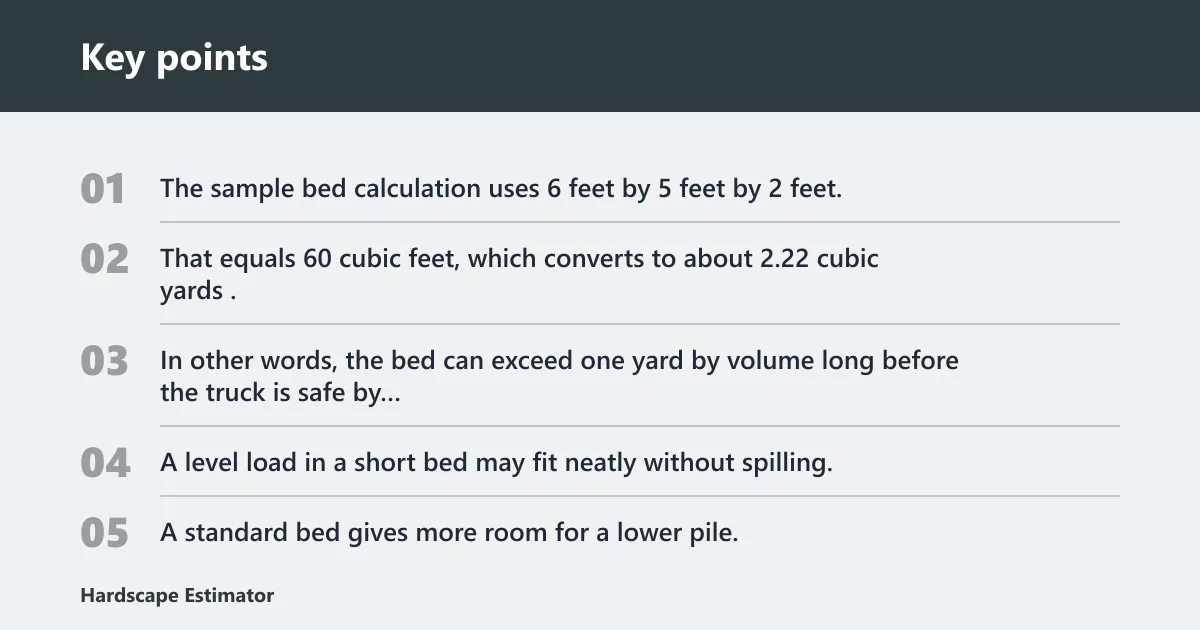
The sample bed calculation uses 6 feet by 5 feet by 2 feet. That equals 60 cubic feet, which converts to about 2.22 cubic yards. In other words, the bed can exceed one yard by volume long before the truck is safe by weight.
Bed volume versus safe load
A level load in a short bed may fit neatly without spilling, but it can still exceed payload. A standard bed gives more room for a lower pile, yet the truck still has to carry the mass of the soil, plus people and gear. Volume and weight solve different problems.
Short-bed trucks are more likely to need a heaped load to reach one cubic yard, which raises the chance of spillage and poor visibility. Standard beds make it easier to spread the load lower, but they do not change the sticker payload rating.
Heaped loads can spill and shift. Level loads are easier to secure. Compacted loads may sit lower in the bed, but they can still weigh the same or more than a loose pile.
How much can a half-ton pickup safely haul?

Most half-ton pickups are rated between roughly 1,500 and 2,300 pounds of payload, depending on configuration. That means many half-ton trucks cannot safely carry a full cubic yard of topsoil, especially if the load is wet or if passengers are riding along.
Half-ton is a class label, not a hauling promise. Some trucks in that category have enough payload for a dry yard with a light driver and no passengers. Others run out of capacity well before the bed is full. The door sticker settles the question.
When the remaining payload is below the soil weight, two trips are the safer choice. That is usually the better answer than overloading the rear axle, suspension, frame, brakes, and tires. Underinflated tires reduce load-carrying capacity even more.
A common first-timer mistake is assuming a short-bed pickup can haul a full cubic yard of topsoil just because the pile looks low enough. A half-ton with a tall bed can still be overweight with one wet yard, while a heavier truck with a shorter bed may handle the same load safely because the sticker payload is higher.
When two trips make more sense
- The sticker payload is under the estimated soil weight.
- Passengers or tools take a large share of the payload.
- The soil is wet, muddy, or freshly delivered after rain.
- The load would need to be piled high to fit.
- The truck already sits low in the rear before loading.
Frequently asked questions
Will wet topsoil exceed my truck’s payload limit?
It can. Wet topsoil is heavier than dry topsoil, and saturated material can reach 3,000 pounds or more per cubic yard. If your truck is already near its payload rating with people and gear aboard, rain can push a borderline load into the unsafe range.
How much topsoil can a half-ton pickup safely haul?
Often less than a full cubic yard. Most half-ton pickups are rated around 1,500 to 2,300 pounds of payload, and that weight includes passengers and cargo. A dry yard may fit on a higher-rated truck, but many half-tons need a partial load or two trips.
What if my truck has passengers or tools in it too?
Subtract them before you load soil. Passenger weight, tools, coolers, recovery gear, and fixed accessories all reduce the payload available for topsoil. If those items leave less remaining payload than the soil load weighs, the safe choice is to cut the load or make another trip.