How to Find Your Truck Payload Capacity on the Door Sticker
Find your truck’s payload capacity on the tire-and-loading sticker on the driver’s door jamb, then subtract passengers, fuel, toolboxes, bed liners, and hitch weight. Skip that number, and you can overload the rear axle, wear tires faster, and come up short on safe gravel, soil, mulch, or paver capacity. This guide shows how to read the sticker and turn it into a real hauling limit for hardscape materials.
Truck payload worksheet
This worksheet turns the sticker number into a usable hauling limit. The sticker value is only the starting point. Real payload drops after people, accessories, cargo, and trailer tongue weight are counted, and the rear axle and tire ratings still have to pass.
| Scenario | Sticker payload | Estimated occupant weight | Accessory weight | Cargo weight | Remaining payload | Rear-axle and tire check |
|---|---|---|---|---|---|---|
| Stock truck | 1,850 lb | 400 lb | 0 lb | 0 lb | 1,450 lb | Pass if axle and tires stay under rating |
| Family in cab with tools | 1,850 lb | 560 lb | 120 lb | 180 lb | 990 lb | Check rear axle first; pass only if scaled load stays under GAWR and tire limits |
| Bed-load scenario | 1,850 lb | 400 lb | 150 lb | 1,100 lb | 200 lb | Likely fail if rear axle or rear tires are near max |
Worked math: 1,850 lb sticker payload minus 400 lb occupants leaves 1,450 lb. Subtract a 120 lb toolbox and 180 lb of hand tools, and the remaining payload is 1,150 lb. If the rear axle rating or tire load rating is lower than that loaded weight distribution allows, the truck still fails.
What the door sticker shows
The Tire and Loading Information label is the first number to use. It is usually on the driver-side door jamb and lists the maximum combined occupant and cargo load for that exact truck, often in pounds. A separate certification label may also be on the jamb and can show GVWR and axle ratings.
Where to find the label
Open the driver door and look along the door jamb, the latch area, or the door edge. Lighting, dirt, fading, and worn clear film can make the label hard to read. If a sticker is split across labels, read both before making a weight decision.
Why trim matters
Similar trucks can carry different payloads because cab size, bed length, drivetrain, and factory options change curb weight. A heavier curb weight leaves less remaining payload. That is why two trucks that look alike may show different sticker numbers.
How do you find the payload number?
Read the occupant and cargo load line on the Tire and Loading Information label. That line is the payload number to start with. If the label is incomplete, compare it with the certification label and the owner’s manual, then verify the exact truck by VIN if needed.
Read the right line
The sticker often says the combined weight of occupants and cargo should never exceed a specific number. That number is payload. It is not bed cargo only, and it is not the towing limit.
What to do if the label is faded or missing
If the door sticker is unreadable, use the VIN to request factory information from the manufacturer or dealer, then compare it with the certification label on the door jamb. If the truck has a swapped axle, upfitter parts, or a modified suspension, treat the factory value as a starting point only.
What does payload capacity include?
Payload includes everyone in the cab, tools, materials, bed cargo, and accessories that were added after delivery. Fuel is already baked into the factory number through curb-weight assumptions, but heavy aftermarket parts reduce usable payload. Trailer tongue weight counts too.
Passengers and tools
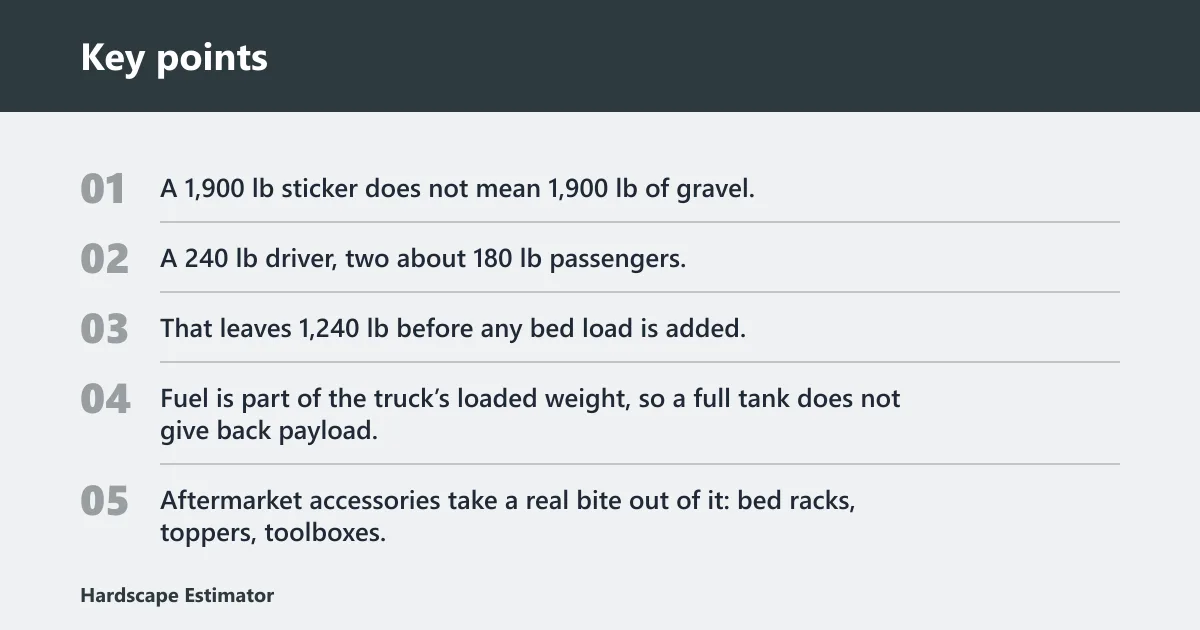
A 1,900 lb sticker does not mean 1,900 lb of gravel. A 240 lb driver, two about 180 lb passengers, and about 60 lb of tools already use about 660 lb. That leaves 1,240 lb before any bed load is added.
Fuel and accessories
Fuel is part of the truck’s loaded weight, so a full tank does not give back payload. Aftermarket accessories take a real bite out of it: bed racks, toppers, toolboxes, bumpers, winches, and slide-in campers all add weight. A 150 lb topper leaves about 150 lb less available on a 1,500 lb payload truck.
Trailer tongue weight
Yes, tongue weight counts against payload. A 10% trailer tongue on a 3,500 lb trailer adds about 350 lb to the truck. That weight sits on the hitch and rear axle, so it can eat the remaining payload quickly even when the trailer itself is doing the hauling.
What you’ll need
- Door-jamb Tire and Loading Information label
- Certification label or owner’s manual for GVWR and GAWR
- Scale ticket or axle ratings if available
- Estimated weights for passengers, tools, and materials
- Known accessory weights for toppers, racks, toolboxes, bumpers, or winches
- Tire sidewall load rating and recommended inflation pressure
- VIN-based label lookup if the sticker is missing or unreadable
Find your remaining payload
Start with the sticker number, subtract the people and equipment that will ride in the truck, then check whether the rear axle and tires still have room. That sequence matters because a truck can stay under payload on paper and still overload the rear axle first.
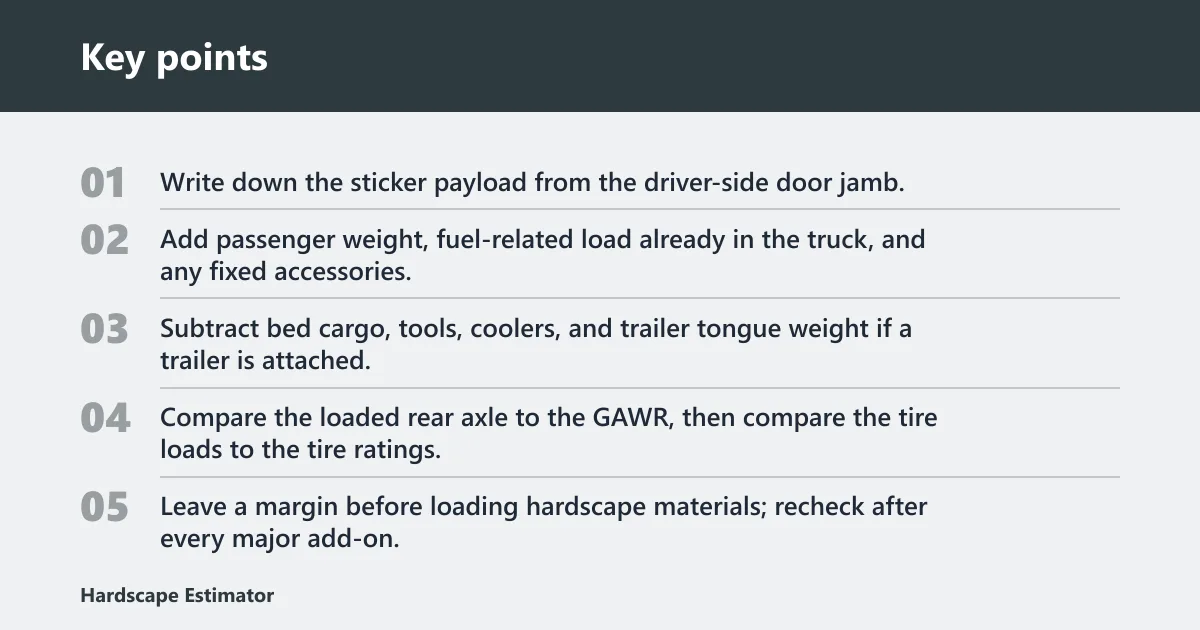
- Write down the sticker payload from the driver-side door jamb.
- Add passenger weight, fuel-related load already in the truck, and any fixed accessories.
- Subtract bed cargo, tools, coolers, and trailer tongue weight if a trailer is attached.
- Compare the loaded rear axle to the GAWR, then compare the tire loads to the tire ratings.
- Leave a margin before loading hardscape materials; recheck after every major add-on.
Say your truck shows 1,850 lb of payload and you plan to haul 1,000 lb of gravel with a 260 lb driver and a 120 lb toolbox. The sticker math says 470 lb remains, but if the rear axle is already close to its limit, that 1,000 lb load can still fail the axle check even though the sticker number looks safe.
Suppose a half-ton truck has a 1,620 lb payload sticker, a 300 lb bed rack, and a 190 lb topper. Those accessories alone consume 490 lb. That leaves 1,130 lb before people, tools, and material are counted, so the practical gravel or paver load is much lower than the headline number.
Can accessories and tires change the answer?
Yes. Aftermarket accessories consume payload, and tire changes do not restore lost capacity by themselves. A stronger tire may improve load reserve, but it does not change GVWR, GAWR, or the sticker payload. The truck still has to stay within the factory weight ratings.
Accessories that consume payload
Bed racks, toolboxes, toppers, winches, heavy bumpers, and slide-in campers all add weight before cargo is loaded. Some of that weight also shifts more load to the rear axle. That is why a topper plus a pallet of pavers can hit the rear-axle rating faster than the sticker number suggests.
Why tire ratings still matter
Tire load rating is the maximum weight one tire can carry at a specified pressure. Two rear tires must safely support the rear-axle load. If the axle is carrying 3,800 lb and each rear tire is only rated for 1,800 lb, the combined 3,600 lb tire capacity is the limit even if payload remains on paper.
When axle balance changes
Adding a toolbox at the tailgate or a heavy topper can shift weight rearward. That shift can push the rear axle over GAWR while the front axle gets lighter. A scaled axle reading is the best check when the truck is close to full.
Common mistakes
Most overload problems come from using the wrong number or stopping too early. The sticker is the starting point, not the finish line. Rear-axle ratings and tire limits can be the real bottleneck for bed materials.
- Confusing payload with GVWR: GVWR is the maximum loaded truck weight; payload is what can be added on top of the truck’s curb weight.
- Ignoring rear-axle limits: The rear axle often reaches its limit before the sticker number does, especially with mulch, gravel, or pavers in the bed.
- Assuming towing capacity covers bed loads: Towing numbers do not replace payload math. Tongue weight still counts against payload.
- Skipping tire checks: The truck can be under payload and still overload the rear tires.
- Forgetting accessories: A topper or toolbox can remove hundreds of pounds from usable capacity.
A common first-timer mistake is loading 60 bags of mulch because the sticker says the truck can carry 1,800 lb. If the driver, passenger, and toolbox already use 500 lb, only 1,300 lb remains, and the rear axle may run out of margin before the bags are all on board.
How much weight can my truck carry with passengers and cargo?
It can carry only what remains after everyone and everything are counted. Start with the sticker payload, subtract the people in the cab, then subtract tools, accessories, and trailer tongue weight. The remaining number is the practical limit for gravel, soil, mulch, or pavers.
For hardscape materials, convert that remaining payload into volume. A yard of dry mulch may weigh roughly 400 to 600 lb, while topsoil and damp gravel can weigh much more. Pavers vary by size, but a pallet can add up fast, so weight matters more than cubic footage.
Why does my towing capacity not match my payload capacity?
Towing capacity and payload capacity measure different limits. Towing is about pulling a trailer; payload is about what the truck carries on its own axles. A truck can tow a large trailer yet have a modest payload, especially when passengers, hitch hardware, and tongue weight are included.
If a trailer is used for hardscape material, tongue weight still counts against payload. That is why a trailer does not make the truck’s payload number disappear. It only moves some of the cargo behind the truck while adding hitch load back onto it.
Frequently asked questions
How do I find my truck payload capacity on the door sticker?
Open the driver door and read the Tire and Loading Information label on the door jamb. The listed occupant-and-cargo number is the payload figure to use. If there are two labels, check both and match them to the exact trim and VIN before loading.
What number on the door sticker is payload?
Look for the line that says the combined weight of occupants and cargo should not exceed a specific number. That number is payload. It is not the GVWR, which is the truck’s maximum loaded weight, and it is not a towing rating.
Is payload the same as GVWR?
No. GVWR is the maximum allowed loaded weight of the truck itself, while payload is the amount that can be added to the truck after curb weight is accounted for. Subtracting curb weight from GVWR gives the general payload framework, but the sticker gives the exact truck value.
Can I trust the door sticker payload if I have aftermarket tires or a topper?
Use the sticker as the base number, then subtract the weight of the topper, rack, toolbox, bumper, or other add-on. Aftermarket tires may improve load reserve, but they do not increase GVWR or payload by themselves. Recheck axle and tire ratings after every major change.
What if my door sticker is missing or unreadable?
Use the VIN to obtain factory payload and rating information, then compare it with the certification label on the door jamb. If the truck has been modified, weigh the truck and each axle separately before loading. When the labels disagree, the scale ticket is the best reality check.
How do I calculate remaining payload after adding people and tools?
Subtract the combined weight of everyone in the cab, then subtract tools, accessories, and trailer tongue weight from the sticker payload. For example, a 1,750 lb sticker minus about 380 lb of people and about 140 lb of tools leaves about 1,230 lb. Load less if the rear axle or tires are close to their ratings.