How Much Gravel Can a Pickup Truck Hold Safely?
A pickup can safely carry only as much gravel as its payload sticker allows after subtracting passengers, tools, fuel, and any other cargo; many half-ton trucks end up with about 1,000 to 1,800 lb of gravel, though the sticker remains the limit. Go past that number and you can overload tires, sag the suspension, and push braking and steering past safe margins. This guide shows how to read the payload label and convert it into a gravel load limit in pounds and tons.
Pickup truck payload capacity
Payload is the number that matters. It is the maximum weight the truck can carry in and on the truck, including people, fuel, tools, tie-down gear, and gravel. It is printed on the driver-side door jamb certification label or payload sticker, and it is usually lower than people expect.
Payload vs. towing capacity
Payload and towing capacity are different limits. Towing capacity is about what the truck can pull behind it. Payload is about what the truck can hold on its own axles. Gravel in the bed uses payload, not towing capacity.
Why the door sticker is the number that matters
The door sticker is the best source because it reflects the exact truck as built, with its trim, cab, drivetrain, options, and tires. A bed that looks large can still be over the limit with a modest gravel load if the sticker number is low. Bed size does not override payload.
How gvwr fits into the calculation
GVWR is the truck’s maximum allowed total weight when loaded. Payload is the difference between GVWR and curb weight, after the truck leaves the factory. If the certification label lists GVWR and axle information, use that label first; it is the same family of limits that supports the payload number.
How much gravel can a pickup truck hold safely?
The safe-load rule is simple: payload left after passengers, fuel, tools, and gear equals the maximum gravel weight you can load, and you should stay under that number. For many half-ton trucks, that leaves about 1,000 to 1,800 lb for gravel, but the exact limit comes from the sticker, not the bed size.
What to subtract before loading gravel
Start with the payload sticker, then subtract everything already in the truck. Use actual weights when possible. A 180-lb driver, a 150-lb passenger, 40 lb of tools, and 20 lb of tie-down gear already remove 390 lb from payload before a single shovel of gravel goes in.
- Read the payload number on the driver-side door jamb label.
- List every person in the cab.
- Add fuel weight if the truck is not near empty, plus toolboxes and gear.
- Subtract that total from payload.
- Use the remainder as the gravel limit in pounds.
When a full yard is too much
A full yard of gravel is often too heavy for a half-ton pickup once passengers and fuel are included. Wet gravel can push a yard well past 3,000 lb. That can exceed the remaining payload even when the bed still looks only partly full.
Truck bed volume and gravel yards

Bed volume tells you how much space is available. It does not tell you how much weight is safe. Short beds, standard beds, and long beds vary in cubic feet, but a loose gravel load can still be too heavy long before the bed looks full.
Short bed, standard bed, and long bed sizes
Common pickup beds range from about 5.5 ft short beds to 6.5 ft standard beds and about 8 ft long beds. Manufacturers publish volume in cubic feet, but real usable space changes with wheel wells, tailgate position, and how evenly the load is shaped.
| Bed type | Typical length | Approx. volume | Volume in cubic yards |
|---|---|---|---|
| Short bed | 5.5 ft | 50 to 55 cu ft | 1.85 to 2.04 yd³ |
| Standard bed | 6.5 ft | 62 to 65 cu ft | 2.30 to 2.41 yd³ |
| Long bed | 8 ft | 75 to 79 cu ft | 2.78 to 2.93 yd³ |
Why 27 cubic feet equals 1 cubic yard
One cubic yard is 27 cubic feet. That conversion matters because gravel is often sold by the yard, but truck beds are usually discussed in cubic feet. Divide bed volume by 27 to estimate the space available in yards.
How tailgate position changes usable volume
With the tailgate up, the load stays more contained and less likely to spill. With the tailgate down, some materials can extend past the bed floor, which can add apparent space but changes the load shape and can put more of the weight farther behind the rear axle. That affects stability.
How much does a cubic yard of gravel weigh?
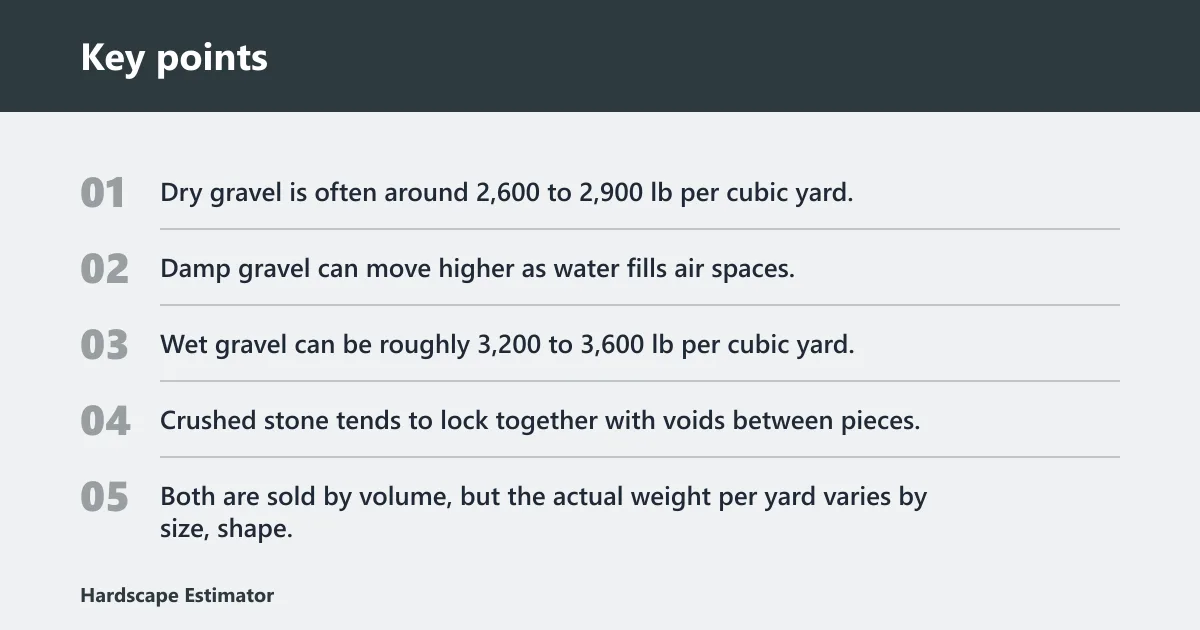
A cubic yard of gravel does not have one fixed weight. Dry gravel, damp gravel, and wet gravel weigh different amounts, and crushed stone and pea gravel can also differ. A safe estimate depends on the supplier’s material and moisture content, not just the volume.
Dry gravel vs. damp gravel vs. wet gravel
Dry gravel is often around 2,600 to 2,900 lb per cubic yard. Damp gravel can move higher as water fills air spaces. Wet gravel can be roughly 3,200 to 3,600 lb per cubic yard, and may be a bit more or less depending on stone type and how much water it holds.
Crushed stone and pea gravel weight differences
Crushed stone tends to lock together with voids between pieces, while pea gravel can pack differently because of its rounded shape. Both are sold by volume, but the actual weight per yard varies by size, shape, and moisture. A supplier’s weight figure beats a guess.
Why supplier weight can beat volume estimates
If the quarry or supplier gives a tonnage number, use that instead of a generic yard estimate. The more moisture in the pile, the less reliable a pure volume estimate becomes. The right question is not only “how many yards fit,” but “how many pounds can the truck safely carry.”
Say your 2024 half-ton pickup has a 1,650-lb payload sticker. After about a 210-lb driver, about a 140-lb passenger, about 60 lb of tools, and about 20 lb of straps, about 1,220 lb remains. That is enough for about 0.4 yd³ of wet gravel or roughly 0.45 yd³ of drier gravel, not a full yard.
Gravel load worksheet
Use the worksheet below to turn payload into a gravel limit. The math is straightforward: subtract everything already in the truck, then divide the remainder by the gravel weight per cubic yard. That gives a safe yard estimate for dry, damp, and wet material.
| Step | Example A: half-ton | Example B: three-quarter-ton | Example C: one-ton |
|---|---|---|---|
| Payload sticker | 1,650 lb | 2,850 lb | 4,200 lb |
| Passengers | 350 lb | 320 lb | 300 lb |
| Fuel allowance | 100 lb | 120 lb | 120 lb |
| Tools / gear | 80 lb | 150 lb | 200 lb |
| Payload left for gravel | 1,120 lb | 2,260 lb | 3,580 lb |
| Dry gravel at 2,700 lb/yd³ | 0.41 yd³ | 0.84 yd³ | 1.33 yd³ |
| Damp gravel at 3,000 lb/yd³ | 0.37 yd³ | 0.75 yd³ | 1.19 yd³ |
| Wet gravel at 3,400 lb/yd³ | 0.33 yd³ | 0.66 yd³ | 1.05 yd³ |
Subtract passengers, fuel, and gear
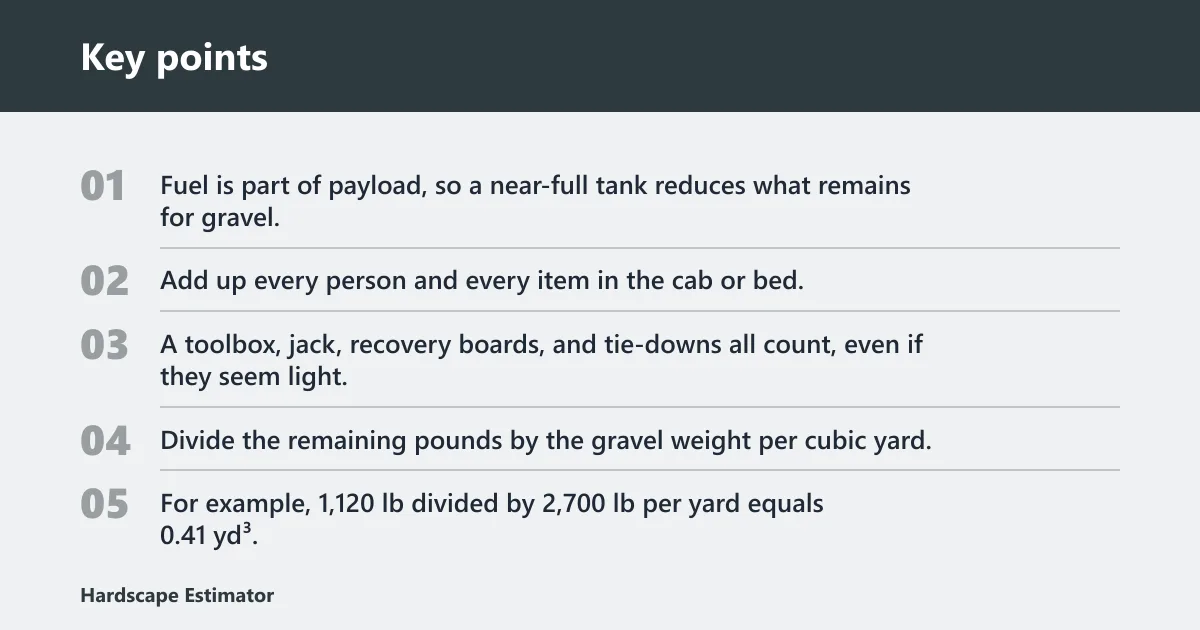
Fuel is part of payload, so a near-full tank reduces what remains for gravel. Add up every person and every item in the cab or bed. A toolbox, jack, recovery boards, and tie-downs all count, even if they seem light.
Convert remaining payload to yards
Divide the remaining pounds by the gravel weight per cubic yard. For example, 1,120 lb divided by 2,700 lb per yard equals 0.41 yd³. Use the heavier wet-gravel number when the pile is damp or the forecast calls for rain.
Worked examples for common pickup classes
A common first-timer mistake is ordering 1 yard because the bed looks large enough. On a short-bed half-ton with family in the cab, the payload often runs out first. A three-quarter-ton truck usually has more margin, but the rear axle and tire ratings still control the final yes or no.
Can my pickup carry a full yard?
Sometimes yes, often no. A full yard of dry gravel may fit in the bed volume, but safe carrying depends on the payload sticker, passenger weight, and whether the load is dry, damp, or wet. Half-ton trucks frequently cannot do it safely.
Half-ton pickup check
Most half-ton trucks should not be assumed to carry a full yard safely. With passengers and fuel included, many half-ton payload ratings leave less than 1,500 lb for gravel. That is usually below the weight of a full yard unless the material is unusually dry and the truck has a strong payload rating.
Three-quarter-ton pickup check
A three-quarter-ton truck may carry close to a full yard of dry gravel if the payload sticker and axle ratings allow it, but wet gravel can still push the load too high. The correct check is weight first, then bed space. Do not rely on the bed size alone.
One-ton pickup check
A one-ton truck often has enough payload for a full yard and sometimes more, but that still depends on the sticker, tire load rating, and rear axle rating. If the gravel is wet or the load sits high above the bed rails, the usable margin shrinks quickly.
How high can I load gravel in a pickup truck bed?
Load gravel level or only slightly crowned. The higher the pile, the higher the center of gravity and the more likely the truck is to sway, squat, and brake poorly. Keep the load contained below the bed rails whenever possible, and secure it with a tarp.
Level the load, do not heap it
A level load is easier to control and easier to keep inside the truck. Heaped gravel can add weight above the rails without adding much useful volume. That extra height makes the truck less stable and increases the chance of spillage.
Why axle loading and tires matter
Rear axle loading rises fast with gravel because most of the weight sits behind the cab. Tire load rating can become the limiting factor before the payload sticker does. If the rear end sags heavily, steering gets lighter and braking distance usually grows.
Loose load vs. contained load
A contained load stays lower and more centered in the bed. A loose, heaped load can shift, settle, and spill. If the gravel is above the rails or the tailgate is down, use care with turns, bumps, and braking because the load can move rearward and sideways.
Do I need a trailer instead of a pickup for gravel?
Use a trailer when the gravel amount exceeds the truck’s remaining payload, when you need more than one safe yard, or when the load would sit too high in the bed. A trailer is also the better choice if the truck is already carrying passengers, tools, or equipment.
Suppose a three-quarter-ton truck has enough room for 0.8 yd³ of damp gravel after subtracting passengers and fuel. Ordering 1.5 yd³ would require either multiple trips or a trailer. Trying to force it into one load risks tire overload, rear sag, and poor braking.
Frequently asked questions
How many cubic yards of gravel fit in a pickup truck bed?
Bed space often ranges from about 1.9 yd³ in a short bed to nearly 3.0 yd³ in a long bed, but that is a volume estimate only. The safe amount can be far less because gravel weight, moisture, and payload limits usually cap the load before the bed fills.
How much weight can a pickup truck carry without overloading it?
The truck can carry up to its payload rating on the certification label, minus the weight of everyone and everything already on board. That includes fuel, passengers, toolboxes, tie-downs, and cargo. Exceeding payload can overload tires, suspension parts, and the rear axle.
What is the payload capacity of my truck?
Look on the driver-side door jamb certification label. The payload number is manufacturer-specific and reflects the exact truck as built. If the label is missing or unclear, use GVWR and the truck’s curb weight, but the door sticker is the best and simplest source.
How does truck bed size affect gravel capacity?
Bed size affects volume, not safe weight by itself. A long bed can hold more cubic feet than a short bed, but the truck still has the same payload limit. A larger bed may fit more gravel shape-wise while still being overloaded on weight.