Sand Calculator for Patios, Pavers, and Fill by Area
A sand calculator estimates cubic feet, cubic yards, tons, or bags from area, depth, and sand type; for paver bedding use roughly 1 in of concrete sand, and for sandboxes use roughly 6 in of clean fill/play sand. Wrong depth or density shifts cost, delivery, and compaction, leaving joints short or a project overbought. This guide shows which sand to use for patios, trenches, round features, and sandbox fills, plus the formula and conversions.
How much sand do I need?
Start with the project type, then use the matching depth. For patios and pavers, a common target is about 1 in of bedding sand. For trench fill, use the trench dimensions and fill depth. For sandbox work, 6 in is a common planning depth. The math comes after the material choice.
Choose the project type before you estimate
Sand is not one product. Paver bedding sand, sharp sand, play sand, and general fill sand have different uses and often different densities. If the wrong type is selected, the volume may still be right while the delivery weight, compaction, and finish are wrong.
Use the right depth for bedding, fill, or sandbox work
A patio bed is usually planned at 1 in, not 3 in or 4 in. A sandbox fill is often planned at around 6 in. Round features use the same depth rule, but the area must be calculated from the circle first. That is the fastest way to avoid underordering.
Convert the result to yards, tons, or bags
Bulk sand is usually sold by the cubic yard or ton. Bagged sand is common for smaller jobs and repairs. A practical sand calculator should convert the same volume into all three units so the user can compare delivery options without redoing the math.
Typical sand density is 100 lb/ft³.
Which sand type should I use?
Use paver bedding sand for patios and hardscape joints, sharp sand or fill sand for trench and leveling work where a firmer granular fill is needed, and play sand for sandboxes and playground areas. Material selection matters because density, shape, and finish behavior are not the same.
Paver bedding sand
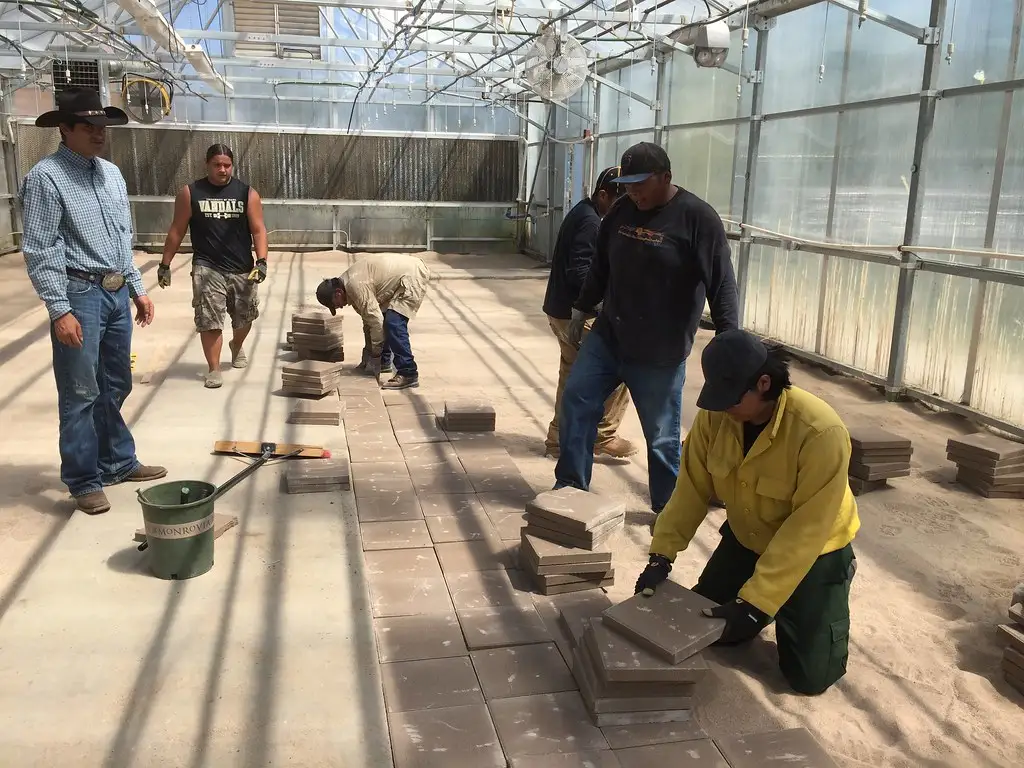
Paver bedding sand is the common choice under pavers. Plan about 1 in of compacted bedding, and keep the thickness consistent across the bed. For planning, a clean concrete sand or paver sand estimate works better than a generic “sand” entry because the layer is thin and detail-sensitive.
Sharp sand and fill sand
Sharp sand is often used where a coarser, better-draining fill is wanted. For trench fill, edge support, or leveling below hardscape elements, the target depth depends on the excavation. Fill sand should be estimated by the actual void volume, not by surface area alone.
Play sand for sandbox and playground use
Play sand is the usual choice for sandbox work because it is selected for a softer finish and child use. It is still estimated by volume. A square yard of sandbox area at 1 ft deep weighs about 900 pounds, so even a small box adds weight quickly.
How do I calculate sand volume?
Use length × width × depth for rectangular areas, and use π × r² × depth for circular areas. Then convert the result into cubic yards, tons, or bags. If the shape is irregular, split it into smaller rectangles and circles, then total the pieces.
Rectangle formula: length × width × depth
For patios, fills, and trenches, the rectangular volume formula is the simplest path. Multiply the measured length by width by depth in feet to get cubic feet. This is the core calculation behind most hardscape sand estimates.
Example: 12 ft × 10 ft × 1 in. Convert 1 in to 0.083 ft. The volume is 12 × 10 × 0.083 = 9.96 cubic feet. That is the starting point before yard or weight conversion.
Circle formula: π × r² × depth
For round pads, fire pits, or circular fills, use the circular area formula first. If the feature has a 6 ft diameter, the radius is 3 ft. Area is 3.1416 × 3² = 28.27 square feet. At 1 in depth, the volume is 28.27 × 0.083 = 2.35 cubic feet.
Irregular areas and waste allowance
Irregular shapes should be broken into simple sections whenever possible. Curves, cuts, and waste from trimming add up quickly. The calculator suggests buying 5-6% more sand than estimated, but irregular projects or compacted installs often need more than that.
How do I convert sand volume to yards, tons, and bags?
Convert cubic feet to cubic yards by dividing by 27, because there are 27 cubic feet in a cubic yard. For inch-based takeoffs, remember there are 46,656 cubic inches in a cubic yard. Then convert volume to weight with density, or to bags by dividing by bag yield.
Cubic feet to cubic yards
If the project volume is 9.96 cubic feet, divide by 27. The result is 0.37 cubic yards. That is the bulk order size before overage. Small patio beds often land under one cubic yard even when the area looks large at first glance.
Volume to weight using density
Typical sand density is 100 lb/ft³, and typical sand density is 1600 kg/m³. One cubic yard of typical sand weighs about 2700 pounds, or about 1.35 tons. Dry sand weighs 1.3 to 1.5 tons per cubic yard, and damp sand weighs 1.5 to 1.7 tons per cubic yard.
Bag-count cross-check for common bag sizes
Bagged sand is often sold in 30 to 40 kg bags, or 66 to 88 lb bags. Common retail formats also include 40, 60, and 80 lb bags. A quick bag-count check helps confirm that a yard or ton estimate makes sense before ordering.
Example: 0.37 cubic yards at 2700 lb per yard is about 999 lb. That equals about 25 bags at 40 lb, about 17 bags at 60 lb, or about 13 bags at 80 lb. If the bag count looks far off, the depth or area input likely needs a second look.
What sand depth should I use for each project?
Patios and pavers usually call for 1 in of bedding sand. Trench fill is set by the trench design, not a fixed depth. Sandboxes commonly use 6 in of fill. Round features use the same depth rules as square areas, but the circular area must be calculated first.
Patio and paver bedding depth
Plan 1 in of bedding sand under pavers unless the installation spec calls for a different depth. One competitor allows up to 1.5 in in its guidance, but thinner, uniform bedding is the safer estimate for most layouts. Overfilling the bed can make compaction harder to control.
Trench fill depth
For trenches, calculate the trench width, length, and fill depth directly. There is no single fixed depth because utility trenches, edge restraints, and drainage strips all vary. The volume method is the right tool, especially where sidewalls or slope change the fill line.
Sandbox fill depth
For a sandbox, 6 in of clean play sand is a common planning depth. A sandbox square yard 1 foot deep weighs about 900 pounds, so depth changes the order fast. If the box is shallow, volume falls quickly; if it is deep, weight rises fast.
Round feature depth
For round pads or circular features, the depth is usually planned just like any other area. The difference is the area formula. A ring, pit, or round border may also need a waste allowance because curved edges and trimming create more loss than straight cuts.
How much extra sand should I buy?
Plan 5-6% extra for a clean, simple job, but increase that amount for irregular shapes, deeper fills, or compacted work. Sand is easy to overestimate by surface area alone and still come up short once settling, cutting, and cleanup are included.
When 5 to 6 percent is enough
For a rectangular patio with straight edges and a known depth, 5-6% extra is usually enough to cover minor grade changes and small mistakes. It is also a practical buffer for bag rounding and delivery mismatch.
When to add more for irregular or compacted installs
Add more when the project has curves, many cuts, or a deep trench that will settle after placement. Compaction-heavy work can reduce finished thickness, so starting with a thin estimate can leave the site short after the first pass.
Why cut losses happen on site
Losses come from spill, trim waste, uneven subgrade, and the difference between loose and compacted volume. Wet material can also pack differently than dry stock. A simple waste factor is useful, but it should not replace a proper volume calculation.
Proof table: sand depth and density by project
The table below gives a project-by-project reference for common hardscape sand uses. It includes depth guidance, approximate density assumptions, moisture notes, and a bag-count cross-check so cubic yards, tons, and bags stay aligned.
| Project type | Typical depth to plan | Working density | Moisture note | Unit cross-check |
|---|---|---|---|---|
| Patio bedding | 1 in | 100 lb/ft³ | Dry stock is lighter; damp stock needs a higher weight allowance. | 1 yd³ ≈ 2700 lb ≈ 1.35 tons |
| Paver bedding sand | 1 in to 1.5 in | 100 lb/ft³ | Wet sand is heavier than dry sand and may bridge in bags. | 40 lb bags need roughly 67 bags per ton |
| Trench fill | Project-specific | 100 lb/ft³ | Damp trench stock can land in the 1.5 to 1.7 tons/yd³ range. | 27 ft³ per yd³ |
| Sandbox fill | 6 in | Varies by play sand product | Play sand density can differ from construction sand. | 1 sq yd at 1 ft deep ≈ 900 lb |
| Round feature fill | Usually 1 in to project spec | 100 lb/ft³ | Curves often need a larger waste allowance. | 46,656 in³ per yd³ |
Frequently asked questions
How much sand do I need?
Multiply length by width by depth for rectangular areas, or use π × r² × depth for circles. Then convert cubic feet to cubic yards by dividing by 27, and use about 100 lb/ft³ if a weight estimate is needed. Add 5-6% extra for a basic buffer.
How much sharp sand do I need?
Estimate sharp sand the same way as any other sand, but choose the project depth first. For leveling, trench fill, or drainage-related work, measure the void and convert it to volume. Then convert to yards, tons, or bags using the density assumption for the selected product.
How much paver sand do I need?
For most patios and walkways, plan about 1 in of paver bedding sand. That thin layer means small depth errors change the order fast. Use the area in square feet, multiply by 0.083 ft for depth, and convert the result to cubic yards or bags.
How much sand do I need for a sandbox?
Sandbox fill is commonly planned at 6 in. A square yard of sandbox area at 1 foot deep weighs about 900 pounds, so the final order depends heavily on depth. Play sand is usually the better material choice for this use than construction sand.
How many tons of sand do I need?
Convert cubic yards to weight using the density estimate. One cubic yard of typical sand weighs about 1.35 tons, while dry sand weighs 1.3 to 1.5 tons per cubic yard and damp sand weighs 1.5 to 1.7 tons per cubic yard. Moisture can change the tonnage meaningfully.
Is sand heavier when it’s wet?
Yes. Wet sand is heavier than dry sand because water adds mass and changes how tightly the grains pack. A dry estimate is useful for planning, but damp or saturated delivery should be priced and ordered with a higher weight assumption so the load does not come up short.