Compost Calculator: Bags, Yards, and Coverage
A compost calculator multiplies area by depth to get volume; as a quick rule, 1 cubic yard covers about 324 sq ft at 1 in. depth. Skip that math, and you can buy too few bags, pay for extra bulk delivery, or leave a bed short after settling. This guide shows area-by-depth formulas, bag, yard, liter, weight, and cost conversions, plus settlement-aware examples for lawns, beds, containers, and raised beds.
How much compost do I need?
Use area × depth to get cubic feet, then convert that result to cubic yards, liters, or bags. For many small projects, it can help to add around 10% for settling and handling loss, especially if the compost is wet or will be mixed into soil.
Core formula
Cubic feet of compost = area in sq ft × depth in inches ÷ 12. Then divide cubic feet by 27 to get cubic yards, or multiply cubic feet by 28.3168 to get liters. (en.wikipedia.org)
Worked example
A 100 sq ft garden bed at 2 in. deep needs 100 × 2 ÷ 12 = 16.67 cu ft. That equals 16.67 ÷ 27 = 0.62 cu yd, or about 472 L. With 10% overage, the buy target becomes 0.68 cu yd. (en.wikipedia.org)
Area shapes the calculator should handle
- Rectangle: length × width = area.
- Circle: π × radius² = area.
- Triangle: 0.5 × base × height = area.
- Custom/direct area: enter square feet directly when the shape is irregular.
What compost depth should I use?
Use the project type to decide whether compost is a surface layer or part of a blend. Established lawns usually get 1/4 to 1/2 in. as topdressing, new lawns and garden beds often use 1 to 2 in., raised beds can use 2 to 3 in. as part of a mix, and planting areas tied to walls or pavers often need a blend rather than pure compost.
Depth by project type
- Established lawn: 0.25 to 0.5 in. for topdressing.
- New lawn: 1 to 2 in. worked into 6 to 8 in. of soil.
- Garden bed: 1 to 2 in. worked into existing soil.
- Raised bed: 2 to 3 in. within a soil blend, not compost alone.
- Trees and shrubs: use a ring or basin approach, not a full-bed layer.
- Pots and containers: use a limited compost share in a potting mix.
The lawn example uses 1/2 inch of compost.
How many bags of compost do I need?
Divide the required volume by the bag size, then round up to whole bags. That rounding matters: if the math says 6.2 bags, the purchase is 7 bags, because partial bags are not practical and settling can reduce usable volume after spreading.
Common bag sizes
Bag labels vary. A 1 cu ft bag is straightforward to estimate. A 2 cu ft bag can cut the count roughly in half. For retail metric bags, 40 L is about 1.4 cu ft by unit conversion, and 50 L is about 1.8 cu ft.
How rounding changes the total
If a project needs 8.3 cu ft, that equals 9 bags at 1 cu ft, 5 bags at 2 cu ft, 6 bags at 40 L, or 5 bags at 50 L. Buying one extra bag is often cheaper than making a second store run.
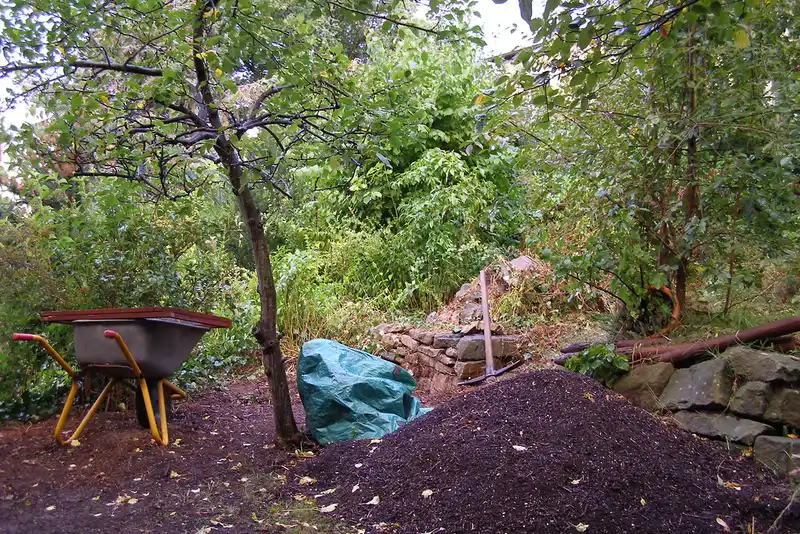
Bulk compost vs bagged compost
Bulk compost is usually priced by the cubic yard, while bagged compost is priced by the bag. To compare them, convert both to the same volume, then add delivery, loading, and the cost of any extra bags needed after settling.
Weight estimate for bulk compost
The calculator starts with 40 pounds per cubic foot. Screened compost at 50% moisture weighs about 1,000 pounds per cubic yard, and very wet compost can weigh over 1,500 pounds per cubic yard. Moisture changes the weight a lot, even when the volume stays the same.
Cost comparison method
- Compute the volume in cubic yards.
- Add the overage buffer you want, usually 10%.
- Multiply bulk cubic yards by the bulk price per yard.
- For bags, divide the adjusted cubic feet by each bag size and round up.
- Multiply the bag count by the bag price.
Proof table: coverage by area and depth
This table gives a fast check for small and large projects. It shows the raw volume, the equivalent in cubic yards, bag counts for common retail sizes, and a 10% overage column so the purchase plan accounts for settling and handling loss.
| Area | Depth | Cubic feet | Cubic yards | 1 cu ft bags | 2 cu ft bags | 40 L bags | 50 L bags | 10% overage yd3 |
|---|---|---|---|---|---|---|---|---|
| 25 sq ft | 1 in. | 2.08 | 0.08 | 3 | 2 | 2 | 2 | 0.08 |
| 25 sq ft | 5 in. | 10.42 | 0.39 | 11 | 6 | 8 | 6 | 0.42 |
| 25 sq ft | 10 in. | 20.83 | 0.77 | 21 | 11 | 15 | 12 | 0.85 |
| 50 sq ft | 1 in. | 4.17 | 0.15 | 5 | 3 | 3 | 3 | 0.17 |
| 50 sq ft | 5 in. | 20.83 | 0.77 | 21 | 11 | 15 | 12 | 0.85 |
| 50 sq ft | 10 in. | 41.67 | 1.54 | 42 | 21 | 30 | 24 | 1.69 |
| 100 sq ft | 1 in. | 8.33 | 0.31 | 9 | 5 | 6 | 5 | 0.34 |
| 100 sq ft | 5 in. | 41.67 | 1.54 | 42 | 21 | 30 | 24 | 1.69 |
| 100 sq ft | 10 in. | 83.33 | 3.09 | 84 | 42 | 59 | 47 | 3.40 |
| 1000 sq ft | 1 in. | 83.33 | 3.09 | 84 | 42 | 59 | 47 | 3.40 |
| 1000 sq ft | 5 in. | 416.67 | 15.43 | 417 | 209 | 295 | 236 | 16.98 |
| 1000 sq ft | 10 in. | 833.33 | 30.86 | 834 | 417 | 590 | 472 | 33.95 |
How to sanity-check supplier claims
If a supplier says a bag covers more than the table suggests, check the labeled bag volume, the stated moisture level, and whether the product is screened or still wet. A bag can be heavier than expected without holding more usable compost.
How do I use compost in beds, lawns, and containers?
Use the project type to decide whether compost is a surface layer or part of a blend. New lawns and garden beds usually use a worked-in layer, while raised beds and containers need a mix that leaves room for structure and drainage.
New lawn and established lawn calculations
New lawns should incorporate 1-2 inches into 6-8 inches of soil. Established lawns use a 1/4 to 1/2-inch layer for topdressing. For topdressing, the required volume is small, so bag rounding can matter more than bulk pricing.
Raised beds and garden bed mixing ratios
A reasonable soil blend uses 25% compost / 75% soil in many mixed beds, while the recommended maximum is 25% to 30% compost in a soil blend. For some mix guidance, 30% to 50% may be used where drainage and planting needs call for it.
Pots, containers, trees, and shrubs
For pots and containers, compost is usually only part of the mix, and up to 25% compost is a practical ceiling in many container and raised-bed blends. For trees and shrubs, compost is best used as a soil amendment or surface dressing, not as a full replacement for soil.
How much compost do I need in litres?
To get liters, multiply cubic feet by 28.3168. A 10 cu ft order is about 283 L. A 2 cu ft bag is about 57 L. This makes it easier to compare metric retail labels with yard-based bulk pricing.
How much compost should I buy to avoid running short?
A 5% buffer covers minor rounding, a 10% buffer is the safest default for most jobs, and 15% to 20% is useful where settling, wet compost, or uneven hand spreading will reduce finished thickness. Buy the extra bag when the project is small; buy the extra yard when the job is large enough that a second delivery would be inconvenient.
When to choose each buffer
- 5%: tight estimate, dry material, little handling loss.
- 10%: standard recommendation for most beds and lawns.
- 15% to 20%: wet compost, rough grade, or mixed projects with settlement risk.
Failure cases to watch
Wet compost compresses more than dry compost. Thin topdressing can disappear into turf. Mixed beds next to pavers or retaining walls often need a little extra because edge work leaves small voids and cleanup loss.
Frequently asked questions
How much compost do I need?
Multiply area by depth, then divide by 12 to get cubic feet. After that, convert to cubic yards or liters and round up for whole bags. Add 10% if the compost is wet, the area is irregular, or the project will settle after watering.
How much compost do I need for a raised bed?
Raised beds should not be filled with compost alone. A common approach is a soil blend with up to 25% compost, or a mixed planting blend in the 30% to 50% range where conditions call for it. The exact amount depends on bed depth and the fill mix.
How many bags of compost do I need?
Divide the needed volume by the bag size and round up. A 1 cu ft bag count is simple, while 2 cu ft, 40 L, and 50 L bags reduce the count. Always round up to whole bags, because partial bags are not a usable purchase unit.
How much compost per 1000 sq ft?
At 1 in. depth, 1000 sq ft needs 83.33 cu ft, or 3.09 cu yd. At 5 in., it needs 416.67 cu ft, or 15.43 cu yd. At 10 in., it needs 833.33 cu ft, or 30.86 cu yd. Add overage if the compost will settle.
What is the best compost ratio for soil?
For many soil blends, 25% compost and 75% soil is a practical starting point. The recommended maximum is 25% to 30% compost in a blend. For some mixed planting areas, 30% to 50% may be used, but the goal is still to keep structure and drainage intact.
How do I work out how much compost I need?
Measure the area, choose the depth, and calculate area × depth ÷ 12. Then convert the result into cubic yards, liters, or bag counts, depending on how the compost will be bought. If the project is small, bag rounding matters more than bulk arithmetic.
How long does it take for compost to be made?
That depends on feedstock, moisture, aeration, and management, so there is no single number that fits every pile. For estimating material needs, the important question is not how fast it was made, but how much volume and weight the delivered compost will provide.