Pickup Truck Bed Size Chart: Short vs Standard vs Long
For hardscape hauling, a standard bed is often the strongest all-around choice: short beds run about 5.5–6.5 ft, standard beds about 6.5–8 ft, and long beds about 8 ft or more. Pick too short a bed and sheet goods overhang, loads need more trips, and payload limits can stop you before volume does. This guide compares usable volume, sheet-good fit, and when payload matters more than bed length.
Truck bed length comparison
| Decision factor | short bed | standard bed | long bed | Winner |
|---|---|---|---|---|
| Inside length for cargo | 67.1 in to 69.92 in on common half-tons | 76.3 in to 79.44 in on common half-tons | 97.6 in to 98.18 in on common half-tons | long bed |
| 4×8 sheet goods flat | No, not flat with the tailgate up | Usually no, but closer than a short bed | Yes, flat fit is the goal here | long bed |
| Parking and tight-site maneuvering | Best | Middle ground | Least easy in tight spaces | short bed |
| Hardscape materials | Works for smaller, lighter loads | Best mix of load room and daily use | Best for repeated sheet goods and long stock | standard bed |
| Payload limit | Set by truck rating, not length alone | Set by truck rating, not length alone | Set by truck rating, not length alone | none |
Short bed, standard bed, and long bed at a glance
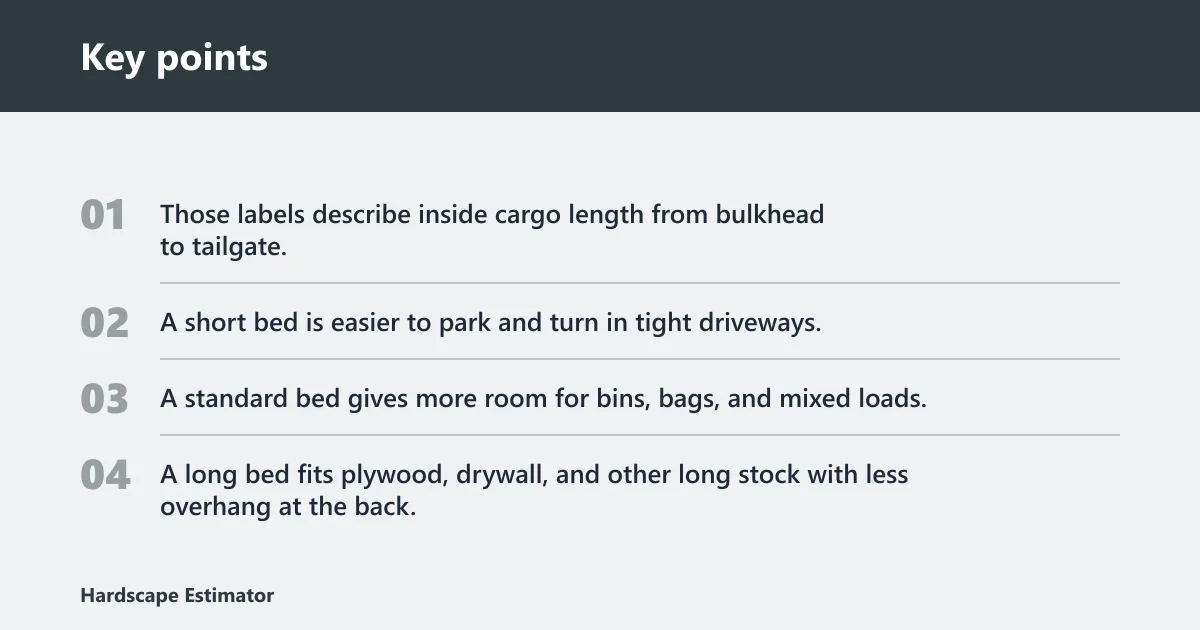
Short beds are about 5.5 to 5.8 ft long. Standard beds are about 6.5 to 7 ft long. Long beds are 8 ft and beyond. Those labels describe inside cargo length from bulkhead to tailgate, so they are about usable space, not total truck length.
The practical difference is simple. A short bed is easier to park and turn in tight driveways. A standard bed gives more room for bins, bags, and mixed loads. A long bed fits plywood, drywall, and other long stock with less overhang at the back.
How is truck bed length measured?
Truck bed length is measured inside the bed from the bulkhead to the inside of the tailgate. That is the number that matters for cargo fit. Exterior truck length is a separate figure, and it can change without changing usable bed space.
Inside length versus outside length
Inside length tells you whether a pallet, bulk bag, or 4×8 sheet will sit flat. Outside length tells you how much truck you have to park and swing around. Those are different decisions. A truck can be long overall and still have a short cargo box.
Why wheelhouses matter
Wheelhouse width and bed depth also affect usable volume. A bed with wide wheel wells leaves less flat floor between them, which can block a pallet or shift how bins sit. Bed depth matters too, because a deeper box can hold more loose material before it spills over the sides.
Say your truck bed is long enough for a 4×8 sheet, but the wheelhouses pinch the floor width too much for your paver pallet. The sheet may fit, yet the pallet still will not sit square. Length solved one problem. Width solved another.
What is a short bed?
A short bed is usually about 5.5 to 5.8 ft long. It is the easiest bed size to live with in parking lots, driveways, and city streets, but it gives up cargo room first. For hauling, that tradeoff matters when material length or loose volume starts to outgrow the box.
Maneuvering and parking tradeoff
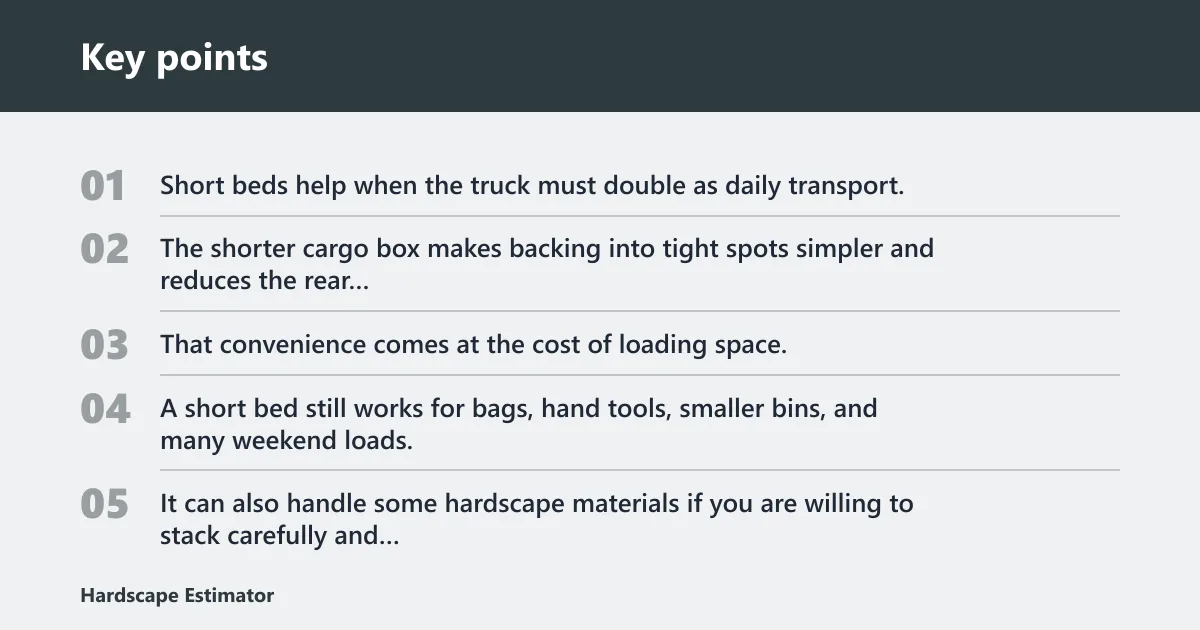
Short beds help when the truck must double as daily transport. The shorter cargo box makes backing into tight spots simpler and reduces the rear overhang that can catch on gates, curbs, or narrow turns. That convenience comes at the cost of loading space.
When a short bed still works
A short bed still works for bags, hand tools, smaller bins, and many weekend loads. It can also handle some hardscape materials if you are willing to stack carefully and accept more trips. For gravel, mulch, and soil, volume may fill the box before length becomes the problem.
What is a standard bed?
A standard bed is usually about 6.5 to 7 ft long. For many buyers, that is the practical middle choice because it gives more usable space without making the truck feel oversized. It is often the most useful balance for hauling and daily driving.
Why many buyers choose it
The standard bed is long enough to improve cargo fit for bins, pavers, and longer bundles, but short enough to remain manageable in everyday use. It gives more margin for tailgate-down hauling and more room for mixed loads than a short bed. That extra margin matters on jobsite days.
Use cases for daily hauling
For mulch, gravel, and soil, the standard bed often makes loading easier because loose material can spread out instead of piling too steeply. For hardscape work, it is a strong compromise when the truck must haul material during the week and still fit in normal parking spaces.
What is a long bed?
A long bed is 8 ft or more. This is the clear choice when the load is sheet goods, dimensional lumber, or other long material that should fit flat instead of overhanging. It is the most jobsite-friendly bed shape, but it is also the least convenient in tight spaces.
Sheet goods and long material fit
Long beds are built for 4×8 sheets, drywall, and other full-length stock. The extra inches reduce the need to rest materials on the tailgate or leave part of the load exposed. That matters for both support and tie-down security.
Best use cases for jobsite hauling
If the truck regularly carries sheet goods, tall bins, edging, lumber, or long pallets, the long bed is the clean fit. It is also the better pick when the hauling pattern is frequent enough that extra cargo length saves time on every trip.
Pickup truck bed size chart: short bed vs standard vs long bed
For hardscape hauling, the right choice depends on what you move most often. A standard bed is the best balance for mixed loads. A short bed is easiest to live with. A long bed is the strongest fit for regular jobsite work and flat sheet-goods transport.
| Truck | Short bed | Standard bed | Long bed | Practical load note |
|---|---|---|---|---|
| Ford F-150 | 67.1 in | 78.9 in | 97.6 in | Common half-ton choice; standard bed is the most flexible daily hauler. |
| Chevrolet Silverado 1500 | 69.92 in | 79.44 in | 98.18 in | Long bed fits 4×8 sheets and long material with the least compromise. |
| Ram 1500 | 67.4 in | 76.3 in | none | No true long bed option; plan around the shorter inside length. |
| Super Duty | common short bed pattern | common standard bed pattern | common long bed pattern | Often chosen when heavier payload and longer cargo both matter. |
| Silverado/Sierra HD | common short bed pattern | common standard bed pattern | common long bed pattern | HD buyers often prioritize both bed length and payload rating. |
Ford F-150 bed lengths
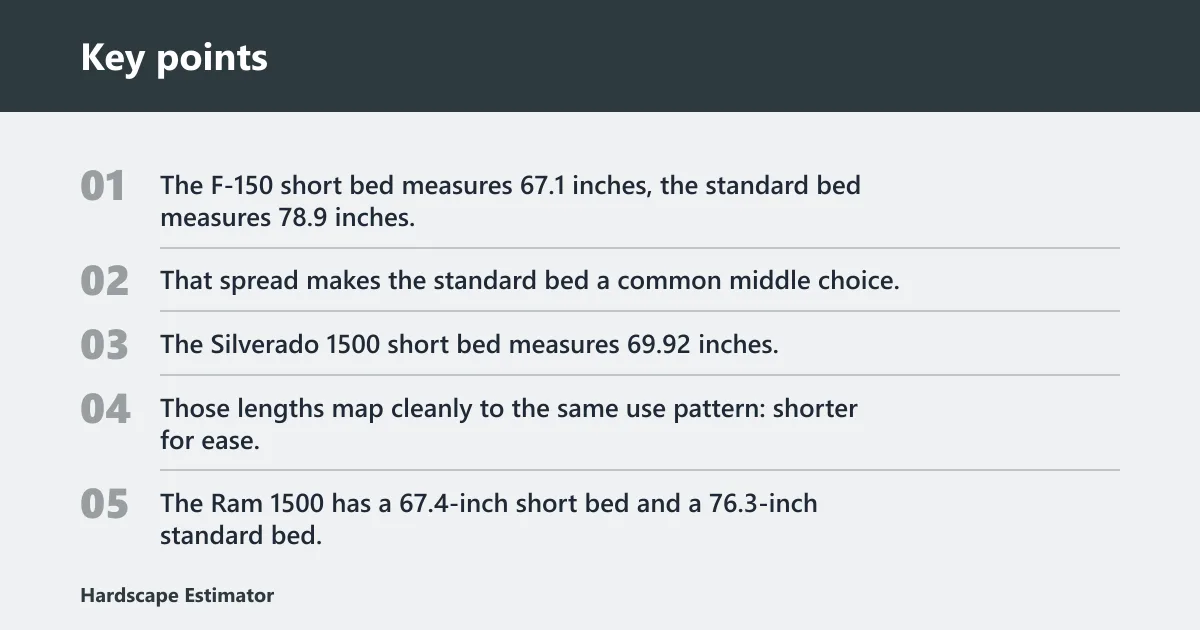
The F-150 short bed measures 67.1 inches, the standard bed measures 78.9 inches, and the long bed measures 97.6 inches. That spread makes the standard bed a common middle choice, while the long bed gives the best support for sheet goods and longer loads.
Chevrolet Silverado 1500 bed lengths
The Silverado 1500 short bed measures 69.92 inches, the standard bed measures 79.44 inches, and the long bed measures 98.18 inches. Those lengths map cleanly to the same use pattern: shorter for ease, standard for balance, long for full-size cargo.
Ram 1500 bed lengths
The Ram 1500 has a 67.4-inch short bed and a 76.3-inch standard bed. It does not have a true long bed option. That makes it less suited to repeated flat transport of 4×8 materials than trucks that offer an 8-foot box.
Does a longer truck bed increase payload capacity? Not by itself. Payload depends more on GVWR, suspension, axle rating, and configuration than bed length alone. A longer bed can make more room for the load, but it does not automatically raise the weight limit.
That distinction matters for gravel, mulch, and soil. Those loads often run into weight limits before they run out of bed space. A longer bed can spread the material out, but if the truck reaches payload first, the extra length does not solve the real constraint.
A common first-timer mistake is chasing bed length for a loose-material job when the truck’s payload rating is the binding limit. A full bed of damp soil can weigh far more than the box suggests. Volume says “fits.” Weight says “stop.”
What fits 4×8 sheets flat?
Long beds are the direct answer for flat 4×8 sheet fit. Short beds do not give enough inside length, and standard beds are usually still short of the full 96-inch sheet length once you account for real cargo placement. Tailgate-down hauling can help, but it is not the same as a true flat fit.
Flat fit with tailgate up
With the tailgate up, a true flat fit needs a bed longer than 96 inches inside. That is why 8-foot beds are the practical target for plywood and drywall. Anything shorter leaves the sheet unsupported or forces a compromise.
Tailgate-down loading
Tailgate-down hauling adds usable support length, so a shorter bed can carry longer panels with less overhang. The tradeoff is clear: the load is not fully inside the box, and the tailgate becomes part of the support surface. That works for some trips, not all of them.
Long-bed advantage for plywood and drywall
Long beds reduce the need to hang sheet goods off the rear. That helps keep the load stable, easier to strap, and less likely to chip at the edge. For regular sheet-goods work, the long bed fits best by a wide margin.
Choose short bed if…
Choose a short bed if the truck spends more time in tight parking, narrow driveways, and daily driving than on repeated hauling runs. It works well for smaller material loads, tools, and lighter hardscape errands where convenience matters more than cargo length.
Choose standard bed if…
Choose a standard bed if you want the best balance for mixed hauling. It is the strongest practical option for bags, bins, smaller pallets, and occasional sheet goods, especially when the truck also needs to stay practical for everyday use.
Choose long bed if…
Choose a long bed if the truck regularly carries plywood, drywall, long lumber, edging, or full-size jobsite loads. It is the best option when flat fit and load support matter more than parking ease, and when hauling is frequent enough to justify the extra length.
Frequently asked questions
What is the difference between a short bed, standard bed, and long bed?
The difference is inside cargo length. Short beds are about 5.5 to 5.8 ft, standard beds are about 6.5 to 7 ft, and long beds are 8 ft or more. The longer the bed, the more room you have for flat sheet goods and longer materials.
How long is a short bed truck bed in inches?
Common short beds run from about 67 to 70 inches inside the bed on the half-ton examples listed here.
How long is a standard truck bed in inches?
Common standard beds run from about 76 to 79 inches inside.
How long is a long bed truck bed in inches?
Long beds are typically 8 ft and beyond, which means about 96 inches or more inside the bed. Those lengths are what make flat 4×8 sheet fit practical.
Is truck bed length measured inside the bed or outside the truck?
It is measured inside the bed, from the bulkhead to the inside of the tailgate. That is the usable cargo length. Outside truck length is different and does not tell you whether a pallet, bin, or sheet will actually fit.
Which truck bed size fits 4×8 sheets flat?
A long bed is the right answer for flat 4×8 sheet fit with the tailgate up. Short beds are too short, and standard beds are still usually short of the full sheet length. Tailgate-down hauling can help shorter beds, but it is a compromise, not a full flat fit.
Does a longer truck bed increase payload capacity?
No. Bed length gives you more cargo room, but payload is set by the truck’s rating, not the box length. For gravel, mulch, and soil, weight often reaches the limit before the bed is full. The right question is capacity by weight, not just length.
What is the best truck bed length for hauling gravel, mulch, or soil?
A standard bed is often the best choice for those materials because it balances cargo room with everyday use. For very frequent hauling, a long bed gives more room to spread the load, but payload still decides the maximum safe amount.
How do I know if a truck bed is actually a long bed?
Measure the inside cargo length from bulkhead to tailgate. If it is about 96 inches or more, it is a true long bed. Model names can vary, so the measurement is the reliable check. That also helps when comparing trims across brands.