Wheelbarrow Calculator: Loads, Volume, and Weight
Wheelbarrow loads = project volume ÷ usable wheelbarrow volume. For planning, treat a 6 cu ft wheelbarrow as about 4.5 cu ft heaped or about 3.5 to 4.0 cu ft for a load you can usually move and dump with control, then check the material weight. Skip fill level and density, and a “10-load” estimate can turn into 14 trips, or into a barrow that is too heavy to push safely. This guide gives a wheelbarrow calculator for trip count, usable volume, and carried weight for soil, gravel, mulch, sand, and wet concrete.
What this calculator tells you
A good wheelbarrow estimate separates project volume, usable volume per trip, and load weight. The key planning number here is working capacity: the volume you can actually load, push, turn, and dump with control for the material and route.
Small homeowner wheelbarrows are usually 2-4 ft³. Standard contractor wheelbarrows are commonly around 6 ft³, though published capacities vary by model and may be listed as struck, level, or nominal tray capacity rather than what is practical to move.
For trip planning, split capacity into these three numbers:
- Rated capacity: the stated tray volume, often in cubic feet.
- Heaped capacity: what fits above the rim; useful for light material, less useful for dense material.
- Working capacity: what can actually be loaded, pushed, turned, and dumped without the load becoming unmanageable.
For dense material, a practical fill level is often about 80%, and 80-85% is a reasonable planning range. For very heavy loads or rough ground, 75% or less is often the better working number.
Cited reference points: 1 cubic yard = 27 cubic feet is a standard unit conversion used by NIST/Commerce references, and wheelbarrow capacities commonly span roughly 2-6 cubic feet in retail and manufacturer specifications. Exact working capacity still depends on material weight, route, and operator control.
How many wheelbarrow loads are in a cubic yard?
One cubic yard equals 27 cubic feet, so the trip count is 27 divided by the usable volume per load. A 3 ft³ barrow filled level takes 9 loads; that same barrow at 85% fill takes about 11 loads after rounding up.
Base conversion
The fixed part is simple: 1 yd³ = 27 ft³. From there, use the volume you will actually carry, not the number printed on the tray.
Loads needed = 27 ÷ usable load volume
Example: if usable load volume is 2.55 ft³, then 27 ÷ 2.55 = 10.59, so plan for 11 loads. Round up every time, because the last partial load is still one more trip.
Why barrow size changes the count so much
A 3 ft³ homeowner barrow and a 6 ft³ contractor barrow can differ by six or more trips per cubic yard once fill level is adjusted. Quick estimates often miss that change.
Suppose a yard of gravel is going into a side path. A 6 ft³ tray sounds like 5 trips at full volume, but at 75% fill the usable load is 4.5 ft³, so the real count is 27 ÷ 4.5 = 6 trips. That extra trip comes from safe working volume, not from wasted material.
Load conversion table
Loads per cubic yard
| Rated barrow size | Fill level | Usable volume per load | Loads for 1 yd³ |
|---|---|---|---|
| 3 ft³ | 100% | 3.00 ft³ | 9 |
| 3 ft³ | 85% | 2.55 ft³ | 11 |
| 3 ft³ | 75% | 2.25 ft³ | 12 |
| 4 ft³ | 100% | 4.00 ft³ | 7 |
| 4 ft³ | 85% | 3.40 ft³ | 8 |
| 4 ft³ | 75% | 3.00 ft³ | 9 |
| 6 ft³ | 100% | 6.00 ft³ | 5 |
| 6 ft³ | 85% | 5.10 ft³ | 6 |
| 6 ft³ | 75% | 4.50 ft³ | 6 |
Per-load weight table
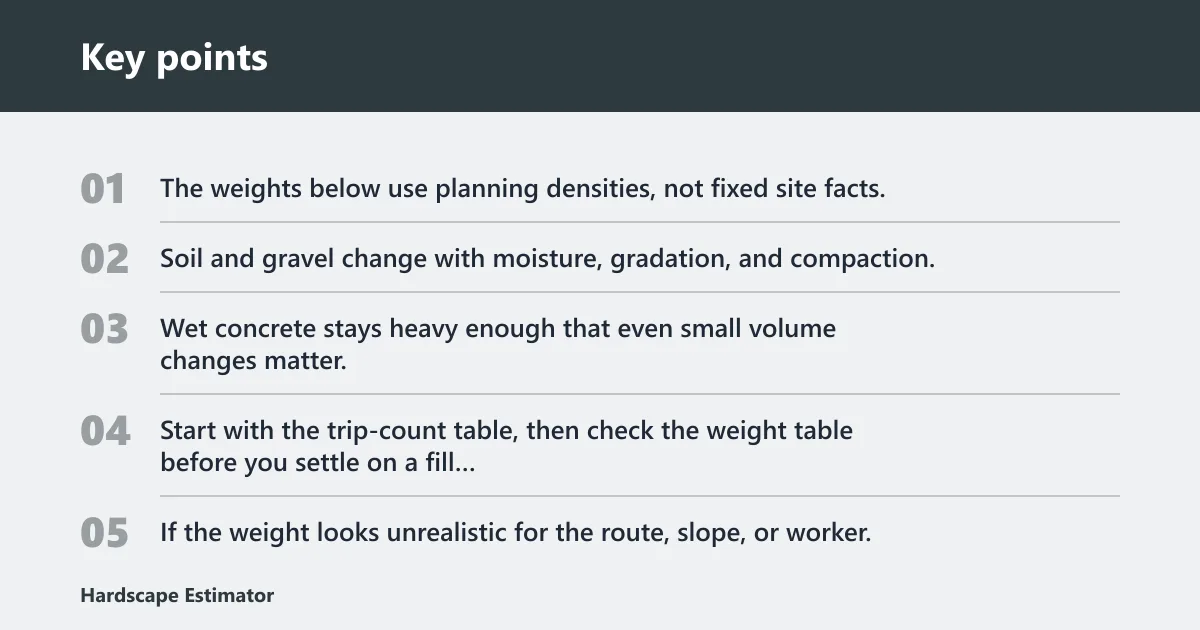
The weights below use planning densities, not fixed site facts. Soil and gravel change with moisture, gradation, and compaction. Wet concrete stays heavy enough that even small volume changes matter.
| Material | Planning density range | 3.0 ft³ load | 3.4 ft³ load | 4.5 ft³ load | 5.1 ft³ load |
|---|---|---|---|---|---|
| Soil | about 75-100 lb/ft³ | 225-300 lb | 255-340 lb | 338-450 lb | 383-510 lb |
| Mulch | about 10-20 lb/ft³ | 30-60 lb | 34-68 lb | 45-90 lb | 51-102 lb |
| Gravel | about 95-110 lb/ft³ | 285-330 lb | 323-374 lb | 428-495 lb | 485-561 lb |
| Wet concrete | about 145-150 lb/ft³ | 435-450 lb | 493-510 lb | 653-675 lb | 740-765 lb |
How to use the tables
Start with the trip-count table, then check the weight table before you settle on a fill level. If the weight looks unrealistic for the route, slope, or worker, drop the fill percentage and run the math again.
Take a 6 ft³ contractor barrow carrying wet concrete. At 85% fill, the usable volume is 5.1 ft³ and the estimated load weight is about 740-765 lb. The tray can contain that volume, but that does not make it a practical transport load.
How full should you load a wheelbarrow?
Load level should match material weight, route, and control, not tray size alone. For mulch or leaves, 100% fill can be reasonable; for gravel, damp soil, sand, or wet concrete, about 80% is a solid default, and 75% or less is often safer on uneven ground, slopes, or longer pushes.
Simple decision rule by material
- Light material: mulch, dry bark, leaves, light debris; up to 100% fill can work.
- Medium material: dry topsoil or loose compost; start around 85% fill.
- Heavy material: gravel, wet soil, sand, wet concrete; start around 80% and go lower if handling is poor.
Why rated capacity and working capacity differ
A 6 ft³ barrow may be rated for 6 ft³ struck level, but dense material shifts the limit from tray volume to pushable weight. That is why a full-looking load can still be the wrong load.
Published examples often use a nominal 6 ft³ contractor tray while recommending much smaller heavy-material loads. That spread is the difference between stated tray capacity and conservative working capacity for dense loads.
How do you calculate wheelbarrow loads from volume?

Convert the job volume to cubic feet, divide by usable wheelbarrow volume, and round up to a whole trip. Usable volume equals rated tray size multiplied by the chosen fill percentage.
The same method works for cubic feet, cubic yards, cubic metres, liters, and gallons as long as each step stays in the same unit.
Core formula
Usable load volume = rated wheelbarrow volume × fill percentage
Loads needed = total project volume ÷ usable load volume
Self-calculate by tray dimensions and fill level
Step 1: Tray volume ≈ length × width × depth
Step 2: Usable load volume = tray volume × (fill % ÷ 100)
Step 3: Loads needed = project volume ÷ usable load volume
Step 4: Round up to the next whole trip
Unit conversions to cubic feet
- 1 cubic yard = 27 cubic feet
- 1 cubic metre ≈ 35.31 cubic feet
- 1 litre ≈ 0.0353 cubic feet
- 1 US gallon ≈ 0.1337 cubic feet
- 1 cubic foot ≈ 7.48 US gallons
Worked examples
-
From cubic feet: 33.3 ft³ of material, using a 4 ft³ barrow at 85% fill.
Usable load = 4 × 0.85 = 3.4 ft³
Loads = 33.3 ÷ 3.4 = 9.79, so round up to 10 trips.
-
From cubic yards: 1.5 yd³ of mulch, using a 6 ft³ barrow at 100% fill.
Total volume = 1.5 × 27 = 40.5 ft³
Loads = 40.5 ÷ 6 = 6.75, so round up to 7 trips.
-
From cubic metres: 0.8 m³ of gravel, using a 6 ft³ barrow at 75% fill.
Total volume = 0.8 × 35.31 = 28.248 ft³
Usable load = 6 × 0.75 = 4.5 ft³
Loads = 28.248 ÷ 4.5 = 6.28, so round up to 7 trips.
A check against a common area-depth estimate
A 10 by 10 foot area at 4 inches deep contains 33.33 ft³: 10 × 10 × (4 ÷ 12) = 33.33. Using a nominal 6 ft³ tray gives 33.33 ÷ 6 = 5.56, which rounds up to 6 loads. If the material is heavy and the working load is 3.4 ft³, the same job becomes 33.33 ÷ 3.4 = 9.80, or 10 trips.
How much does a wheelbarrow load weigh?
Load weight equals usable volume times material density. Two loads with the same cubic feet can differ by several hundred pounds, so volume alone is a weak planning number.
Soil, gravel, and wet concrete can make a rated barrow impractical well before the tray is full.
Weight formula
Load weight = usable load volume × material density
Using the planning density ranges above, a 3.4 ft³ load of gravel weighs about 323-374 lb. The same 3.4 ft³ load of mulch weighs about 34-68 lb.
Assumed densities used here
- Soil: about 75-100 lb/ft³ for planning
- Mulch: about 10-20 lb/ft³ for planning
- Gravel: about 95-110 lb/ft³ for planning
- Wet concrete: about 145-150 lb/ft³ for planning
Moisture and compaction change the result
Wet soil weighs more than dry soil. Compact gravel weighs more than loose gravel. A manageable load in the morning can get harder after rain, or after repeated shoveling packs the tray tighter.
That is why density assumptions should be treated as ranges. Moisture content, particle size, and compaction can move real weights above or below any single rule-of-thumb number.
How many cubic feet does a wheelbarrow hold?
Most standard wheelbarrows typically hold about 2 to 6 cubic feet, with small homeowner models usually in the 2-4 ft³ range and contractor models commonly around 6 ft³.
For planning, the number that matters is not the printed rating by itself, but the usable carried volume after you reduce fill percentage for the material.
Common size ranges
Small homeowner trays are often easier to maneuver through gates, garden beds, and narrow side yards. Contractor trays around 6 ft³ reduce trip count for light material and bulk hauling on open paths.
Rated, struck, heaped, and working volume
A struck-level rating means the tray is filled level with the rim. Heaped volume adds the mound above the rim. Working volume is the load that still leaves enough control for starts, stops, bumps, and dumping.
A common first-timer mistake is using heaped volume to estimate gravel trips. The tray may hold the material, but the handles get heavy, the wheel digs in, and the practical carried volume ends up closer to three-quarters full.
How do you measure the inside volume of your wheelbarrow?
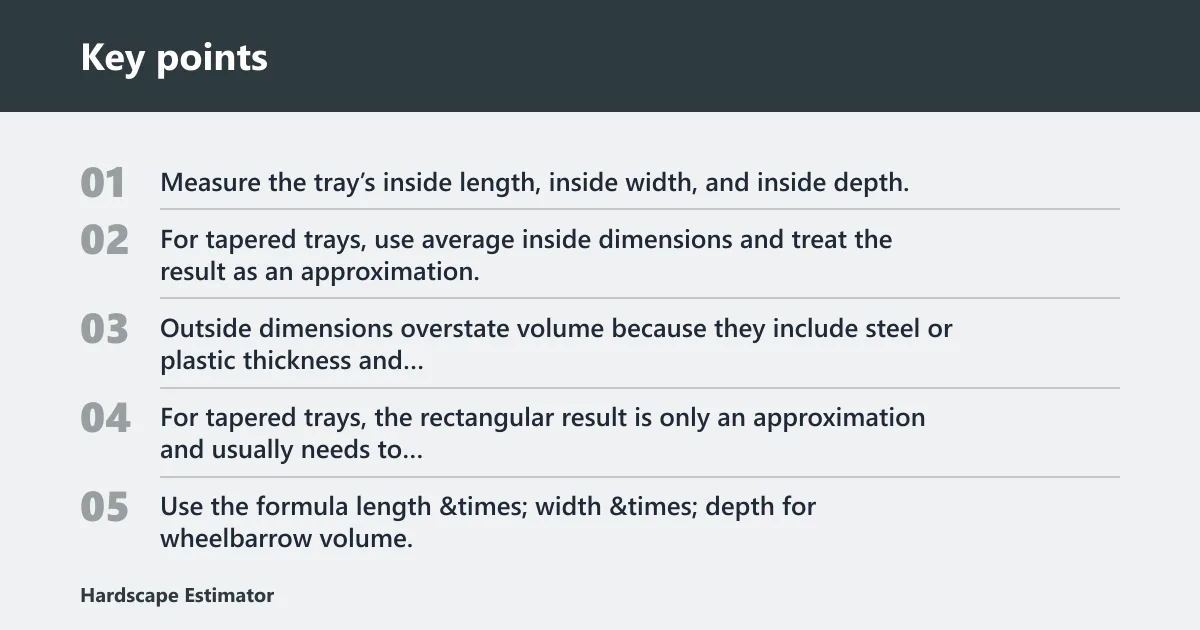
Measure the tray’s inside length, inside width, and inside depth, then multiply them for a quick rectangular estimate. For tapered trays, use average inside dimensions and treat the result as an approximation.
Outside dimensions overstate volume because they include steel or plastic thickness and flare. For tapered trays, the rectangular result is only an approximation and usually needs to be adjusted downward.
Rectangular estimate
Use the formula length × width × depth for wheelbarrow volume. Use inside measurements only, in feet, then multiply.
Example: inside length 3.0 ft × inside width 2.0 ft × inside depth 1.0 ft = 6.0 ft³
Tapered or irregular trays
Many trays are narrower at the bottom than at the top. A quick rectangular calculation based on the widest inside width will overstate volume. For better planning, use the average inside width and average inside length if the tray tapers noticeably.
If the shape is strongly rounded or pinched, treat the result as a rough upper estimate and reduce it for working capacity. That is more reliable than pretending the tray is a perfect box.
Metric and gallon checks
If a manufacturer lists liters, convert to cubic feet first. For example, 100 litres is about 100 × 0.0353 = 3.53 ft³. If a spec is given in gallons, 1 US gallon is about 0.1337 ft³.
What size wheelbarrow should you use?
The best size depends on both trip count and per-load weight. A 6 ft³ contractor barrow is efficient for mulch and light bulk material, while a 3-4 ft³ barrow is often the better choice for gravel, damp soil, or wet concrete because the working load stays more controllable.
Best fits by material
- Mulch and light yard debris: 6 ft³ saves trips and keeps weight low enough for full or near-full loads.
- Soil and compost: 4 ft³ is a balanced choice when access is tight or the route is long.
- Gravel and sand: 3-4 ft³ often makes more sense than a larger tray because weight rises fast.
- Wet concrete: smaller loads are usually more realistic than larger trays filled high.
When wheelbarrows become a poor concrete plan
Mixing volume is not the same as safe transport volume. Wet concrete at about 145-150 lb/ft³ makes even moderate tray volumes heavy in a hurry.
Say your pour needs only a short run from mixer to form, and the route is flat. A part-full 3 ft³ or 4 ft³ barrow can work. Change that to a long run, soft ground, or a ramp, and the same volume gets much harder to control.
Frequently asked questions
How many wheelbarrow loads do I need for a cubic yard?
Use 27 ft³ for one cubic yard, divide by your usable load volume, and round up. A 3 ft³ barrow takes 9 loads at full fill, 11 at 85%, and 12 at 75%; a 6 ft³ barrow takes 5 loads at full fill and 6 at 85% or 75%.
How do I calculate wheelbarrow loads from cubic feet or cubic yards?
Convert everything to cubic feet first, then divide by usable wheelbarrow volume. For cubic yards, multiply by 27. For usable volume, multiply the rated tray size by the fill percentage, then round up.
How full should I load a wheelbarrow for gravel or wet concrete?
For gravel or wet concrete, start around 80% fill, with 75% or less often safer on uneven ground, slopes, or long pushes. Dense material hits a handling limit before it hits tray volume.
How much does a full wheelbarrow of soil or gravel weigh?
It depends on usable volume and density. Using the planning ranges here, a 4.5 ft³ load weighs about 338-450 lb for soil and about 428-495 lb for gravel.
Wet or compacted material can weigh more, so treat those numbers as planning estimates rather than exact field weights.
How do I measure the inside volume of my wheelbarrow?
Measure the tray’s inside length, inside width, and inside depth, then multiply them. Do not use outside dimensions; if the tray tapers, use average inside dimensions for a closer estimate.
How much concrete can I mix in a wheelbarrow?
A wheelbarrow can hold a lot by volume, but wet concrete gets heavy fast. Safe transport volume is usually well below rated tray capacity, especially in a 6 ft³ barrow.
For planning, calculate both cubic feet and carried weight before deciding how much to mix or move per trip.
Sources
- National Institute of Standards and Technology (NIST), SI and customary unit conversions: 1 cubic yard = 27 cubic feet; 1 cubic metre ≈ 35.31 cubic feet; 1 US gallon ≈ 0.1337 cubic feet.
- Portland Cement Association and ACI reference values for normal-weight concrete: fresh concrete commonly approximates 145-150 lb/ft³.
- USDA NRCS and engineering reference tables for soils and earth materials: soil unit weight varies significantly with moisture and compaction, commonly falling across broad planning ranges that can span roughly 75-100+ lb/ft³ for loose-to-moist soils.
- FHWA and aggregate reference tables: gravel and crushed stone unit weight varies by gradation and compaction, commonly around 95-110 lb/ft³ for planning.
- Published manufacturer and retailer specifications for residential and contractor wheelbarrows commonly list tray capacities from about 2-6 ft³; stated capacities may be nominal, struck, or heaped and are not the same as working capacity.